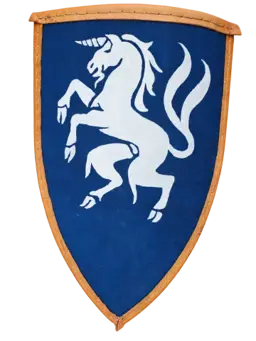
William Marshal: Reconstructing the Shield of the Greatest Knight
What did the shield of William Marshal (c.1147–1219) actually look like? Matthew Paris's drawings, Marshal's own seal, the Temple Church effigy and the surviving shields from Oña, Seedorf and Szczecin show what can be known about his gold, green and red lion arms, and what a maker has to interpret.
- Author
 Michal, shieldwright.eu
- Published
- 2026-10-24
- Updated
- 2026-10-25
- Read
- 11 min read
- Status
- Research article
Few knights of medieval Europe achieved a reputation comparable to that of William Marshal (c.1147–1219). Born into the Anglo-Norman nobility, he rose from a younger son with limited prospects to become one of the most powerful men in England, serving kings, winning tournaments, commanding armies and ultimately governing the kingdom as regent.
His career has been studied for centuries. Yet one question remains particularly interesting to historians, heraldry enthusiasts and makers of historical shields: what did William Marshal's shield actually look like?
The answer leads beyond modern illustrations into medieval manuscripts, a surviving seal, a funerary monument and the physical remains of shields from the late twelfth and early thirteenth centuries.
The Short Answer
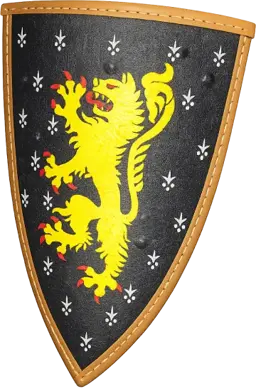
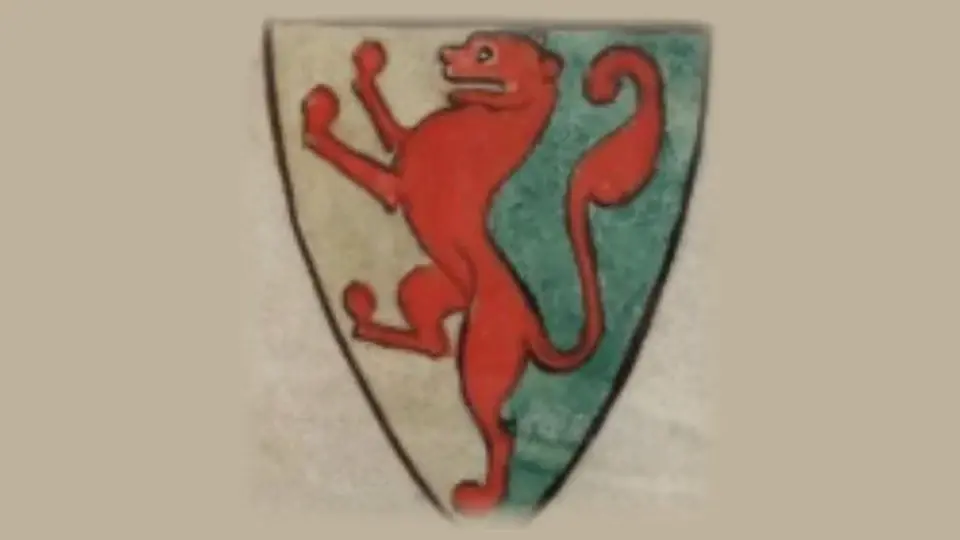
A shield divided vertically into gold and green halves, bearing a red lion rampant.
That is how the Marshal arms are blazoned. Matthew Paris painted them within a generation of William Marshal's death as a shield of green beside a half left pale, which is conventionally read as gold, with a red lion, and it is the design firmly associated with him and his sons. The shield itself does not survive. Its size, wood, construction and fittings have to be reconstructed from other shields of the same period, and even the colours are documented most securely for his later career, not his earliest tournaments.
A Note on the Evidence
This article keeps five kinds of information apart.
The Knight Who Became a Legend
William Marshal's early career was built on the tournament circuit, where skill with weapons, horsemanship, endurance and the capture of opposing knights could bring considerable rewards. His success made him famous long before he acquired substantial lands and titles.
Marshal served in the household of Henry the Young King, son of Henry II, and later became a trusted military and political figure under Richard I and King John. In 1189 he married Isabel de Clare, heiress to extensive estates, and in 1199 King John formally made him Earl of Pembroke.
His importance increased dramatically in the crisis that followed King John's death in 1216. With the kingdom divided by civil war and facing a French invasion, Marshal supported the young Henry III and became regent. In 1217, despite his advanced age, he played a decisive role in defeating the opposing forces at the Battle of Lincoln. He also helped secure the reissue of Magna Carta, contributing to the restoration of royal authority and political stability.
William Marshal died on 14 May 1219 and was buried in the Temple Church in London six days later. His career earned him a lasting reputation as one of the greatest knights of his age.
What Did William Marshal's Shield Look Like?
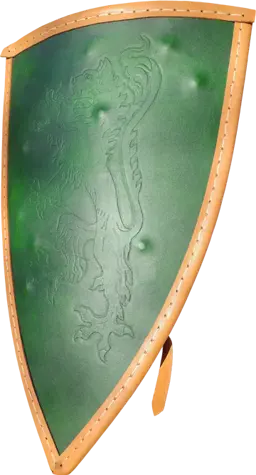
The arms traditionally associated with William Marshal are striking in their simplicity: a shield divided vertically into gold and green halves, bearing a red lion rampant. In heraldic language the design is blazoned Per pale Or and Vert, a lion rampant Gules.
- Or: gold, conventionally represented as yellow.
- Vert: green.
- Gules: red.
The lion rampant stands upright on one hind leg with its forelegs raised. The terms used for the parts and divisions of a shield are explained in What Were the Parts of a Medieval Shield Actually Called?.
The design has become closely associated with William Marshal and his descendants. A historical reconstruction, however, needs more than a familiar modern depiction. The question is whether the colours and the charge can be traced to medieval evidence. Several important sources survive.
Matthew Paris: A Medieval Illustration of the Marshal Shield
One of the strongest pieces of evidence comes from the thirteenth-century chronicler Matthew Paris, a Benedictine monk of St Albans Abbey. In the margins of his Chronica Majora, written and illustrated c.1240–1255, he drew heraldic shields beside the events and deaths he recorded.
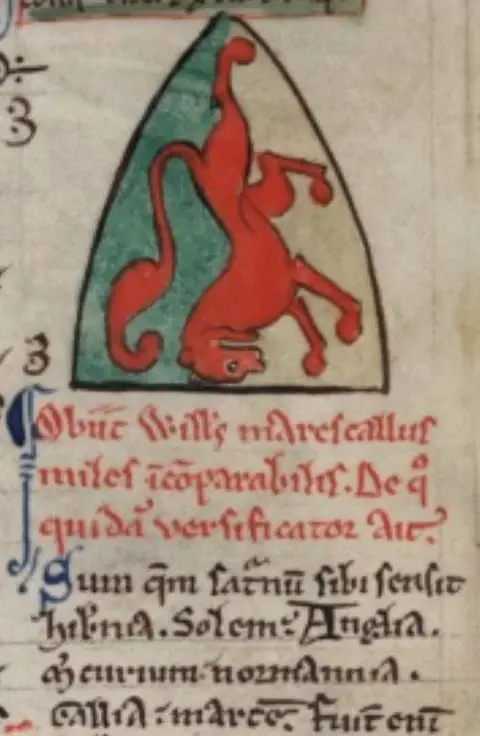
The shield is drawn upside down, a visual convention Paris used to mark the death of the person whose arms are shown. Turned over in this way, the pale half, read as gold, appears on the right. Because the drawing stands beside the notice of his death, it is explicitly associated with William Marshal the elder, not simply with his family.
Matthew Paris drew the Marshal shield inverted again in his Historia Anglorum (British Library, Royal MS 14 C VII), including at folio 117r beside the arms of Gilbert de Clare, apparently for the death of William Marshal the Younger, his son, in 1231. Together with the Chronica Majora drawing, these manuscripts are strong evidence that the green and red lion design, with its pale or gold half, belonged to the Marshal family's heraldic tradition in the thirteenth century.
These illustrations are medieval evidence, but they were not painted during William Marshal's own lifetime.
The Surviving Seal of William Marshal
Another significant piece of evidence is William Marshal's personal seal. An original of the 1217 reissue of Magna Carta, kept at Oseney Abbey until 1539 and now in the Bodleian Libraries, Oxford, was sealed by the papal legate Guala and by William Marshal the elder as regent for Henry III. Guala's seal is lost. Marshal's, a small equestrian seal showing a mounted knight, survives and is kept with the charter.
Medieval equestrian seals often show the knight's military equipment, including his shield. But a seal is a single-colour impression in wax, so it cannot record heraldic colours at all, and at this small size the detail of the shield is limited.
The Temple Church Effigy
William Marshal's burial in the Temple Church in London is well documented. The church contains a group of thirteenth-century knightly effigies, one of which is traditionally identified as William Marshal himself. The recumbent figure wears mail and a long surcoat and carries a long shield on its left arm.
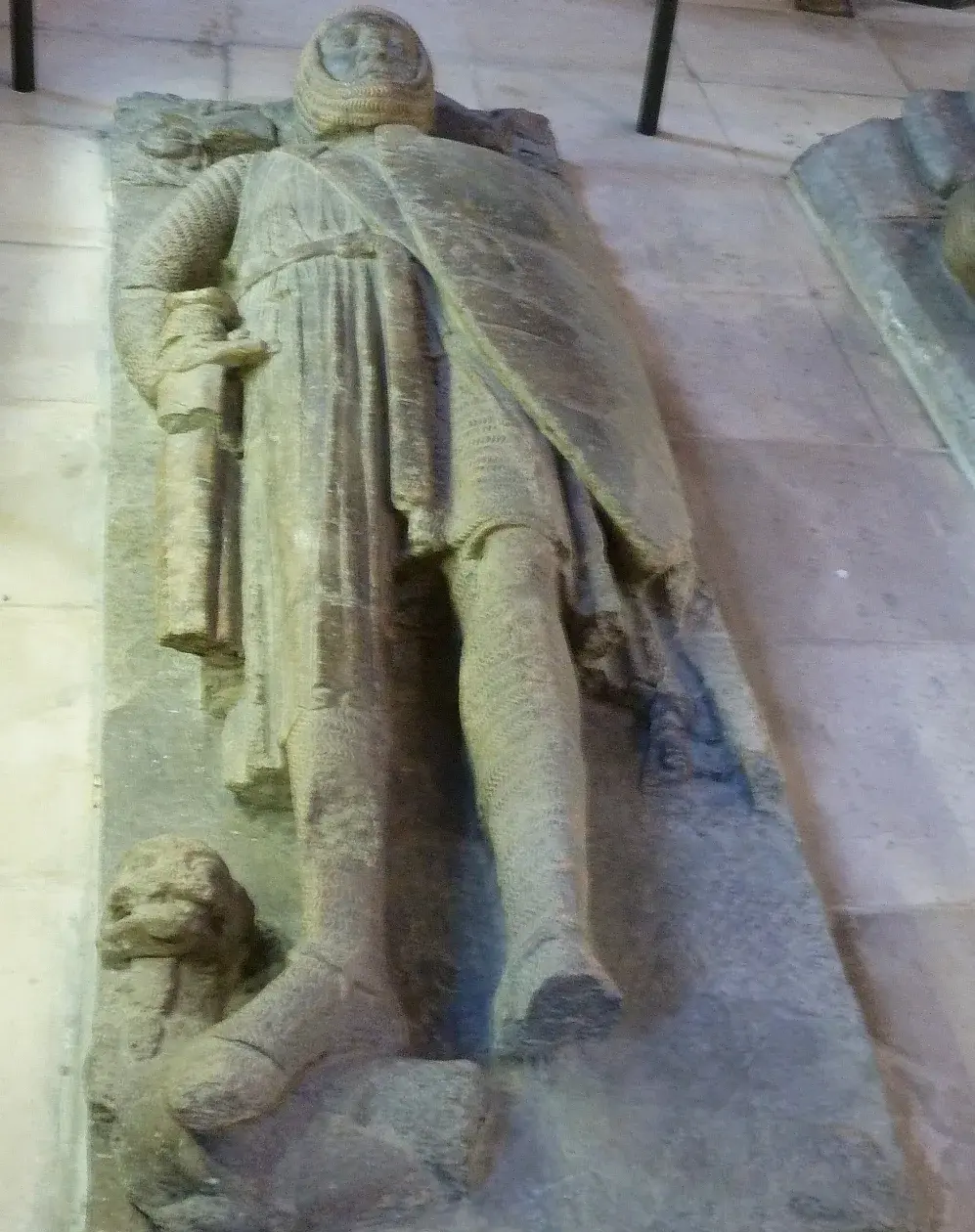
Antiquarian accounts connect a lion rampant with the Marshal monuments in the church, but not with the effigy now identified as the elder William. Nineteenth-century descriptions place a lion-rampant shield on the effigy of his son, William Marshal the Younger, and a drawing of about 1610 records a lion rampant on a gravestone that has since been lost. Neither shows what the elder Marshal's own shield looked like, so the monument has to be approached carefully.
The monument is also a work of funerary sculpture, not a shield used in combat. Its carved shield can help in understanding medieval representations of knightly equipment, but it cannot provide exact measurements or construction details for William Marshal's own shield.
Reconstructing a Shield from Around 1200
No surviving shield can be identified with certainty as one William Marshal personally carried. That is a real challenge for anyone attempting a historically informed reconstruction.
The most reliable approach combines the heraldic evidence associated with Marshal himself with the construction shown by surviving shields from about the same period. Three groups are particularly useful.
| Shield | Date | Approx. size | Construction evidence |
|---|---|---|---|
| Real Armería D 59 (from Oña) | 12th century (by style) | 115 × 62 cm | Cedar-like wood, parchment on both faces; gypsum reported (1988); remains of buckskin straps |
| Seedorf | c.1200–1220 | 87.3 × 65.8 cm | Glued alder boards, parchment on the front, prepared painted layers |
| Szczecin, painted shield | Late 12th century | Fragmentary | Thin alder planks, painted surface |
| Szczecin, second shield | Late 12th century | Two planks survive | Thin alder planks |
None of these shields can be connected to William Marshal, and they differ in date, preservation and relevance to his lifetime. Seedorf falls within his later career, the Szczecin shields survive only as fragments, and the date of D 59 rests on its style rather than on scientific dating. Each one shows how a shield of about his period could be made, not how his shield was made.
Real Armería D 59: A Surviving Kite Shield from Oña
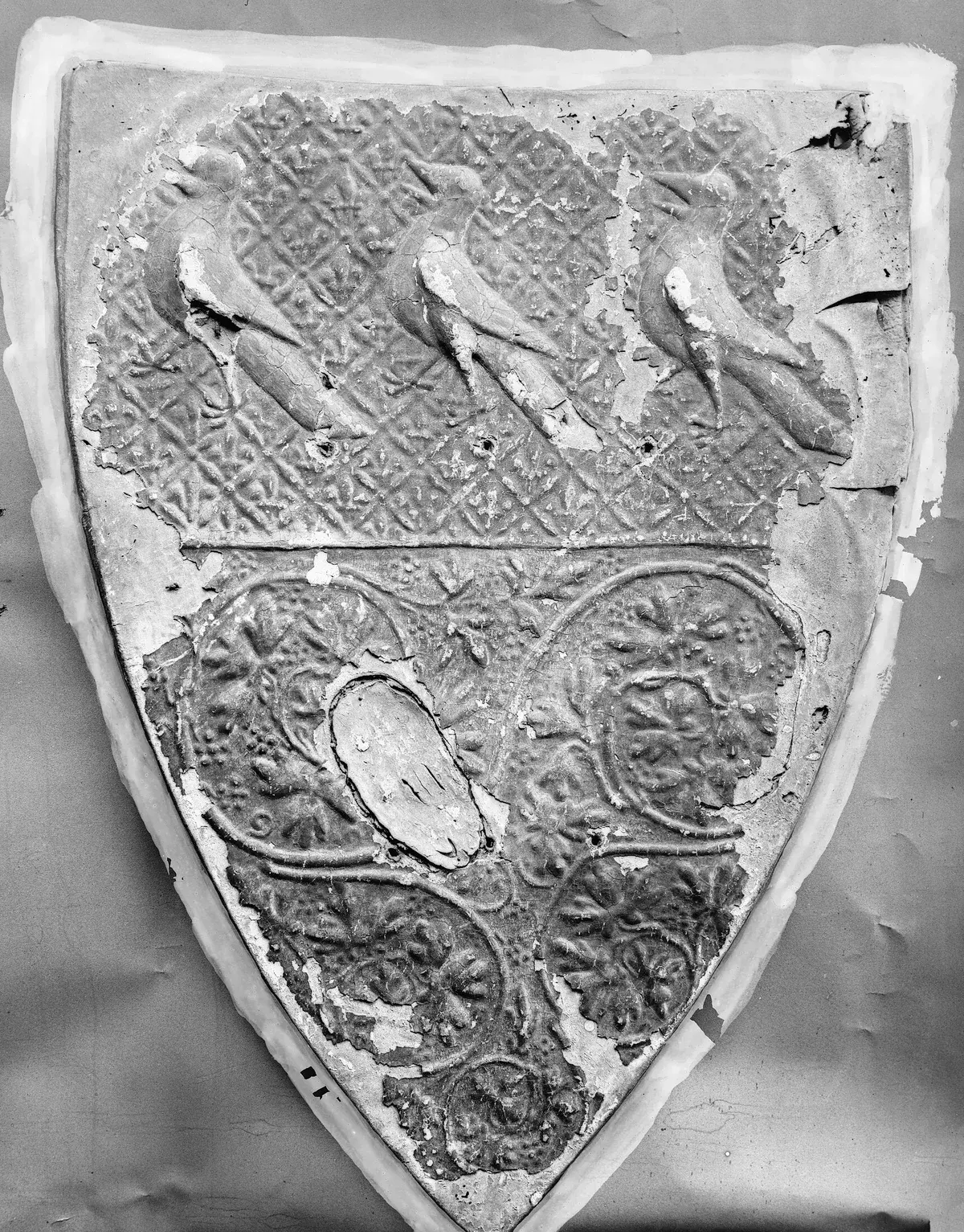
This long, kite-shaped shield in the Real Armería in Madrid, associated with the monastery of San Salvador de Oña, is an important surviving example of medieval shield construction. The armoury's 1898 catalogue records it as about 115 × 62 cm and 17 mm thick.
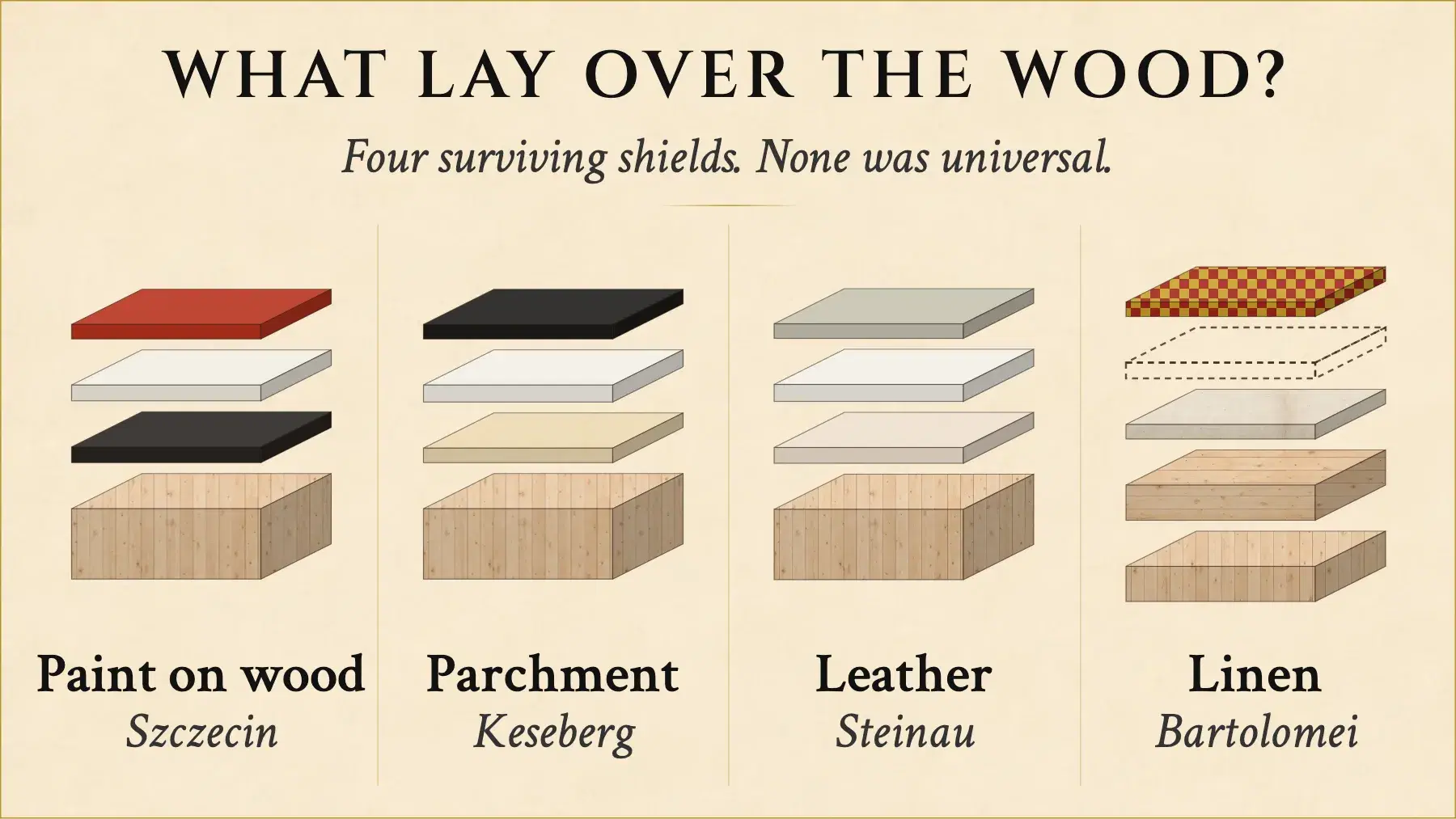
Even with these limits, it shows how complex medieval shield construction was: wood, animal-derived coverings, surface finishes and leather fittings formed a single working whole. The coverings are discussed in What Covered Medieval Shield Wooden Cores? and the ground layers in Did Medieval Shields Use Gesso?.
Seedorf, c.1200–1220: A Glued Alder Core
The Seedorf shield, conventionally dated c.1200–1220 and associated with Arnold von Brienz, is close in date to the later part of Marshal's career. Its surviving dimensions are approximately 87.3 × 65.8 cm.
It shows that shields of the period could use carefully assembled solid-wood cores rather than anything like modern plywood. It is also a reminder that shields of the same period varied considerably in proportions, shape and construction. How such boards were joined is examined in How Were Medieval Shield Planks Joined?.
Szczecin, Late 12th Century: Plank-Built Remains
Two late-twelfth-century wooden shields from Szczecin, one painted and one plain, provide further evidence for plank-built shield construction in the period. Both survive only in part: of the second, just two planks remain.
Although they cannot be connected to William Marshal, they add to what is known about the materials and methods available to shield makers of his time. Together with D 59 and Seedorf, they give a firmer foundation for reconstruction than modern artwork alone.
How Might William Marshal's Shield Have Been Made?
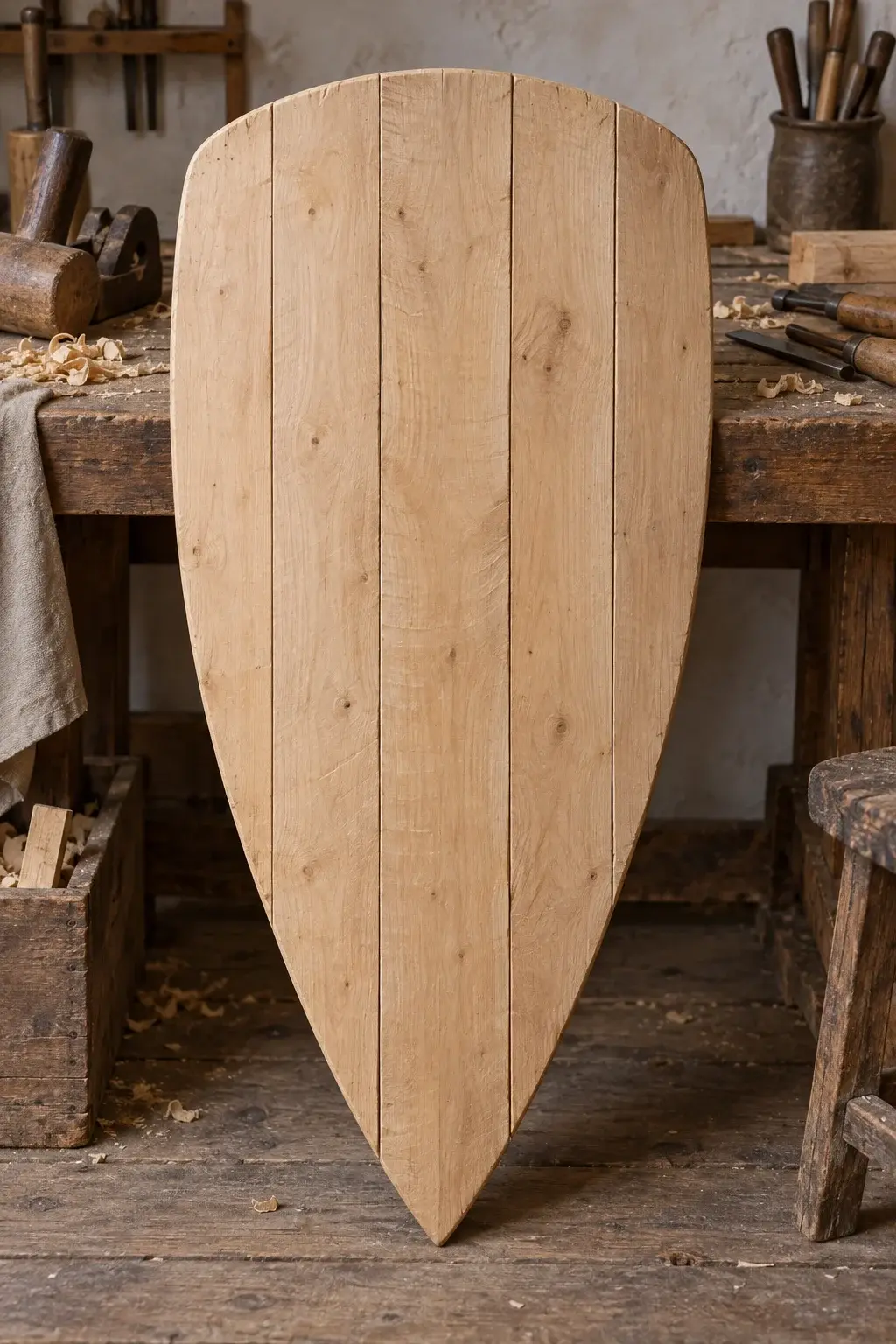
For a historically informed reconstruction representing William Marshal's later career, approximately 1199–1219, a plausible approach would be a shaped wooden core built from joined planks.
The outer surface could be covered with parchment or another historically supported organic facing, prepared with suitable ground layers and painted with the documented heraldic design. The painting sequence is set out in How Was a Medieval Shield Actually Painted?.
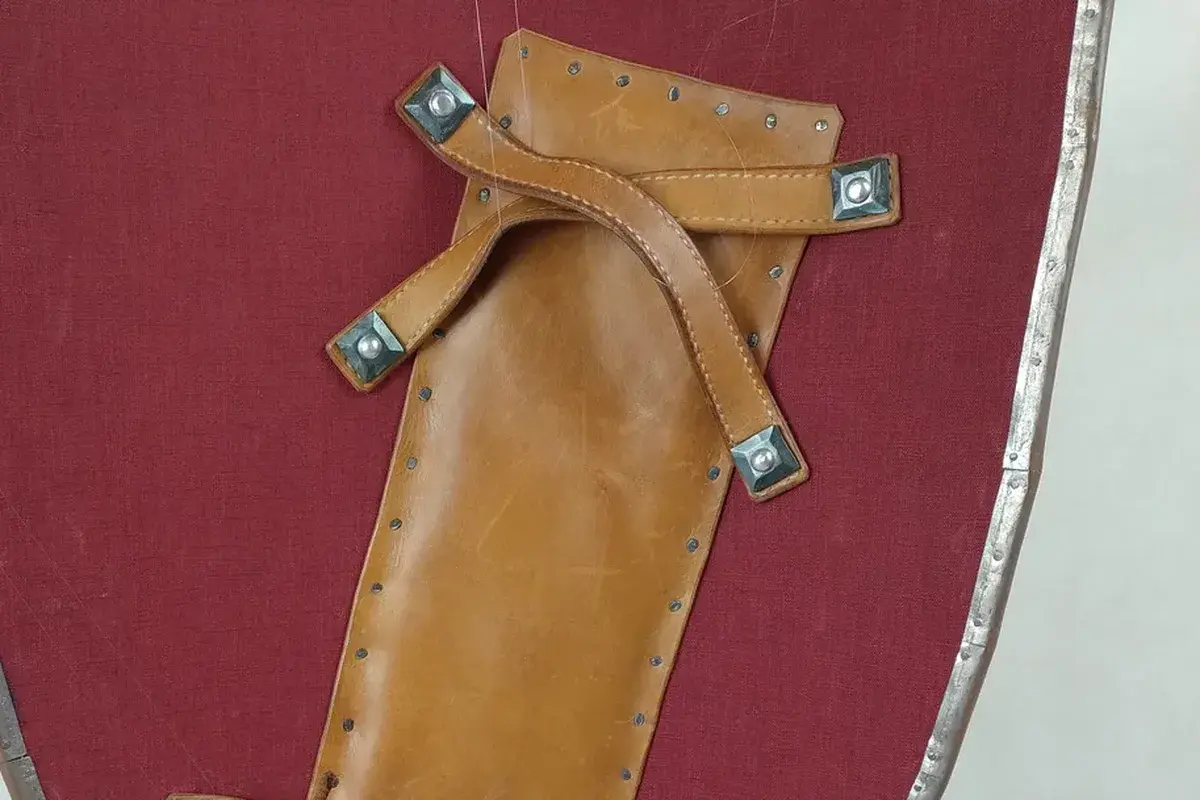
Leather arm straps (enarmes) and a carrying strap (guige) could be fitted using surviving medieval shields as comparative evidence. Their arrangement on surviving shields is examined in Rear Straps, Guige, Padding and Attachment Geometry.
Explore My Reconstruction of William Marshal's Shield
Below is the shield I would make in his arms today, drawn by the same renderer as my shield builder. Turn it to see the edge and the reverse, pause it, save the front or the back as an image, or open it in the builder to change it.
Heroes Collection
William Marshal — The Marshal Lion
Per pale Or and Vert, a lion rampant Gules
This interactive shield is a historically informed interpretation of mine, based on the heraldic evidence associated with William Marshal and comparative evidence from surviving medieval shields. Its shape, construction and rear fittings are documented reconstruction choices, not verified details of Marshal's own equipment.
- ArmsEvidence
- Per pale Or and Vert, a lion rampant Gules: gold on the dexter half (the bearer's right), green on the sinister, as Matthew Paris drew them c.1240–1255. The pale half of his drawing is read as gold.
- LionReconstruction
- A rampant lion with a single curled tail from my heraldry set, painted red, facing dexter. Matthew Paris also drew a single tail; the flame-like tufts of the mane and limbs are my artistic choice.
- Shape and sizeReconstruction
- Tall Flat-Top Heater, 58 × 85.4 cm, with the workshop's standard bow. Marshal's own shield does not survive; Seedorf (87.3 × 65.8 cm, c.1200–1220), the nearest surviving shield of his time, is a little longer and wider.
- CoreReconstruction
- Linden planks, 10–12 mm thick, glued edge to edge with animal glue and shaped to the curve. Shields of his time were built from glued boards (Seedorf: alder); linden was a shield wood of the thirteenth century (Konrad von Thüringen, Marburg).
- FrontReconstruction
- Two layers of linen glued over the face and turned round the edge onto the back, standing in for the parchment of surviving shields; gesso, paint and a beeswax finish.
- BackReconstruction
- Two layers of linen dyed burgundy. A workshop colour choice: the reverse of his shield is not recorded.
- FittingsReconstruction
- Leather enarmes for the left arm (crossed forearm straps and a hand grip), a leather-covered arm pad and an adjustable guige on two riveted mounts. Enarmes and a neck strap survive on Real Armería D 59; their layout here is mine.
Bringing William Marshal's Shield Back to Life
At shieldwright.eu, I am particularly interested in the point where historical research meets traditional craftsmanship. William Marshal's shield is a chance to reconstruct an object associated with one of medieval Europe's most remarkable knights while respecting the limits of the surviving evidence.
The gold and green field with its red lion is a compelling heraldic design, supported by important medieval manuscript sources. The surviving shields of the late twelfth and early thirteenth centuries give a practical foundation for decisions about the wooden construction, coverings, painted surface and leather fittings. Together, these sources allow a historically informed interpretation without claiming to reproduce a physical object that no longer survives.
That distinction matters. For me, historical authenticity is not about pretending that every detail is known. It is about researching the evidence, acknowledging uncertainty and making thoughtful craft decisions wherever the historical record is incomplete.
William Marshal's original shield may be lost, but enough survives of his world, his heraldry and the equipment of his contemporaries to bring a carefully researched interpretation within reach.
And perhaps that is the most fascinating part of historical shield making: connecting objects that can still be studied with the people whose stories have endured for eight centuries.
Bibliography / Source Base
- Parker Library MS 16. Matthew Paris, Chronica Majora II, Cambridge, Corpus Christi College, Parker Library MS 16 (c.1240–1255), fol. 58r, used here for the inverted Marshal shield drawn beside the notice of William Marshal's death in 1219. The hero image and figure are from the public-domain reproduction on Wikimedia Commons. Source link.
- Royal MS 14 C VII. Matthew Paris, Historia Anglorum, London, British Library, Royal MS 14 C VII (c.1250–1259), used here, as described in the British Library catalogue, for the inverted Marshal shields, including fol. 117r beside the arms of Gilbert de Clare, and for inverted arms as Paris's sign of a death. Source link.
- Bodleian Libraries. Magna Carta, 1217 reissue, Oxford, Bodleian Libraries, MS. Ch. Oxon. Oseney 142b, used here for the charter sealed by Guala and by William Marshal as regent, and for Marshal's surviving small equestrian seal. Source link.
- Temple Church. Temple Church, London, history pages "Magna Carta 1214–1291" and "The 20th and 21st Centuries", used here for Marshal's reissues of Magna Carta under his own seal, his death on 14 May 1219 and burial on 20 May 1219, and the damage to the effigies on 10 May 1941. Source link.
- Griffith-Jones and Lankester. Robin Griffith-Jones and Philip J. Lankester, "Appendix: The Knights' Effigies: Newly Discovered Drawings by John Guillim, c.1610", in Robin Griffith-Jones and Eric Fernie (eds), Tomb and Temple (2018), used here for the early identifications of the effigies, the effigy identified since the 1840s as William Marshal the Younger, and the lost gravestone with a lion rampant. Source link.
- Thornbury. Walter Thornbury, Old and New London, vol. 1 (London, 1878), pp. 149–158, used here for the nineteenth-century description of the effigies, with a lion at the elder Marshal's feet and a lion-rampant shield on the effigy of his son. Source link.
- Dictionary of Irish Biography. "Marshal, William", Dictionary of Irish Biography (Royal Irish Academy), used here for his marriage to Isabel de Clare in 1189 and his creation as Earl of Pembroke by King John in 1199. Source link.
- Real Armería 1898. Conde de Valencia de Don Juan, Catálogo histórico-descriptivo de la Real Armería de Madrid (Madrid, 1898), D. 59, pp. 150–151, used here for the dimensions, thickness, wood, parchment covering, painted ornament, strap remains and the stylistic twelfth-century date of D 59. Source link.
- Bruhn de Hoffmeyer. Ada Bruhn de Hoffmeyer, Las armas en la historia de la Reconquista, Gladius, special volume (1988), 31–101, at p. 43 and fig. 8a–b, used here for the gypsum layer she reports on the Oña shields and the date c.1190–1200 she proposes for D 59. Source link.
- Senn and Moser. Matthias Senn and Franz Moser, Der Reiterschild von Seedorf UR: ein Untersuchungs- und Restaurierungsbericht, Jahresbericht Schweizerisches Landesmuseum Zürich 100 (1991, published 1992), 80–85, used here for the Seedorf shield's dimensions, glued alder boards, parchment facing and painted layers. DOI: 10.5169/seals-395364. Source link.
- Dowen et al. 2019. Keith Dowen, Lech Marek, Sławomir Słowiński, Anna Uciechowska-Gawron and Elżbieta Myśkow, Two Twelfth-Century Kite Shields from Szczecin, Poland, Arms & Armour 16, no. 2 (2019), 121–148, used here for the two plank-built Szczecin shields. DOI: 10.1080/17416124.2019.1667049. Source link.