How Were Medieval Shield Planks Joined?
A historian-quality evidence-status article on glued plank construction, joint geometry, and why casein is a reconstruction candidate rather than proven shield-seam chemistry.
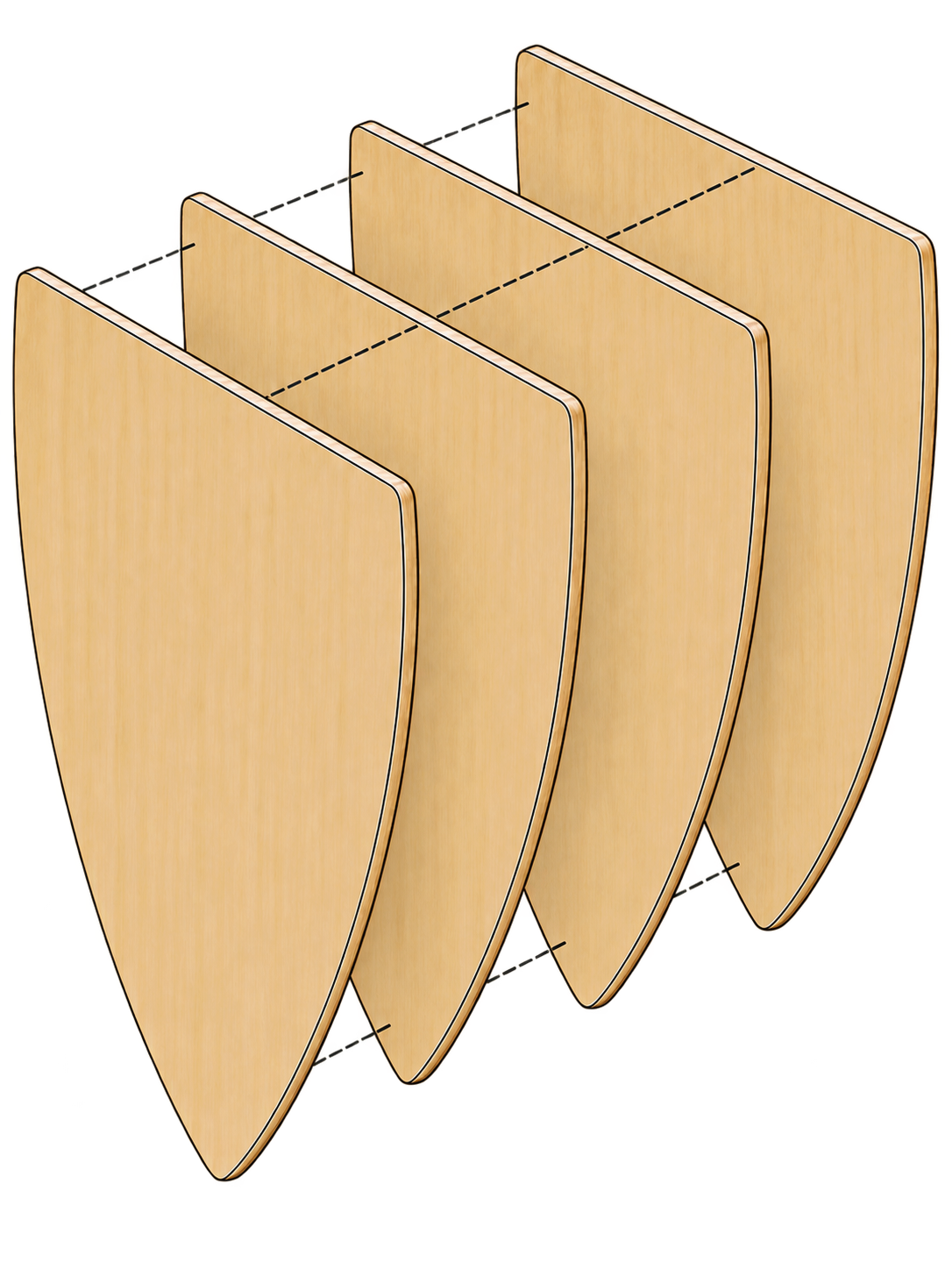
Some surviving high-medieval European shields were made from separate wooden boards joined edge to edge. The best direct example is the Seedorf / Arnold von Brienz shield, dated around 1200-1220, whose conservation report describes four longitudinal alder boards glued together along bevelled mating edges.
The Szczecin shield evidence gives a different construction pattern: late-12th-century alder planks with square or right-angled mating edges, no observed dowels, lap joints or dovetails, and institutional wording that records gluing or glue in the construction.
That proves something important: medieval shield boards could be glued, and their joint geometry was not always the same. The harder question is what the glue was.
The Short Answer
At present, no accessible 12th- or 13th-century European shield-board seam in the Shieldwright archive has a secure chemical identification of its original adhesive. Casein, or cheese-lime glue, is the strongest historically grounded reconstruction candidate. Collagen glue, such as hide or bone glue, remains a credible alternative.
Seedorf and Szczecin prove that glued plank construction belongs in the evidence. They do not prove the exact chemistry of the glue.
Neither casein nor collagen has yet been proven as the original seam adhesive in Seedorf, Szczecin or the Konrad von Thuringia shield at Marburg. That distinction is the centre of this article.
Evidence Categories Used Here
Why Plank Joining Matters
A shield core is not only a sheet of wood hidden under paint. Its structure controls weight, stiffness, curvature, repair behaviour and how the front covering or painted surface survives. If a shield was made from several boards, the joins between those boards were load-bearing parts of the object.
For Shieldwright, the practical question is clear: when we build a historically informed plank-built shield, should we use square butt joints, bevelled joints, dowels, glue, a facing layer as reinforcement or some combination of those choices?
The historical answer is less tidy than a workshop recipe. The surviving evidence supports more than one construction solution.
Seedorf: Bevelled, Edge-Glued Alder Boards
The Seedorf shield associated with Arnold von Brienz is the strongest target-period object for glued plank joining. Matthias Senn and Franz Moser's conservation report describes the wooden body as four alder boards running lengthwise and glued tightly together. The long mating edges were bevelled, increasing the bonding surface of each joint.
Szczecin: Square Plank Edges
The late-12th-century Szczecin shields provide a valuable contrast because their surviving construction does not simply repeat the Seedorf pattern. Dowen et al.'s 2019 technical study records square or right-angled mating edges in the painted shield rather than bevelled ones. It also reports no dowels, lap joints or dovetails in the observed construction.
The National Museum in Szczecin catalogue records gluing or glue in the construction/material description of the painted shield. Together, the published object study and institutional record support a high-medieval multi-plank shield built without observed mechanical interlocks and with adhesive joining treated as part of the construction record.
Marburg Inv.3177: Context, Not Chemistry
The shield of Landgrave Konrad von Thuringia at Marburg, inventory 3177, is an important early-13th-century comparator. The institutional record identifies the object, dates it around 1230/1240, and records linden wood, leather, chalk ground and polychromy.
Were Shield Seams Mechanically Reinforced?
The Glue Problem
The word glue is too broad for historical reconstruction. Medieval craftspeople had access to several adhesive families: milk/casein glues, collagen glues from hide or bone, plant or resin materials, and specialised glues used in other crafts.
The main historical problem is not whether these materials existed. It is whether one of them can be tied to a specific shield-board seam, from a specific object, with a source or analytical method strong enough to carry the claim.
For the 12th- and 13th-century European shield seams in the current Shieldwright archive, that chemical identification has not yet been recovered.
Theophilus: Cheese-Lime Glue
Alfonso X: Shield Facing, Not Seams
Dura-Europos: Earlier Direct Casein
Alt, Karl and Lleti
Best Current Reconstruction Choice
Plant/resin adhesives remain possible in the Szczecin discussion, but the current evidence is too weak to make them a first-choice structural seam hypothesis. Fish glue is historically real in other craft contexts, but the current Shieldwright evidence gives it a weaker case for primary load-bearing shield plank seams.
What This Means In The Workshop
The practical next step is a controlled experiment, not a more confident sentence. A responsible Shieldwright test series should separate variables.
- Seedorf-style bevelled long edges versus Szczecin-style square edges;
- alder and linden where each is relevant to the object being modelled;
- casein / cheese-lime glue;
- collagen glue as a comparison adhesive;
- dry strength, humidity response, creep and failure mode;
- behaviour under induced curvature;
- behaviour before and after a facing layer is added.
A casein-glued bevelled alder panel may perform beautifully. That would make it a strong reconstruction choice, not proof that Seedorf used casein.
What The Evidence Does Not Justify
Surviving high-medieval shields show edge-joined plank construction, and Seedorf directly documents glued bevelled seams. Szczecin shows a different square-edge plank geometry and institutional evidence for gluing. But the original adhesive chemistry of accessible 12th- and 13th-century European shield plank seams remains unidentified. Casein / cheese-lime is the strongest reconstruction candidate, with collagen glue a credible alternative.
Provisional Evidence Comparison
| Evidence item | Date | Function | What it supports | What it does not prove | Evidence status |
|---|---|---|---|---|---|
| Seedorf / Arnold von Brienz shield | c. 1200-1220 | Structural plank seam | Four alder boards; bevelled mating edges; glued construction | Exact adhesive chemistry | DIRECT for glued seam; UNKNOWN chemistry |
| Painted Szczecin shield | 1176-1200 | Structural plank joining | Alder planks; square/right-angle mating edges; no observed dowels/laps/dovetails; institutional gluing/glue wording | Resin, bone glue, collagen or casein as identified seam chemistry | DIRECT for construction; MEDIUM-HIGH for gluing; LOW for chemistry |
| Unpainted Szczecin shield | 12th c. | Plank construction / possible joining | Surviving alder planks; square/right-angle edge tradition | Exact joining compound or original plank count | DIRECT for surviving geometry; UNKNOWN adhesive |
| Marburg inv.3177, Konrad von Thuringia shield | c. 1230/1240 | Target-period object context | Linden, leather, chalk ground, polychromy; archival route for conservation evidence | Plank-seam adhesive chemistry | DIRECT institutional material context; UNKNOWN seam chemistry |
| Theophilus, Book I ch.17 | early 12th c. | Structural wooden panel glue | Cheese-lime glue in target-period woodworking | Explicit shield plank-seam instruction | DIRECT recipe; INFERENCE for shield seams |
| Alfonso X, Libros del saber de astronomia | after 1276 | Shield facing / hide attachment | Cheese glue associated directly with shield covering and strength | Board-to-board seam chemistry | DIRECT shield-context text; function-limited |
| Dura-Europos painted wooden shields | mid-3rd c. CE | Shield slat-edge adhesive | Bovine milk/casein proteins at shield wood edges | 12th-13th-c European continuity | DIRECT ancient comparator |
| Alt / Karl / Lleti | later medieval or methodological | Comparanda and analytical method | Useful source routes, cautions and method standards | Direct target-period European shield-seam chemistry | USEFUL but not proof |
Conclusion
Bibliography / Source Base
- Senn and Moser. Matthias Senn and Franz Moser, Der Reiterschild von Seedorf UR: ein Untersuchungs- und Restaurierungsbericht, Jahresbericht Schweizerisches Landesmuseum 100 (1991; published 1992), 80-85.
- Muzeum Narodowe w Szczecinie. Tarcza drewniana, MNS/A/22250/1, digital collection.
- Glosek and Uciechowska-Gawron. Wczesnosredniowieczna tarcza z podgrodzia w Szczecinie, Materialy Zachodniopomorskie NS VI/VII (2009/2010), 269-283.
- Jagielska. Badania i konserwacja drewnianej tarczy ze szczecinskiego Podzamcza, Materialy Zachodniopomorskie NS VI/VII (2009/2010), 285-298.
- Dowen et al. 2019. Keith Dowen, Lech Marek, Slawomir Slowinski, Anna Uciechowska-Gawron and Elzbieta Myskow, Two Twelfth-Century Kite Shields from Szczecin, Poland, Arms & Armour 16:2 (2019), 121-148, DOI 10.1080/17416124.2019.1667049.
- Bildindex / Marburg inv.3177. Bildindex / Museum fuer Kunst und Kulturgeschichte der Philipps-Universitaet Marburg, institutional record for the shield of Konrad von Thuringia, inv.3177.
- Theophilus. Theophilus Presbyter, De diversis artibus / On Divers Arts, Book I, ch.17-18; Hawthorne and Smith translation used in research notes.
- Alfonso X. Libros del saber de astronomia, ed. Rico y Sinobas, vol. IV (Madrid, 1863), p. 69.
- Gunnison et al. 2020. Anne Gunnison, Irma Passeri, Erin Mysak and Lisa Brody, Painted Roman Wood Shields from Dura-Europos, in Mummy Portraits of Roman Egypt (Getty, 2020), with associated proteomic analysis.
- Alt 2013 and related work. Anja Alt, Zwei mittelalterliche Schilde. Technologische Untersuchungen zum Aufbau im Vergleich, Waffen- und Kostuemkunde LV (2013), 73-96; related 2008 thesis and 2019 chapter remain archival targets.
- Karl 2019. Daniela Karl, Technologischer Aufbau dreier mittelalterlicher Schilde im Bayerischen Nationalmuseum, in Schilde des Spaetmittelalters und der Fruehen Neuzeit (2019), 175-190; full chapter/sample details remain to be recovered.
- Lleti et al. 2003. R. Lleti et al., Application of the Kohonen artificial neural network in the identification of proteinaceous binders in samples of panel painting using gas chromatography-mass spectrometry, Analyst 128 (2003), 281-286.
- Castellani et al. 2001. Technical study of the Piero della Francesca panel backing; full bibliographic details to complete from the archive before public citation.
- Siennicki 2019. Martin Siennicki, Der Kaufbeurer Setzschild im Bayerischen Nationalmuseum. Materialtechnologische Untersuchung und Replik, in Schilde des Spaetmittelalters und der Fruehen Neuzeit (2019); use only as later comparative evidence unless exact function and sample context are cited.