Rear Straps, Guige, Padding and Attachment Geometry
The reverse of a medieval shield connects its wooden structure to the bearer. Surviving straps, leather bridges and attachment traces on the Seedorf, Marburg and Karl von Trier shields reveal parts of that system, but complete layouts and padding details often require interpretation.
- Author
 Michal, shieldwright.eu
- Published
- 2026-10-10
- Updated
- 2026-10-27
- Read
- 12 min read
- Status
- Research article
The painted face of a medieval shield is usually the part that is remembered. Its reverse answers a different question: how did someone actually use it?
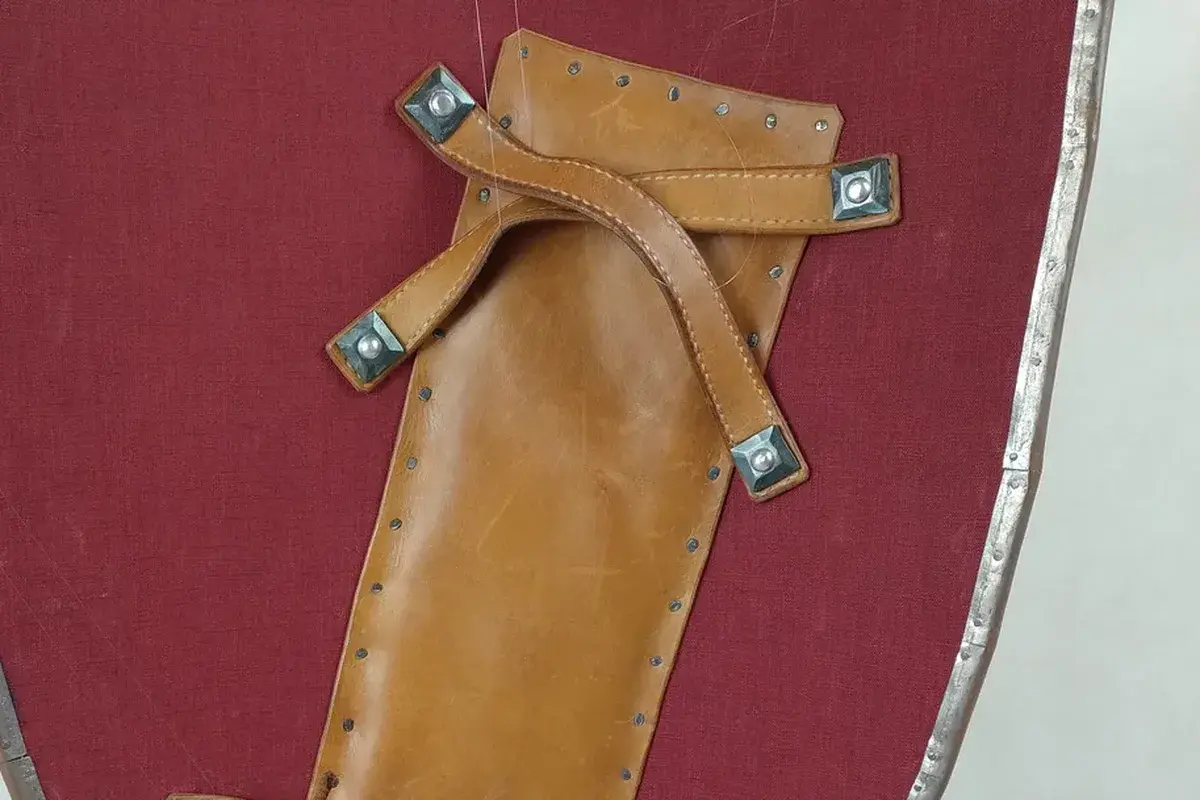
A wooden shield needs more than a strong board. The bearer must be able to hold it, change its angle and support its weight. Leather straps connect the shield to the hand and arm. A longer suspension strap can transfer some of that weight to the body. A lining or pad changes how the arm meets the shield. The position of every attachment affects how the whole assembly behaves.
These components belong together. A comfortable pad cannot correct a badly positioned grip, and strong rivets cannot make an unsuitable strap layout work.
The difficulty is that the evidence rarely survives as a complete, untouched arrangement. Sometimes leather fragments survive. Sometimes only fasteners, holes or marks on the reverse remain. Historical drawings may combine observed details with reconstructed straps. Understanding the back of a medieval shield starts with separating those things.
The Short Answer
Medieval shield backs could combine hand and arm straps, a long suspension strap called a guige, and local lining or padding. Their arrangement varied.
Surviving fittings can establish where straps were attached and how their ends were secured. They do not necessarily establish the original length of each strap, its complete route across the reverse, or the posture of the person using it.
For reconstruction, the strongest starting point is a particular shield and its documented remains. For a modern functional build, the missing details must also be fitted and tested, but those decisions should remain identified as workshop choices.
A Note on the Evidence
This article concentrates on high-medieval European wooden shields, particularly arm-strapped shields. The early-fourteenth-century Karl von Trier / Reifenstein shield appears as a later comparison. Four kinds of information are kept separate.
Enarmes and Guige: Different Jobs, Related Components
Enarmes is a historical term for the fittings or straps by which a shield was held. The Anglo-Norman Dictionary records twelfth-century examples and defines the term around the arm brace, thong or handle used to hold a shield. It does not prescribe one universal arrangement consisting of exactly one forearm loop and one hand grip.
The guige is the longer suspension strap. Medieval textual examples associate it with a shield hanging from the neck, and the dictionary definition also covers suspension from the shoulder. Its existence is historically secure. Its exact attachment positions and adjustment system must be established separately for each reconstruction.
For practical discussion, it helps to distinguish three functions. The first two are modern names for parts of what medieval texts call the enarmes.
| Component | Principal function | What needs separate verification |
|---|---|---|
| Hand grip or hand straps | Allow the hand to hold and direct the shield | Orientation, clearance and complete strap route |
| Arm strap or straps | Connect the shield to the forearm | Fit, position and freedom of movement |
| Guige | Suspend the shield from the body | Anchor positions, length and method of adjustment |
These functions interact. A suspension strap under tension changes how much weight the arm carries and how freely the shield can move. That is a mechanical consequence of the arrangement, not proof that every medieval bearer used it in the same way.
The wider terminology is covered in What Were the Parts of a Medieval Shield Actually Called?.
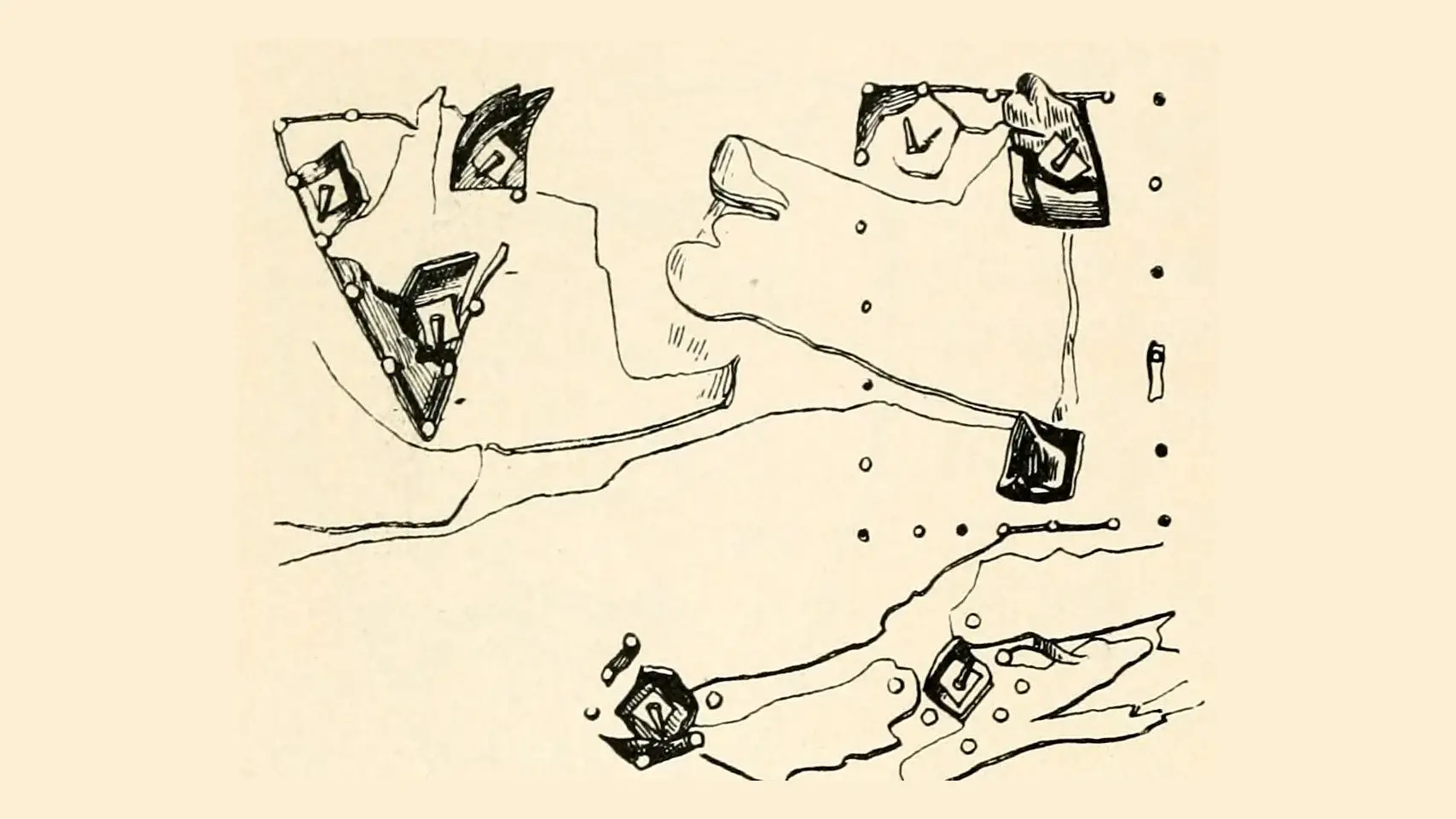
Seedorf, c.1200–1220: Attachments Survive More Clearly Than the Layout
The Seedorf shield, traditionally associated with Arnold von Brienz and conventionally dated c.1200–1220, is an important starting point.
This gives a substantial attachment system, but not an unquestionable diagram of its original use.
A fastener identifies a fixed point. A leather remnant may establish the direction in which a strap left that point. Neither necessarily reveals how long the missing strap was, how much slack it contained, or which other terminal it joined. A reconstruction can connect the surviving evidence coherently and still remain a reconstruction.
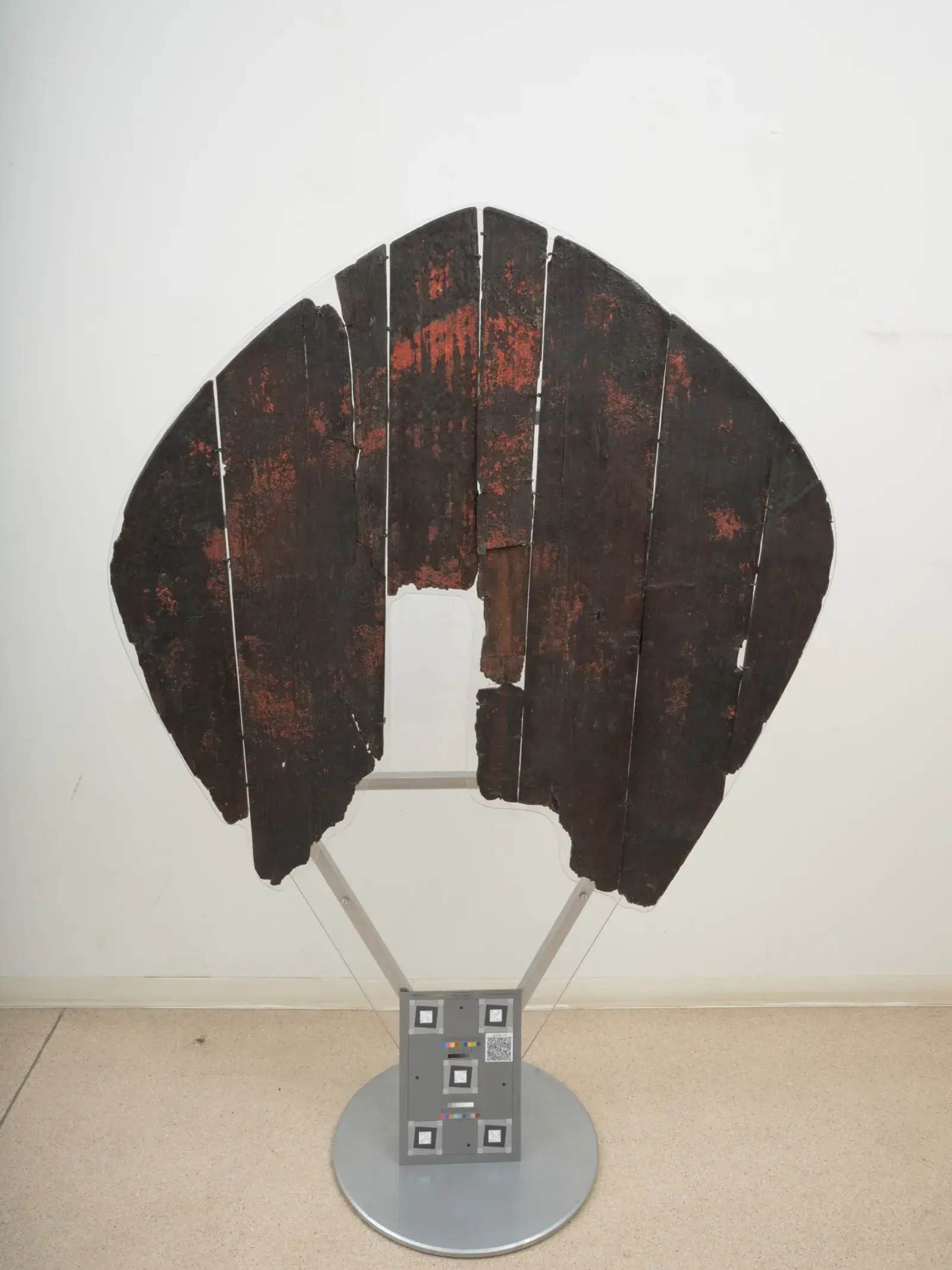
The Marburg Shields, c.1250–1300: Leather Bridges and Alternative Reconstructions
The Marburg material helps explain how suspension and control fittings could relate to one another. Jan Kohlmorgen's discussion of three of these shields keeps their recorded remains apart from Helmut Nickel's proposed strap reconstructions.
The three descriptions below are Kohlmorgen's published accounts. I have not been able to check them independently, against the shields themselves or against Friedrich Warnecke's earlier description of the Marburg group, so they are given as his descriptions, with his dates.
A leather bridge is an attachment feature, not a surviving full-length guige. Protective leather over metal is also different from a cushion beneath the arm.
Those distinctions matter when a modern drawing gives every leather component the same colour and makes the arrangement look more complete than the evidence actually is.
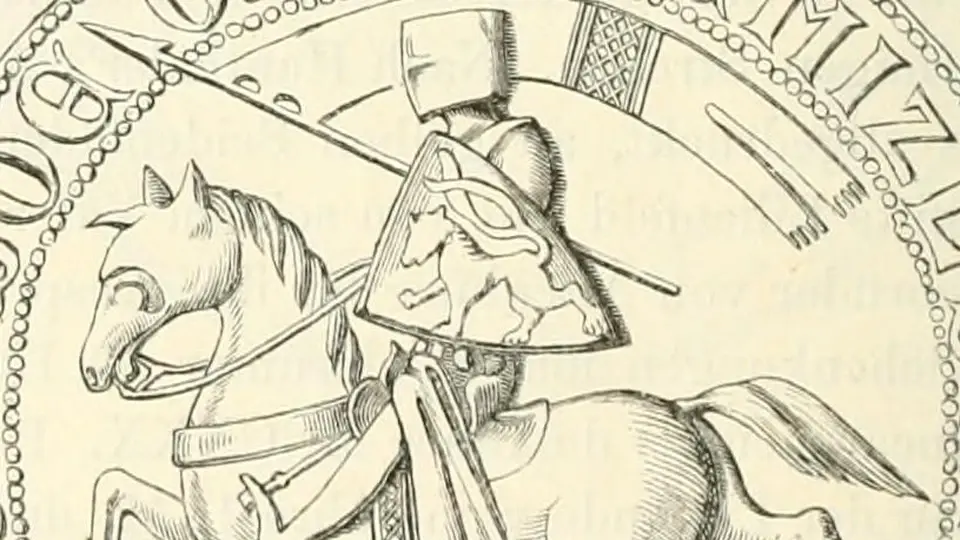
Karl von Trier / Reifenstein, c.1320: A Lining Described as Probably Padded
The shield associated with Grand Master Karl von Trier, now in Innsbruck and formerly at Burg Reifenstein, supplies a useful later comparison. Its date of around 1320 rests on its painted heraldry. In 1900 Freiherr von Rahden argued that it was an older, thirteenth-century shield, painted with the Grand Master's arms later in that century for decoration or perhaps as a memorial. Engel replied that its painted reverse, pad and straps showed a shield made for use. With its date and function disputed, it should not become a default model for a thirteenth-century fighting shield.
A drawn strap can look as definite as a surviving rivet. Reading the accompanying text prevents the two from becoming confused.
Backing, Protective Leather and Padding Are Different Things
Several materials may sit between the wooden core and the bearer. They should not all be called padding.
- A rear covering extends over the shield's inner face.
- A leather underlay belongs to an attachment assembly.
- A protective flap covers exposed metal.
- A local lining sits where the hand or arm bears against the shield.
- A pad adds a compressible cushion there.
One piece may serve more than one purpose, but that must be demonstrated rather than assumed. None of the descriptions used here names what any medieval pad was filled with.
A leather sheet on the reverse does not by itself prove a stuffed cushion. Holes around a contact area may support an interpretation of an attached pad without revealing its filling. A darker or lighter patch may preserve a former component's outline without preserving its full construction.
For the maker, this leaves several separate questions:
- Where did the arm contact the shield?
- Was a local lining or cushion present?
- How was it attached?
- What evidence identifies its cover, filling and thickness?
When only the first two can be answered, the remaining details belong to reconstruction.
Attachment Geometry: Why Position Matters
"Attachment geometry" means the spatial relationship between the grip, arm supports, suspension anchors, contact surface and the shield itself.
Grip Position and the Shield's Weight
The geometric centre of a shield is not necessarily its centre of mass. Its outline, varying thickness, coverings and fittings all affect where its weight acts.
If that weight acts away from the effective support provided by the hand, forearm and guige, it tends to rotate the shield. The bearer must resist that rotation.
Mechanically, even a shield that feels well balanced can still roll about the line of the forearm. With hand and forearm both engaged, weight acting to one side of that line has to be held by the grip, by the shield pressing against the arm, or by a taut guige.
Moving the grip can change this tendency, but balance is only one consideration. A grip also determines where the shield sits relative to the shoulder, elbow and torso. A shield that feels balanced while hanging at rest may still be awkward to raise or turn.
Hand and Forearm Relationship
The distance between the hand grip and the arm support influences the posture of the wrist and elbow.
If the grip pulls the wrist into an uncomfortable angle, tightening the arm strap is unlikely to solve the underlying problem. If the forearm support sits in the wrong place, a thicker pad may merely move the pressure elsewhere.
Hand size, arm length, clothing and protective equipment all affect this relationship. That is why an apparently precise arrangement copied from a photograph may fit a different bearer poorly.
Strap Length and Clearance
The distance between two fastening holes is not the usable length of the strap connecting them.
The strap must rise away from the shield to accommodate the hand or forearm. Its working clearance changes with leather thickness, flexibility, adjustment and the material beneath the arm. Too little clearance can pinch or restrict movement. Excessive slack can allow the shield to shift before the hand or arm brings it under control.
The archaeological question is where the strap was fixed. The fitting question is how much space the completed arrangement needs. They are related, but they are not interchangeable.
Guige Anchors and Suspension
A guige pulls towards the body from its attachment points. Changing those points changes the way the shield hangs and the direction in which the strap loads the reverse.
Changing its length also changes when it becomes taut. A short arrangement may begin carrying weight while the shield is held close. A longer one may remain slack until the shield moves farther away. Either choice affects movement.
Consequently, "add a shoulder strap" is not a complete specification. A reconstruction must address the anchor locations, the intended hanging position and the interaction with the hand and arm fittings.
Curvature and Padding
The bearer meets the shield's three-dimensional surface, not its outline on paper.
Curvature changes the space beneath a strap. Padding occupies some of that space and compresses under load. The same hole pattern can therefore produce a different fit on a flatter shield, a more strongly curved shield or one with thicker padding.
Mechanically, how much depends on the strap's direction and the shape of the surface. A strap spanning the curve has more space beneath it than its hole spacing suggests, while one running down a shield's uncurved length gains none. Not every shield was curved: Engel described the Innsbruck shield as flat both lengthwise and across, with only its long edges bent back.
A fit check should include the intended contact layer and clothing. Testing on a bare board alone leaves part of the arrangement untested.
What the Fastenings Can and Cannot Show
A complete attachment study should ask more than how many holes survive. It should distinguish:
- holes still containing fasteners or leather,
- empty holes whose function remains uncertain,
- alterations or repairs,
- fittings associated with later display,
- reconstructed connections between surviving points.
The direction of a surviving strap terminal can be especially valuable. So can a washer impression, a protected patch of paint or an older photograph showing material now lost. Each contributes a different piece of information.
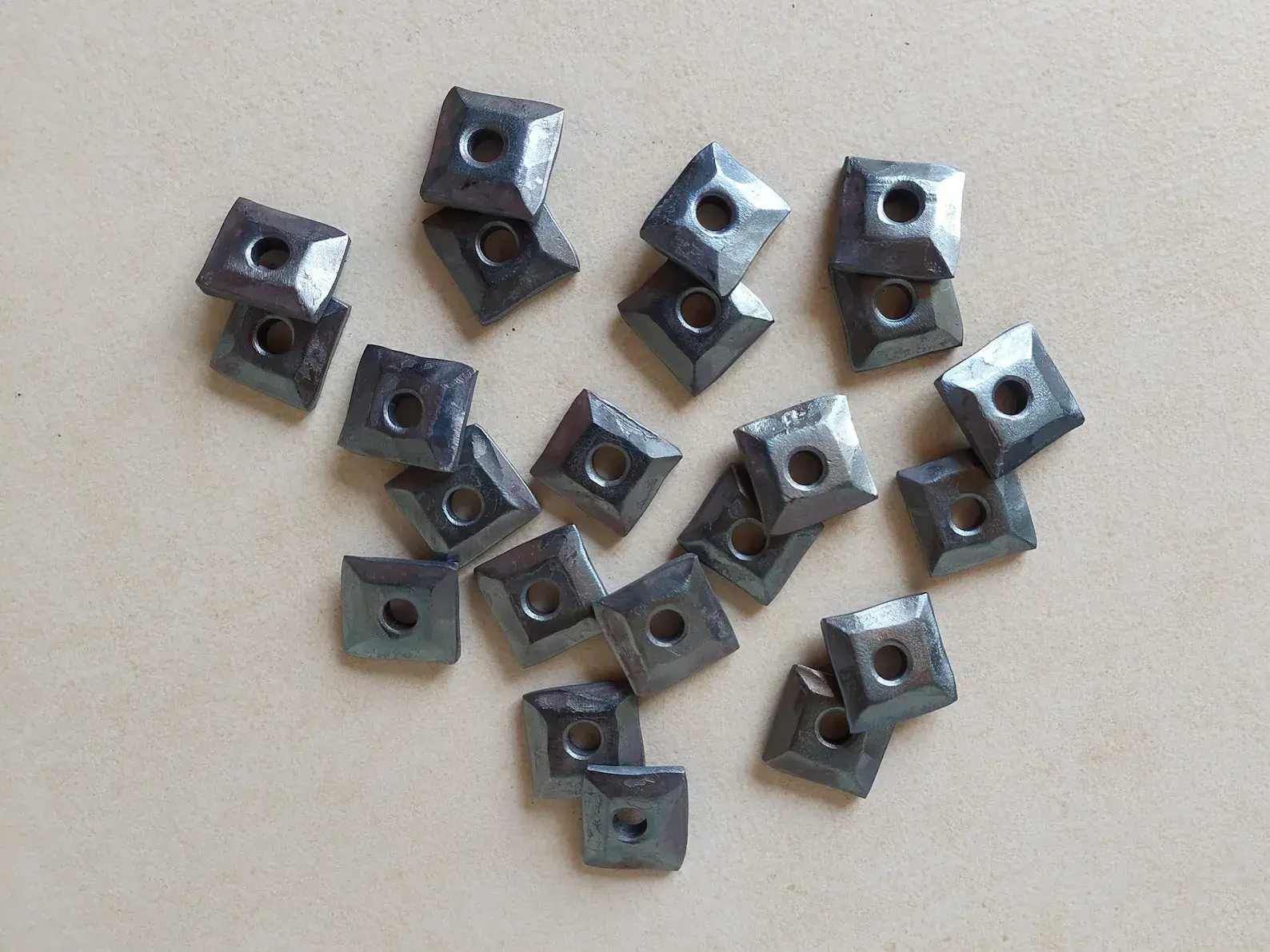
Mechanical reasoning also matters. Loads pass through the strap terminal and fastener into the shield structure. The leather, bearing plate, wood around the hole and condition of the assembly all affect the joint. Stronger metal alone does not guarantee a stronger attachment.
The fastening evidence itself is examined in How Were Medieval Shield Handles Fixed? and How Were Medieval Shield Washers Made?.
What This Means for My Workshop Choices
Leather enarmes are standard on my shields. A leather-and-wool arm cushion and a guige are optional, and whether the grip is adjusted with a buckle depends on the shield. These describe present-day builds. They do not establish the materials or arrangement of every medieval shield.
A wool-filled leather pad may be a reasonable modern choice. Its suitability must be judged in the completed shield, and its historical status must be described separately. The same applies to an adjustable buckle, a replacement strap or modern fastening hardware.
This is proposed workshop practice, not a claim that a finished programme of tests has established one optimal arrangement.
A useful test record would describe wrist comfort, unwanted shield rotation, strap movement, pressure points and changes after repeated use. Those observations can improve the build. They cannot retrospectively prove that a medieval maker used the same solution.
Is There a Correct Medieval Strap Layout?
There can be a well-supported reconstruction of a particular shield. There is no basis here for prescribing one arrangement for every medieval shield.
Nor should a visually convincing reverse combine whichever features are most attractive from several centuries without explaining the selection.
If the intention is a close reconstruction, follow the chosen object as far as its evidence permits. If the intention is a historically inspired shield fitted for modern use, say which decisions serve that purpose. Both approaches can produce carefully made shields. The description should make clear what has been built.
Conclusion
The reverse of a shield connects its structure to the person carrying it.
Straps, suspension and padding cannot be understood independently of their attachment positions. Their relationship determines where the shield hangs, how it responds to the hand and where it bears against the arm.
The historical challenge is to reconstruct that relationship without turning fragments into certainty. Surviving leather and fittings provide fixed points. Historical descriptions preserve additional observations. Complete layouts often require interpretation, and a usable modern shield requires fitting decisions beyond what survives.
Make the arrangement work, document why it was chosen, and keep the evidence visible.
Bibliography / Source Base
- Anglo-Norman Dictionary. Anglo-Norman Dictionary, entries enarme¹ and guige, used here for the historical meaning of both terms and their dated twelfth-century and later textual examples. Source link.
- Denier. Anton Denier, "Der Schild von Seedorf", Zeitschrift für christliche Kunst 10 (1897), no. 1, cols. 19–32, used here for the seven surviving stubs of the cut-away arm fittings, the four leather straps, the eight gilt-headed front-entering nails bent over square iron plates, the leather layer beneath the fittings and the two holes he read as the guige passage (col. 24), and his caution about reconstructing the arm fittings (col. 27). Source link.
- Boeheim. Wendelin Boeheim, "Der Reiterschild von Seedorf", Zeitschrift für historische Waffenkunde 1 (1897–1899), from p. 69, continued pp. 93–96, used here for his conjectural strapping of the Seedorf shield (fig. 6, p. 94; text p. 95). Source link.
- Ganz. Paul Ganz, Geschichte der heraldischen Kunst in der Schweiz im XII. und XIII. Jahrhundert (Frauenfeld, 1899), pp. 27–28 and 30, used here for his rejection of Boeheim's strapping, his reconstruction of the Seedorf straps (figs. 16–17), the padded hand-loop underlay and nail pads he described, the bronze nails and his account of the guige ends. Source link.
- Kohlmorgen. Jan Kohlmorgen, Der mittelalterliche Reiterschild: Historische Entwicklung von 975 bis 1350 und Anleitung zum Bau eines kampftauglichen Schildes (2002), ISBN 978-3-935616-10-2, used here for the identity and dating of the Keseberg, Liederbach and Welfenberg-Helfenberg shields, their recorded strap remains, leather bridges and padding traces, and for Helmut Nickel's strap reconstructions as Kohlmorgen reports them. Nickel's own work has not been consulted for this article.
- Engel. Bernhard Engel, "Waffengeschichtliche Studien aus dem Deutschordens-Gebiet. I. Ein Original-Deutschordens-Hochmeisterschild", Zeitschrift für historische Waffenkunde 2 (1900–1902), pp. 94–102, and "Nochmals der Deutschordens-Hochmeisterschild", ibid., pp. 214–217, used here for the Innsbruck shield's flat profile and the details and retouched photographs supplied by von Wieser (p. 95), its arm straps, rivets, plates and leather underlays and its former, probably padded lining (p. 96), his reading of the carrying strap and the modern hanging fitting (p. 97, with figs. 6–7 on p. 96), and the dispute with von Rahden over its date and function (pp. 214–215). Source link.