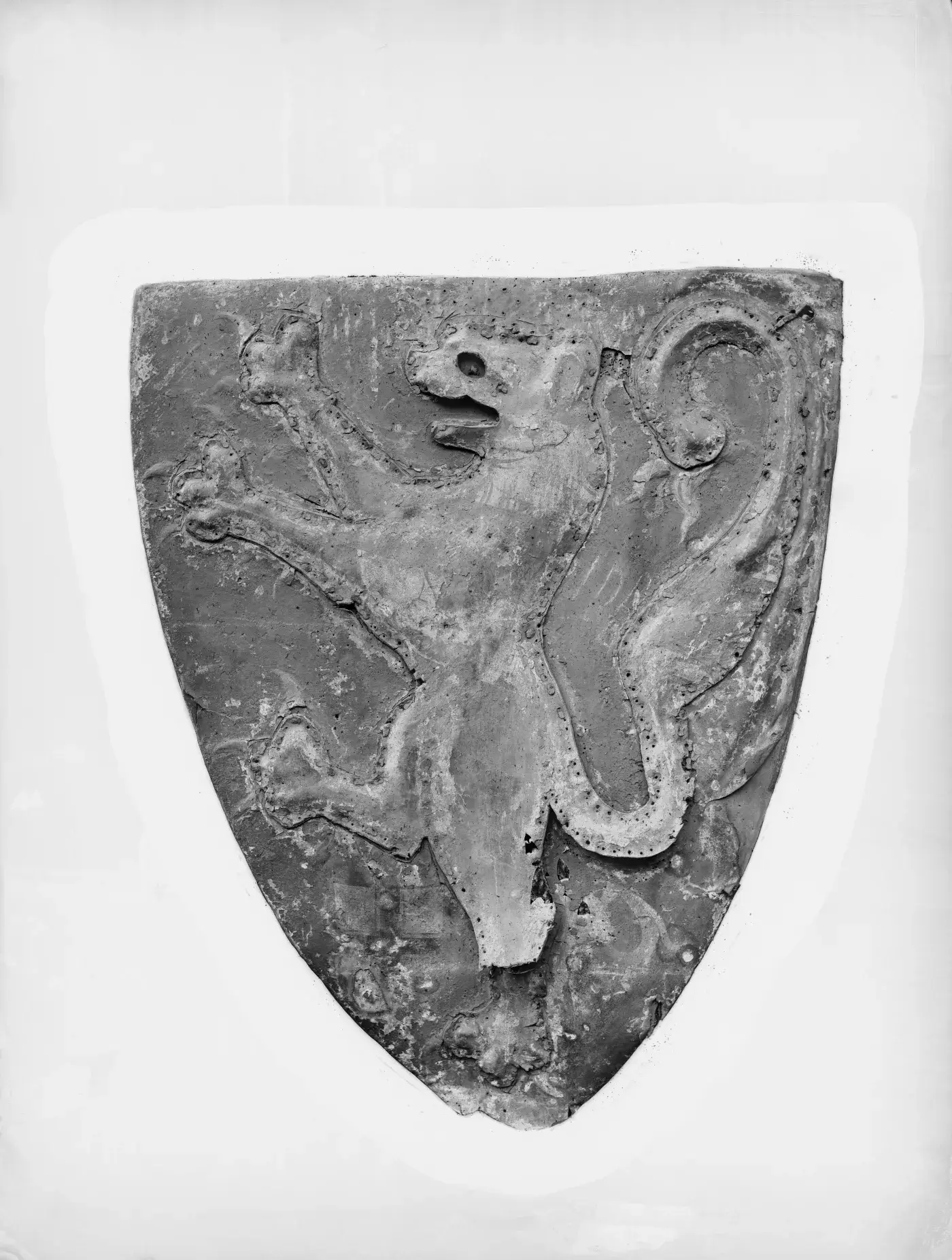
Did Medieval Shields Use Gesso? Grounds and Preparation Layers on Surviving Medieval Shields
A study of chalk grounds, gypsum, gesso, stucco and modelled relief across 24 surviving medieval shields — testing what actually lay beneath the paint, from the unresolved Szczecin shield to the multilayer stucco system of the Oña shields.
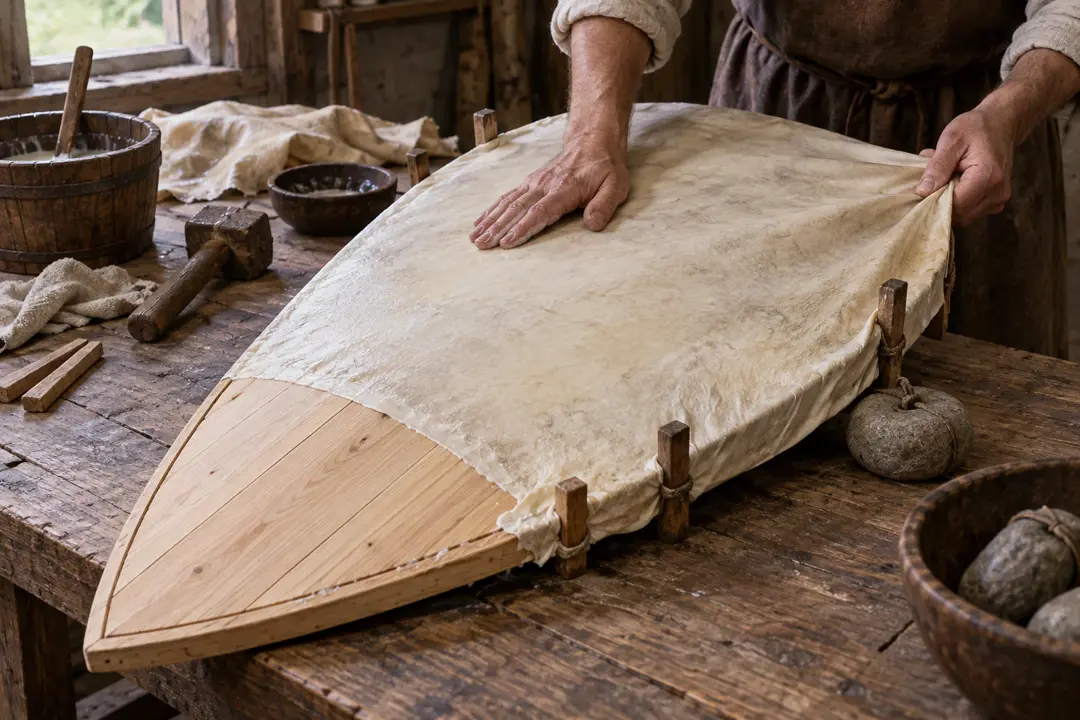
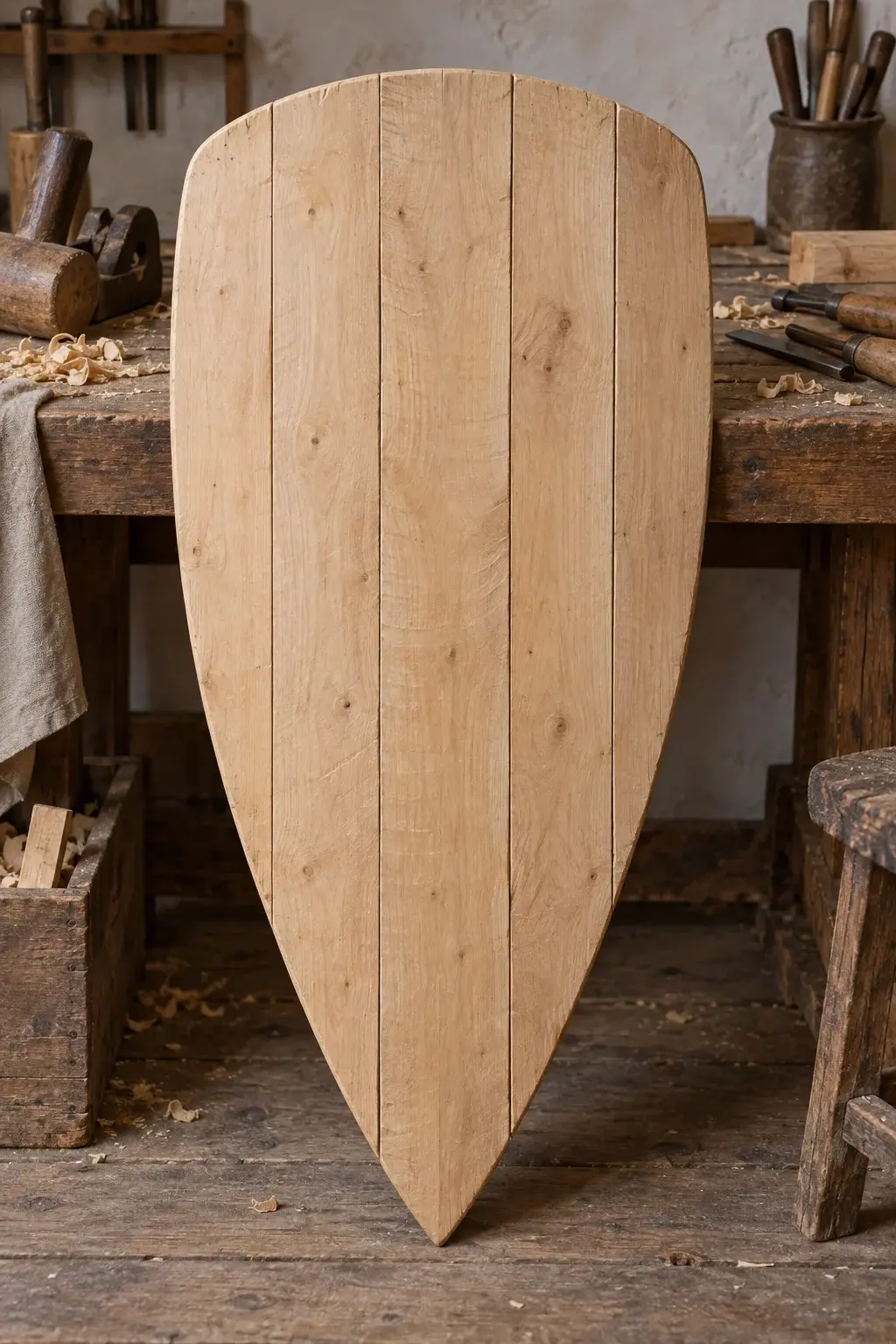
A painted medieval shield was not necessarily a piece of wood with colour brushed directly onto it. On many surviving shields, the painted surface was the final part of a much more complicated structure. Wood might first be covered with parchment, leather or textile. Over this could be applied a pale preparation layer. Only then came paint, silver or gold, and sometimes elaborate raised decoration.
This preparation is often loosely called gesso. That word is useful, but it can also be misleading.
The surviving shields examined for this article contain descriptions of chalk grounds, gypsum or gesso, stucco-like preparations, glue-bound layers and heavily modelled relief grounds. In other cases we know that a shield was painted but cannot establish what, if anything, lay beneath the paint.
The archaeological evidence therefore does not support a single universal recipe. Instead, it reveals a family of related techniques that changed according to place, date, materials and the kind of surface the shield maker wanted to create.
A Note on the Evidence
The archaeological evidence does not support a single universal shield-ground recipe. It reveals a family of related techniques that changed according to place, date, materials and the kind of surface the shield maker wanted to create.
Grounds and preparation layers are among the least visible parts of a medieval shield, so this article separates several kinds of evidence with particular care. A conservator's stratigraphic analysis, a museum catalogue description, a proposed reconstruction and an open unknown are not the same kind of claim, even when they describe the same word: gesso.
What Do We Mean by a Shield Ground?
A ground is the prepared layer between the structural surface of an object and its final decoration.
In its simplest form, the sequence might be:
- wood → covering → preparation ground → paint
But surviving medieval shields demonstrate considerably more complicated arrangements:
- wood → parchment → chalk ground → paint
- wood → parchment → chalk ground → silvering → paint
- wood → parchment → thick modelled ground → metallic leaf → paint
- wood → textile → gesso → additional sheet material → leather
Some shields were even decorated with relief elements constructed from textile stiffened with the same sort of mineral preparation used for the painted surface.
The ground therefore had several possible functions. It could smooth the irregular surface beneath it, conceal wood grain, parchment texture or seams, provide a pale, bright base for pigments, or receive metallic leaf. In thicker applications it could also be shaped, stamped or modelled into relief.
Some medieval shield grounds were not simply primers. They were part of the sculpture of the shield.
The Earliest Evidence: Caution Before Assuming Gesso
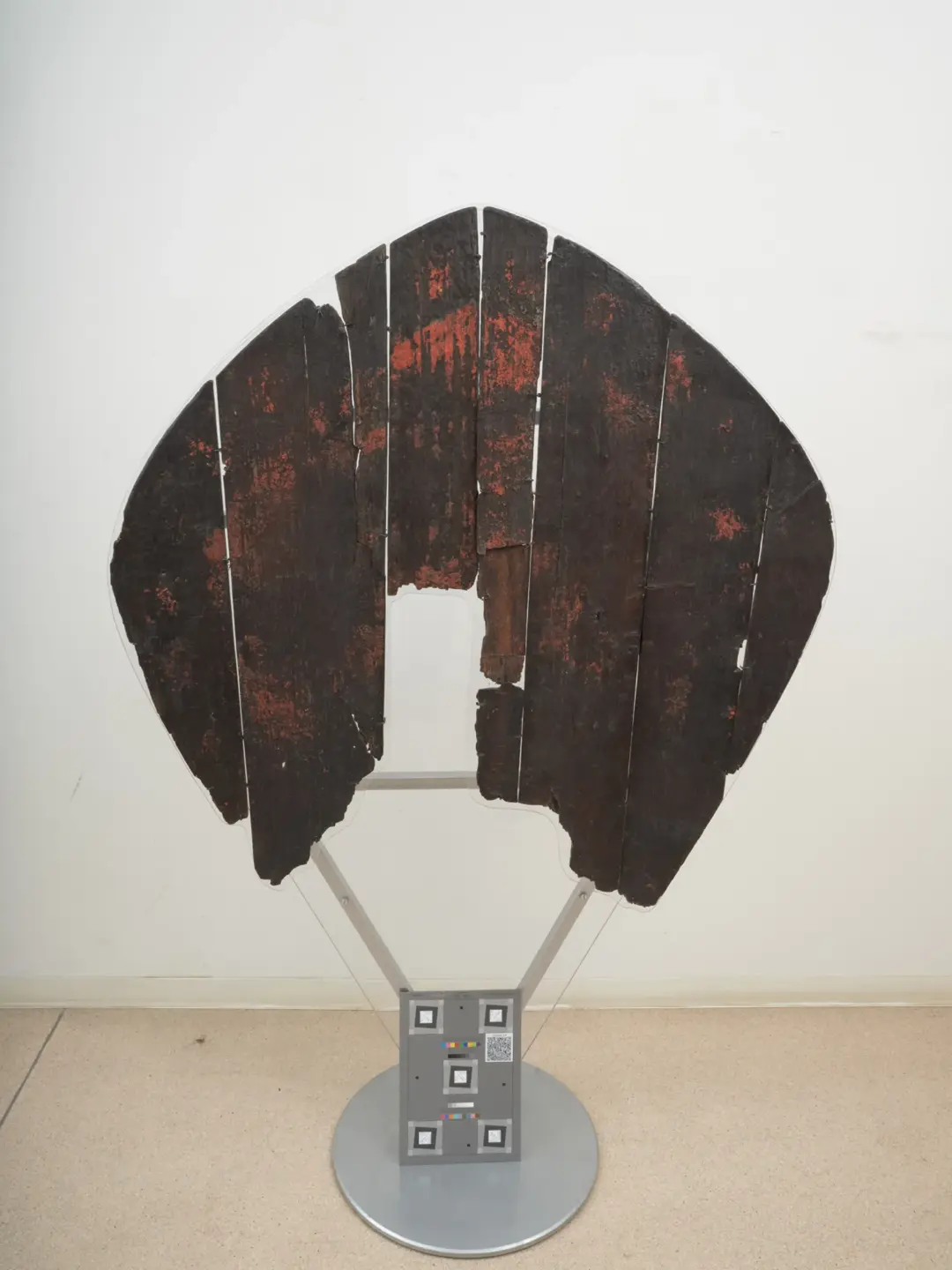
One of the earliest shields in this comparative group is the surviving shield from Szczecin, generally dated to the late twelfth century.
The so-called unpainted Szczecin shield is particularly useful because of what it does not tell us. Calling the shield "unpainted" does not prove that medieval craftsmen left its wood deliberately bare, nor does the present state of the object demonstrate that it never carried a facing, preparation layer or painted surface.
The absence of surviving gesso is not automatically evidence that gesso was never present.
Thin mineral and organic surface layers are among the parts of a shield most vulnerable to abrasion, moisture, burial, biological deterioration and later conservation.
Seedorf, Around 1200 to 1220
The shield traditionally associated with Arnold von Brienz at Seedorf provides much stronger evidence. Its wooden core was covered rather than simply painted as exposed timber: historical and conservation evidence identifies parchment on the front, followed by a prepared painted surface. Descriptions of the preparation refer to gypsum or chalk associated with a glue-based system.
The original appearance was also considerably richer than the shield's present muted colours suggest. Analysis reported by the Swiss National Museum indicates that the field was originally blue and that the lion incorporated silver leaf.
The important point for shield construction is the sequence. The heraldic decoration was separated from the wooden core by several technological stages: the wood provided structure, the covering provided a continuous surface, the mineral preparation created the painting ground, and pigment and metallic decoration produced the visible heraldry.
Already around the beginning of the thirteenth century, therefore, we are dealing with something much closer to medieval panel-painting technology than to paint simply brushed onto boards.
Konrad von Thüringen, Around 1230 to 1240
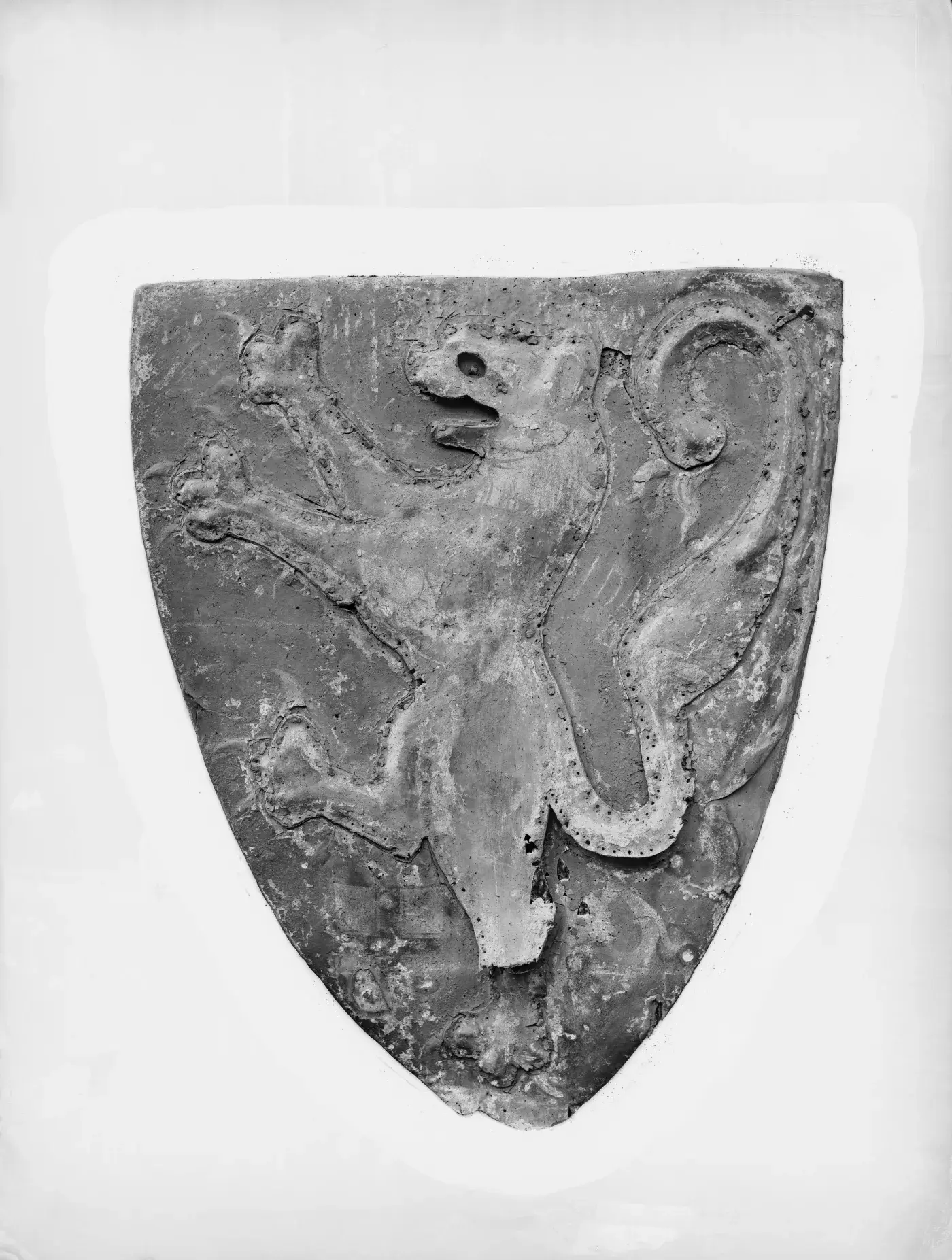
The shield associated with Konrad von Thüringen provides another strong example. Its front is parchment-covered and its surface is recorded as having a chalk ground beneath the polychrome decoration. The reverse was also decorated.
Historical descriptions are particularly revealing because later damage caused portions of the gilding and paint to detach from the chalk preparation. That observation confirms that the preparation was a physically distinct layer within the decorative system.
Again, the structure was not merely wood followed by paint. It was substantially closer to:
- wood → parchment → chalk ground → decorative surface
The Mid-Thirteenth Century: Parchment and Chalk Become Repeatedly Visible
Several surviving shields associated with the thirteenth-century and early Marburg group show the same general principle. The shield of the Vögte von Keseberg is reported as having one piece of parchment on each face, followed by chalk ground and paint.
The precise composition of that chalk preparation and its binder has not yet been analytically established, but the existence of the ground itself is well supported.
We should not turn the phrase "chalk ground" into a precise modern recipe when the surviving evidence does not provide one.
The craftsmen clearly prepared the surface. Exactly how much chalk was used, what animal glue or other binder was employed, how many coats were applied, and how the mixture was worked may remain unknown.
Heinrich's Lion Shield: When the Ground Became Three-Dimensional
The shield associated with Heinrich of Hesse is one of the most extraordinary examples in the group. Both faces are reported as parchment-covered.
On the front was a chalk ground associated with gilding. Above this was an elaborate heraldic lion made using two layers of linen impregnated or stiffened with chalk ground. The textile was shaped and pierced to form the animal.
Another scholarly description characterises the construction as a lace-like overlay of gesso-stiffened linen over a gilded background.
This is a major piece of evidence because it destroys the idea that a shield ground should always be imagined as a thin, perfectly flat coat. Here the preparation material participates directly in constructing relief.
The shield maker was simultaneously painter, modeller and textile worker. The decorative surface was effectively built.
Around 1250 to 1300: Increasingly Elaborate Surfaces
As we move through the later thirteenth century and into the early fourteenth, the surviving evidence becomes especially rich.
The Nordeck zur Rabenau shield has a parchment or parchment-like covering and a white chalk ground on the front. The reverse apparently did not receive the same chalk-ground treatment. That difference is valuable: it suggests that surface preparation could be applied according to the intended decorative requirements of a particular face rather than automatically coating every part of the shield in an identical way.
The Welfenberg or Helfenberg shield takes the technique much further. Its surface includes chalk ground and modelled decoration. The heraldic background was worked into an elaborate damask-like pattern, a raised wolf-iron charge stood approximately two millimetres above the surrounding surface, and gilding was incorporated into the composition.
The preparation layer was therefore no longer merely hidden beneath the painting. It was being deliberately manipulated to create texture, light and relief.
Silver Beneath the Paint
The shield attributed to W. von Liederbach demonstrates another important technique. Both faces carry chalk ground, while the front appears to have been extensively silvered before the coloured decoration was applied.
Parts of the heraldry could therefore be created by allowing the metallic substrate itself to remain visible while other areas were painted over it. The sequence becomes:
- wood → parchment → chalk ground → silvering → paint
This tells us something fundamental about medieval shield colour. A heraldic "white" or "silver" area need not necessarily have been painted with white pigment. It could actually have been metallic.
Because silver tarnishes, a surviving medieval shield may look very different today from the brilliant object originally carried or displayed.
Modelled Grounds Around 1300
Some of the Marburg shields provide spectacular evidence for increasingly sophisticated relief decoration.
The Stromberg shield is reported with parchment coverings followed by chalk ground, engobage or modelled preparation, silvering and paint. Its heraldic birds were built up in substantial relief; one later description gives the raised chalk mass as reaching approximately thirteen millimetres.
Even if that measurement ultimately requires confirmation from conservation records, the surviving object clearly demonstrates substantial modelling. The ground had effectively become sculptural material.
The Steinau-Steinrück shield similarly carries a modelled chalk preparation with elaborate background ornament, including complex geometric forms and medallions with female heads. Again, the preparation was not something the medieval viewer was supposed to forget existed — its relief was an intentional part of the shield's appearance.
The Arnsberg Shield
The shield attributed to the Counts of Arnsberg provides an unusually understandable layer sequence. Both faces have thin parchment-like coverings.
On the front came chalk ground, followed by approximately one-and-a-half-millimetre raised or dotted relief. The field was painted red.
The heraldic eagle incorporated silvering, but not every pale part of the bird was metallic: fine features were also executed with opaque white paint, while darker details were added separately.
The approximate sequence can therefore be reconstructed as:
- wood → parchment-like facing → chalk ground → modelled relief → silvering and paint
A "silver" animal could combine actual metallic leaf with painted white details.
The Schenk von Schweinsberg Shields
The two surviving Schenk von Schweinsberg shields provide further evidence for prepared parchment surfaces.
The older shield is described with parchment on both faces and chalk ground beneath its painted decoration.
The younger shield, dating to around the middle of the fourteenth century, gives an especially clear published sequence:
- parchment → chalk ground → silvering → paint
Once again, metallic decoration was integrated into the prepared surface rather than simply painted as an imitation of metal.
Muschenheim and the Repeated Marburg Pattern
The Herren von Muschenheim shield repeats a closely related technological sequence. One piece of parchment is reported on each face, followed by:
- chalk ground → silvering → painting
Its red field and silver chevron were therefore produced as part of a layered decorative system rather than by painting directly onto wood.
Across the Marburg group, repetition of parchment, chalk preparation, modelling, metallic leaf and paint is difficult to dismiss as an isolated workshop experiment. It represents a mature decorative technology. But it still does not justify claiming that every medieval shield everywhere was constructed this way.
Karl von Trier: Gypsum and Chalk
The shield associated with Karl von Trier is particularly relevant to the question of terminology. Both faces were covered with parchment or rawhide-like skin, and descriptions of its preparation specifically refer to a gypsum/chalk ground. The shield was richly decorated on both sides.
This is why simply asking "Did medieval shields use gesso?" can produce an unsatisfactory answer. Yes, material described as gesso or gypsum preparation certainly occurs. But medieval technical descriptions and modern conservation literature may use terms such as chalk ground, gypsum ground, gesso, stucco or engobage for preparations that were not necessarily chemically or technologically identical.
Unless a shield has been scientifically analysed, we should preserve the terminology actually supported by its evidence.
The Oña Shields: Extraordinarily Complex Preparation
The shields associated with Oña and now connected with the Real Armería provide some of the most detailed stratigraphic evidence in the entire group. They demonstrate just how misleading the simple formula "put gesso on the shield and paint it" can be.
The D sixty shield is covered with parchment and carries multiple layers of stuccoed gypsum or gesso. On the front, analysis identified two preparatory layers associated with animal glue, with gold leaf applied directly over the preparation. Elsewhere the decorative system includes multiple preparatory stucco layers beneath blue paint containing azurite and lead white.
The reverse is different again. There, three preparatory stucco layers are reported with an oil-based binder, followed by coloured layers containing materials including lead white, minium and vermilion.
So even on one shield, there was not necessarily one universal ground recipe.
Different faces and different decorative requirements could involve different preparation systems. This is perhaps the strongest evidence in the surviving-shield group for thinking of medieval shield decoration as a deliberately engineered stratigraphy.
Textile Grounds and Later Re-Covering at Sion
The Bartolomei shield from Sion demonstrates another complication. Investigation revealed an earlier medieval shield beneath a later transformation.
The original fourteenth-century shield had a linen or canvas surface carrying its heraldic decoration. In the later fifteenth century it was reactivated and another painted linen covering was applied over the earlier one.
The precise ground beneath these painted textile layers has not yet been established. That uncertainty is itself important: textile on a medieval shield does not automatically mean linen → gesso → paint. There may have been such a preparation, but unless analysis demonstrates it, it should remain an open question.
The Black Prince's Shield: A Different Layered Solution
The shield associated with the Black Prince at Canterbury provides one of the most unusual recorded sequences.
Older technical descriptions give a construction broadly consisting of:
- wood → textile or canvas → gesso → paper-like layer → leather
Later institutional descriptions refer to poplar wood, linen layers and boiled-leather heraldic elements. The terminology and exact relationship between the layers still require further conservation evidence, but one conclusion is secure: gesso was not necessarily the last preparation immediately beneath paint. It could occur inside a much more complicated composite surface.
Medieval shield makers were solving structural and decorative problems rather than following a modern textbook recipe.
So, Did Medieval Shields Use Gesso?
Yes. Surviving medieval shields provide direct and published evidence for mineral preparation layers that modern sources describe variously as gesso, gypsum, chalk ground and stucco-like preparation.
But that answer needs qualification. There was no single medieval shield-gesso system demonstrated across all surviving shields.
- Some shields have chalk preparation.
- Some have gypsum or gesso.
- Some carry several preparation layers.
- Some grounds were bound with animal glue.
- At least one exceptionally well studied example shows different binding systems on different parts of the same shield.
- Some grounds were thin painting preparations, and others were built into substantial relief.
- Some supported paint, some supported silver leaf or gold leaf, and some were used to stiffen and model textile decoration.
And for a number of surviving shields, the preparation remains unknown.
What the Surviving Shields Actually Tell Us
Taken together, the twenty-four shield dossiers studied by Shieldwright suggest a recurring medieval manufacturing principle rather than a universal recipe.
The painted face of a high-quality shield was often constructed as a sequence of specialised layers. The wooden core provided strength and shape. Parchment, leather or textile could isolate and unify that core. A mineral preparation could then create a controllable decorative surface — polished smooth, modelled into relief, used to stiffen textile, covered in silver or gold, or painted with heraldic colours.
The finished shield was therefore not simply painted carpentry. It could combine the crafts of the woodworker, parchment worker, painter, gilder and modeller in a single object.
Perhaps the most useful reconstruction model is consequently not:
- wood → gesso → paint
but:
- structural core → facing or covering where evidenced → preparation appropriate to that object → relief or metallic treatment where evidenced → paint → later coatings or interventions where evidenced
That sequence should never be imposed on a shield for which the evidence says something different.
A Note for Historical Reconstruction
For modern reconstruction, the evidence argues against selecting one convenient "medieval gesso recipe" and applying it to every shield from the twelfth to fourteenth centuries.
A plausible medieval technique is not automatically the documented technique of a particular surviving object.
That distinction is central to experimental archaeology.
Conclusion
The surviving evidence changes the way we should imagine a medieval shield. Under the heraldic lion, eagle, cross or chevron there could be an entire hidden technological structure: parchment stretched across timber, layers of chalk or gypsum bound with organic material, relief built from prepared textile or thick mineral paste, silver or gold leaf, and finally coloured paint.
Centuries of abrasion, tarnishing and material loss have flattened much of that complexity. Originally, some of these shields must have been remarkably bright and three-dimensional objects.
Their grounds were not merely preparation for the artwork. They were part of the artwork itself.
Bibliography / Source Base
- Archäologisches Landesmuseum Brandenburg. Institutional material and finds documentation on the 11th-century Lenzen shield fragment.
- Muzeum Narodowe w Szczecinie. National Museum in Szczecin, catalogue record for wooden shield MNS/A/22250/1, dated 1176-1200, used here for the unresolved surface-preparation status of the unpainted shield. Source link.
- Dowen et al. 2019. Keith Dowen, Lech Marek, Slawomir Slowinski, Anna Uciechowska-Gawron and Elzbieta Myskow, Two Twelfth-Century Kite Shields from Szczecin, Poland, Arms & Armour 16, no. 2 (2019), 121-148. DOI: 10.1080/17416124.2019.1667049. Source link.
- Soler del Campo. Álvaro Soler del Campo, technical study of the Oña shields D 59 and D 60 in the Real Armería, Madrid, including the parchment, gypsum/gesso, animal-glue and oil-bound stucco layers, gold leaf, azurite, lead white, minium and vermilion evidence on both faces.
- Senn and Moser. Matthias Senn and Franz Moser, Der Reiterschild von Seedorf UR: ein Untersuchungs- und Restaurierungsbericht, Jahresbericht Schweizerisches Landesmuseum Zurich 100 (1991/1992), 80-85. DOI: 10.5169/seals-395364. Source link.
- Rahn. Johann Rudolf Rahn, 1878 examination / 1883 publication tradition for the Seedorf shield, used here for the source-qualified observation of front parchment with a gypsum/chalk, glue-bound preparation.
- Bildindex / Bildarchiv Foto Marburg. Institutional records for the Marburg shield group, including Schild des Landgrafen Konrad von Thuringen, Museum fuer Kunst und Kulturgeschichte der Philipps-Universitaet Marburg, inventory 3177, object record 0001336328, and related shields (Vögte von Keseberg, Heinrich of Hesse, W. von Liederbach, Nordeck zu Rabenau, Welfenberg/Helfenberg, Stromberg, Steinau/Steinrück, the Counts of Arnsberg, the Schenk von Schweinsberg shields, Karl von Trier and Muschenheim). Source link.
- Kohlmorgen. Jan Kohlmorgen, Der mittelalterliche Reiterschild: Historische Entwicklung von 975 bis 1350 und Anleitung zum Bau eines kampftauglichen Schildes (2002), used here as technical secondary literature for the Marburg group ground, gilding and modelled-relief evidence.
- Warnecke. Friedrich Warnecke, Die mittelalterlichen heraldischen Kampfschilde in der St. Elisabeth-Kirche zu Marburg (Berlin, 1884), used here only as older source-chain evidence for Marburg technical descriptions, not as unchecked modern conservation proof.
- Nickel. Helmut Nickel, Der mittelalterliche Reiterschild des Abendlandes, FU Berlin dissertation 1958 / Der Herold offprint 1959/60, cited as broader historiography unless direct wording is available for a specific technical claim.
- Musées cantonaux du Valais. History Museum of Valais records and catalogue research for the Bartolomei shield at Sion, including the fifteenth-century re-covering with painted linen over an earlier linen/canvas-faced fourteenth-century surface.
- Laking. Guy Francis Laking, historical technical description of the Black Prince's funerary shield at Canterbury, used with modern institutional evidence where available.
- Canterbury Cathedral / Royal Armouries. Canterbury historical and archaeological material and Royal Armouries research references for the Black Prince shield at Canterbury Cathedral, including the composite gesso, paper-like layer and leather front-layer sequence.