What Were the Parts of a Medieval Shield Actually Called?
Guige, enarmes, boucle and umbo are real historical shield words. "Core", "facing" and "padding" are useful modern labels. Why the difference matters — traced through Old French texts, dictionaries and surviving shields.
When describing a medieval shield today, it is tempting to give every visible component a neat technical name: core, rim, grip, arm strap, shoulder strap, boss, facing, padding.
That is useful in a workshop. It is not necessarily medieval vocabulary.
Some shield terms really do occur in medieval language. Old French texts name the guige, the long strap by which an escu could be suspended, and the enarmes, the straps used to hold and control it. Earlier shield traditions also preserve boucle and the Latin umbo for the projecting central boss.
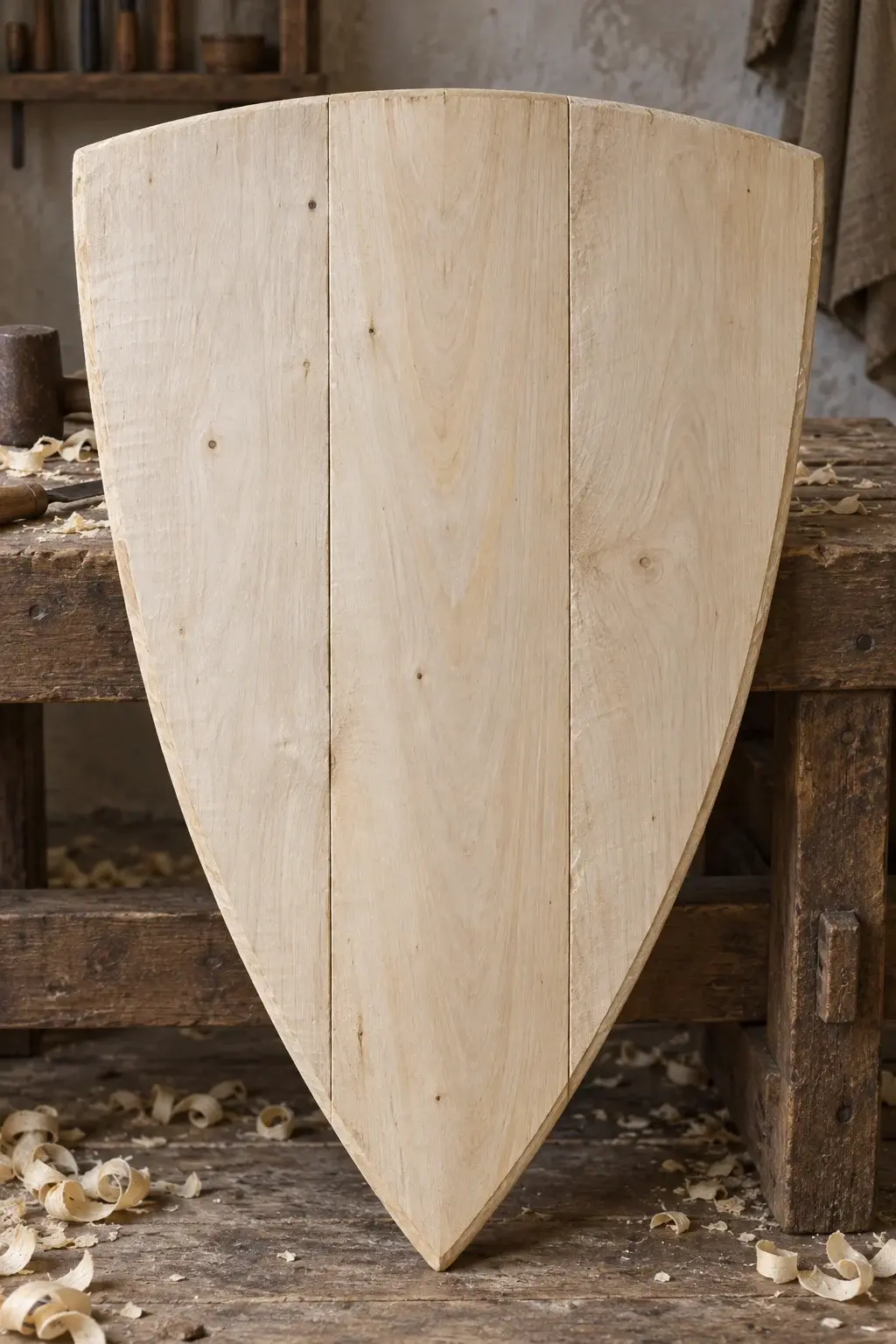
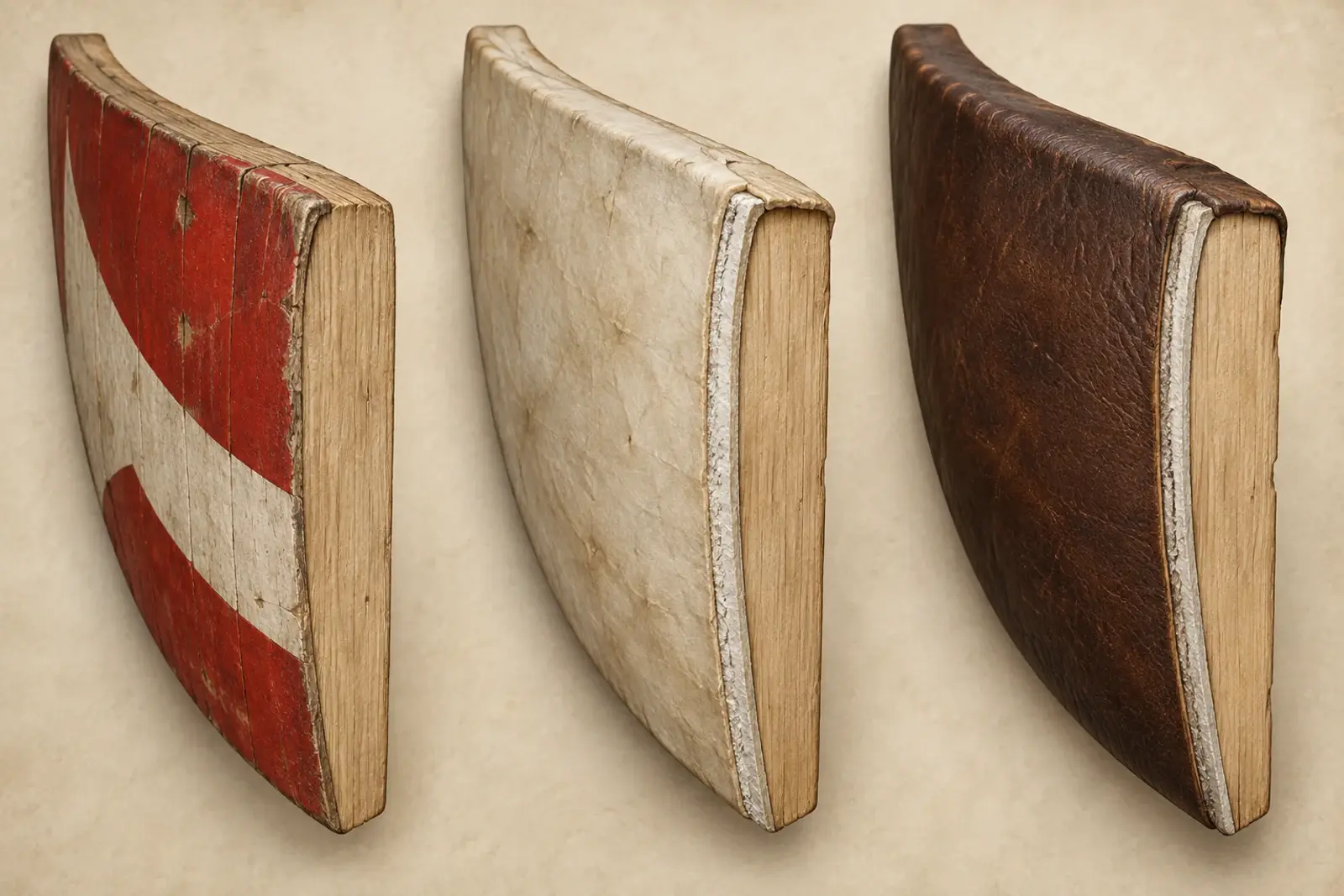
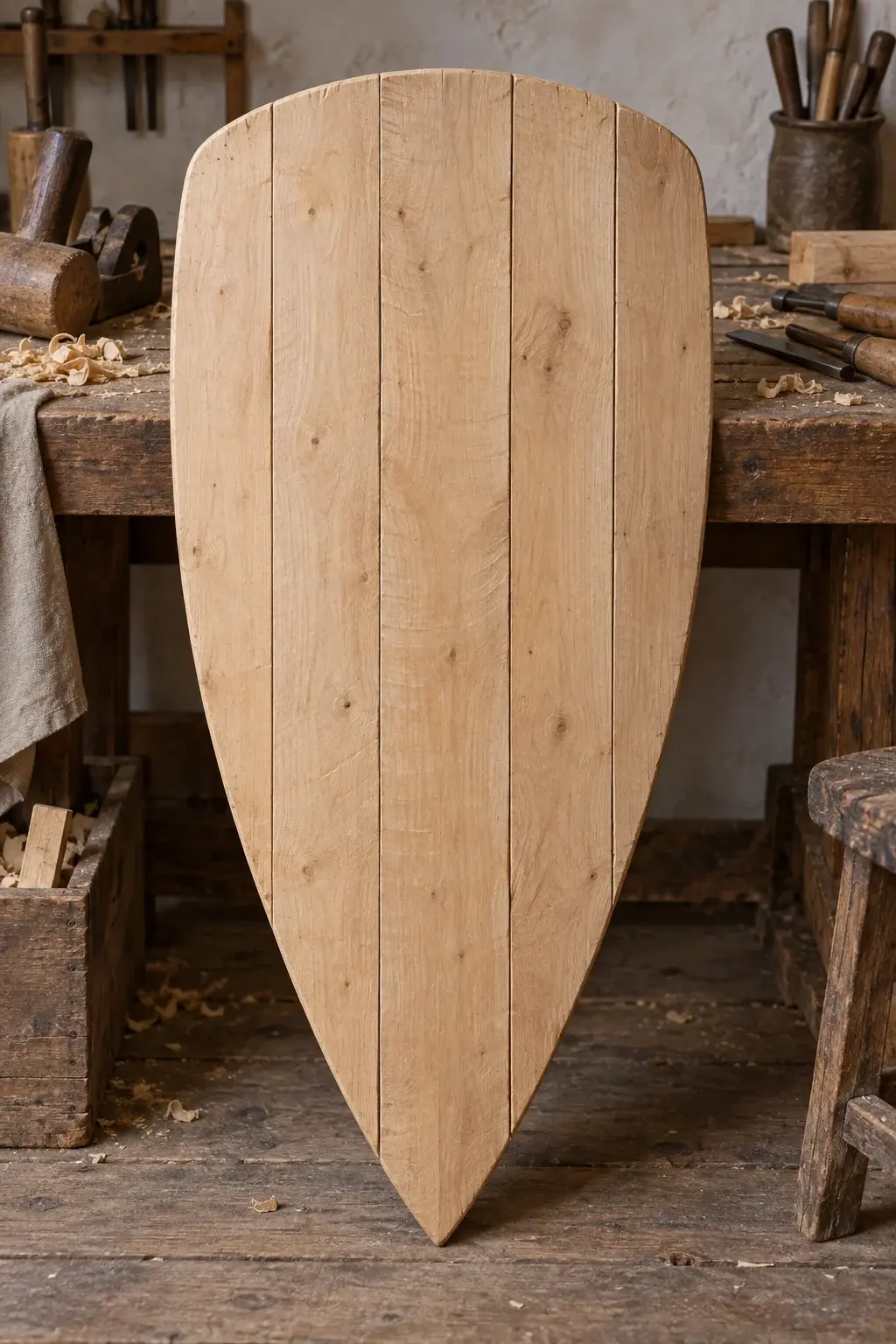
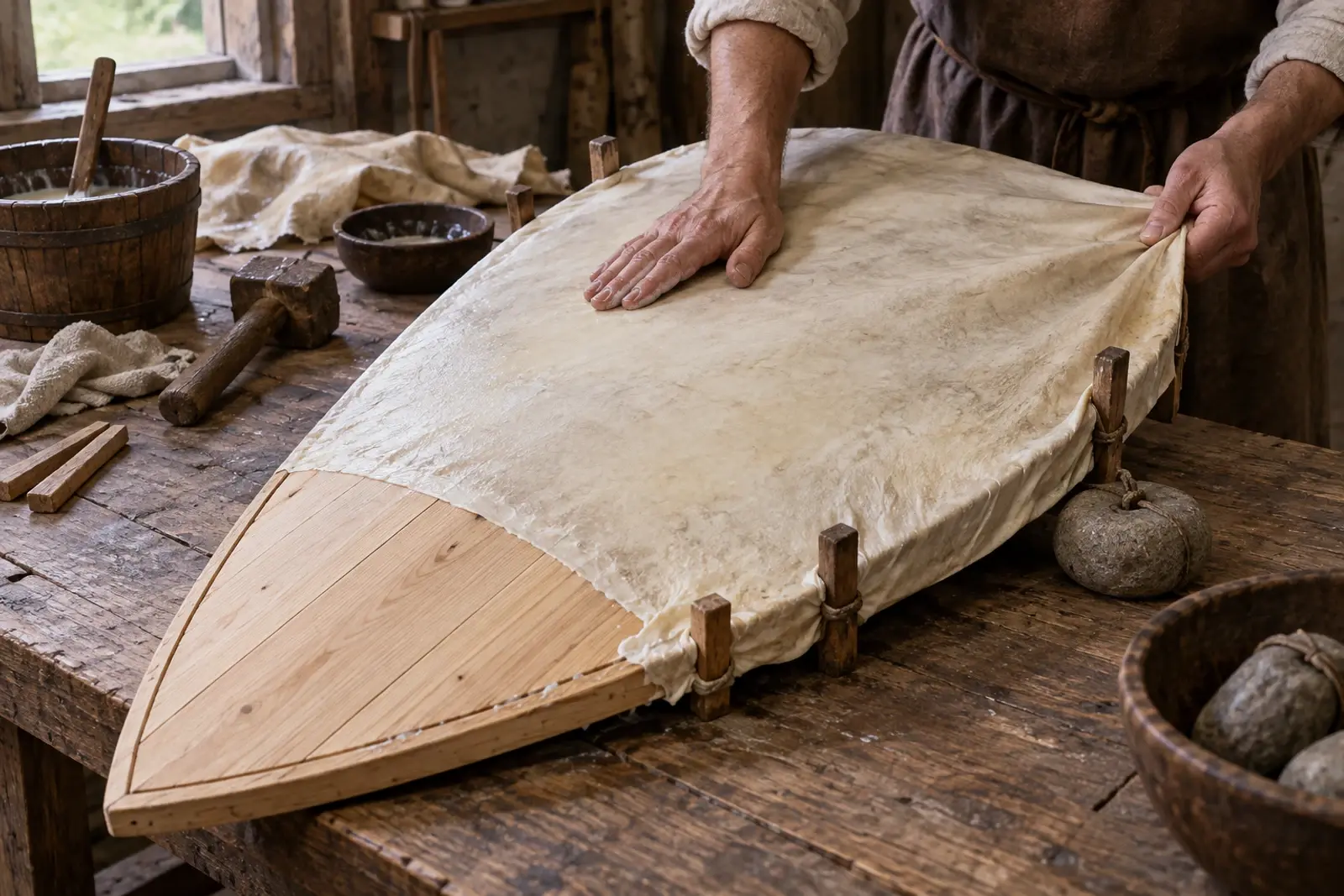
Other familiar words are much more complicated. Bouche, for the lance notch of a later shield, belongs principally to a later medieval and tournament context. Terms such as wooden core, facing, ground, backing, forearm pad and edge binding are often modern descriptive language. They may describe real physical parts perfectly well, but that does not mean a shield maker in 1200 called them by those names.
For my work, this distinction matters. If I am trying to understand how medieval shields were actually constructed, I should also be careful about the language I place on them.
The Short Answer
For the high-medieval shields at the centre of my research, the strongest historical terminology currently includes:
- escu / écu: the shield itself;
- guige / guiche: the long suspension or carrying strap;
- enarme / enarmes: the strap or straps used by the arm and hand to hold and control the shield;
- boucle: an Old French term for the projecting boss of a shield;
- umbo: the Latin term for a shield boss, retained in historical and technical vocabulary;
- bouche: a notch for the lance, but principally relevant to later medieval shields rather than the 12th- and 13th-century heater shields discussed most often here.
The most important finding is almost the opposite of a glossary.
Medieval shield anatomy does not come to us as one complete labelled diagram.
There are surviving objects, archaeological reports, medieval texts, manuscript images and later technical vocabulary. They overlap, but they are not the same kind of evidence.
How To Read The Terminology
This article separates shield terminology into four categories.
That distinction prevents a modern exploded diagram from quietly turning into supposed medieval vocabulary.
Escu: The Shield Before It Was a "Bouclier"
One of the most useful linguistic clues is the name of the object itself.
Old French escu, modern French écu, derives from Latin scutum. Medieval texts use escu repeatedly for the shield.
The modern French word bouclier has a more interesting history. The Académie française traces it to escut boucler: an escu equipped with a boucle.
That matters because boucle did not originally mean only the familiar buckle used to adjust a leather strap. In medieval shield vocabulary it could mean the projecting central boss.
The Anglo-Norman Dictionary records boucle specifically as the boss of a shield, with examples extending back into the 12th century. The Chanson de Roland likewise repeatedly describes the bucle at the centre of an escut.
So one of the ordinary modern European words for "shield" preserves the memory of an actual shield component.
Boucle and Umbo: The Shield Boss
The central projection familiar from round and early kite shields is usually called a boss in modern English. Two older terms are especially important.
Umbo is the Latin term. It remains standard technical vocabulary for the central boss of a shield and is still used by museums and archaeological catalogues.
Old French gives us boucle. The historical meaning is well attested. The Académie française records the 12th-century sense of boucle as the boss of an écu. The Anglo-Norman Dictionary gives examples such as escu od boucle de cristal, and the Chanson de Roland describes blows reaching or breaking the shield around its bucle.
Guige: The Long Shield Strap
The guige is one of the clearest named components in medieval shield terminology.
Old French dictionaries define guige as the strap by which a shield could be suspended from the neck or carried on the person. Variant forms include guiche.
More importantly, the word survives in medieval literary evidence. The historical lexicographical record includes the Chanson de Roland, around 1100, describing a shield whose guige hangs from the warrior's neck. Another Old French example, from Perceval, describes the shield hanging by the guige.
That makes the word particularly useful for anyone studying how these shields were carried.
In other words, knowing the medieval name does not magically reconstruct the component.
Enarmes: The Straps That Controlled the Shield
The other exceptionally important term is enarmes.
The Dictionnaire du Moyen Français defines enarmes as straps fixed to the inside of the shield through which the forearm was passed or which were grasped by the hand to hold the shield during combat.
The surviving medieval examples are explicit. Texts describe warriors taking an escu par les enarmes and shields being carried or grasped by their enarmes. The singular enarme also existed.
This is important because modern shield discussion sometimes uses enarmes as though it meant one specific two-strap arrangement: one forearm loop and one hand grip. The historical word is broader than that.
Bibliography / Source Base
- Académie française. Dictionnaire de l'Académie française, used here for the derivation of bouclier from escut boucler and the 12th-century sense of boucle as the boss of an écu.
- Anglo-Norman Dictionary. Entries for boucle and related shield vocabulary, including the example escu od boucle de cristal. Source link.
- Dictionnaire du Moyen Français. ATILF / CNRS, entries for enarme / enarmes and guige. Source link.
- Chanson de Roland. Old French epic, c.1100, used here for the bucle at the centre of the escut and the guige hanging from the warrior's neck.
- Chrétien de Troyes, Perceval. Old French romance, used here for the shield hanging by the guige.