Přemysl Ottokar II: The Lion of Bohemia on a King's Seal
Přemysl Ottokar II, King of Bohemia, died on the Marchfeld in 1278. His two-sided seal shows him riding with a lion shield on one face and the Austrian band on the other. What do the seal and the armorials establish about his shield, and what must a reconstruction leave open?
- Author
 Michal, shieldwright.eu
- Published
- 2026-11-07
- Updated
- 2026-11-07
- Read
- 12 min read
- Status
- Research article
On 26 August 1278, two royal armies met on the Marchfeld, between Dürnkrut and Jedenspeigen, northeast of Vienna. One was led by Rudolf of Habsburg, elected King of the Romans in 1273. The other belonged to Přemysl Ottokar II, King of Bohemia, who had once also ruled Austria, Styria, Carinthia and Carniola. His army was defeated, and Ottokar was killed.
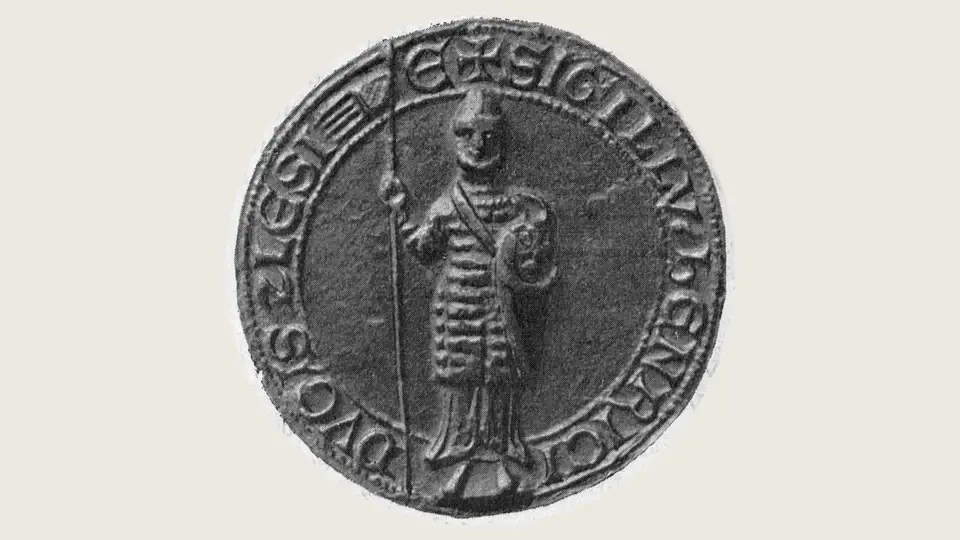
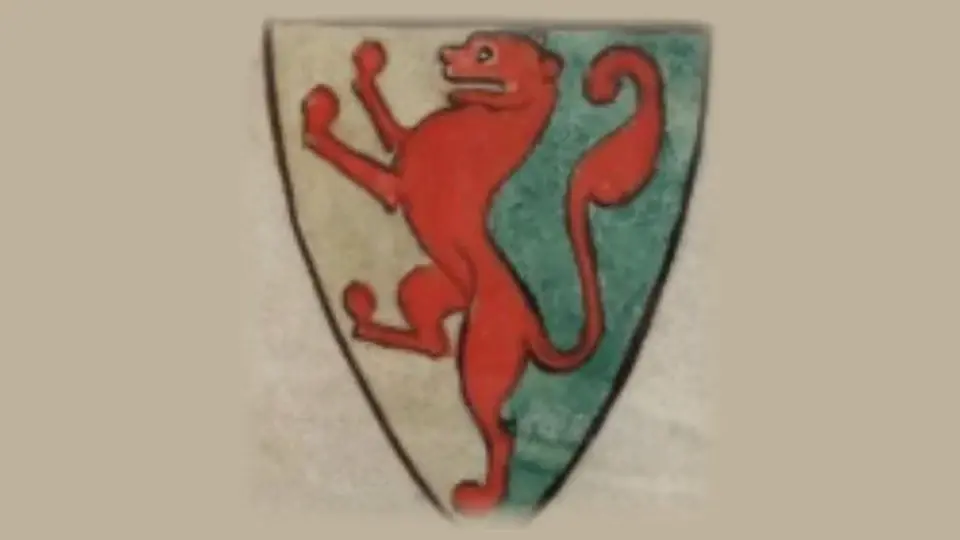
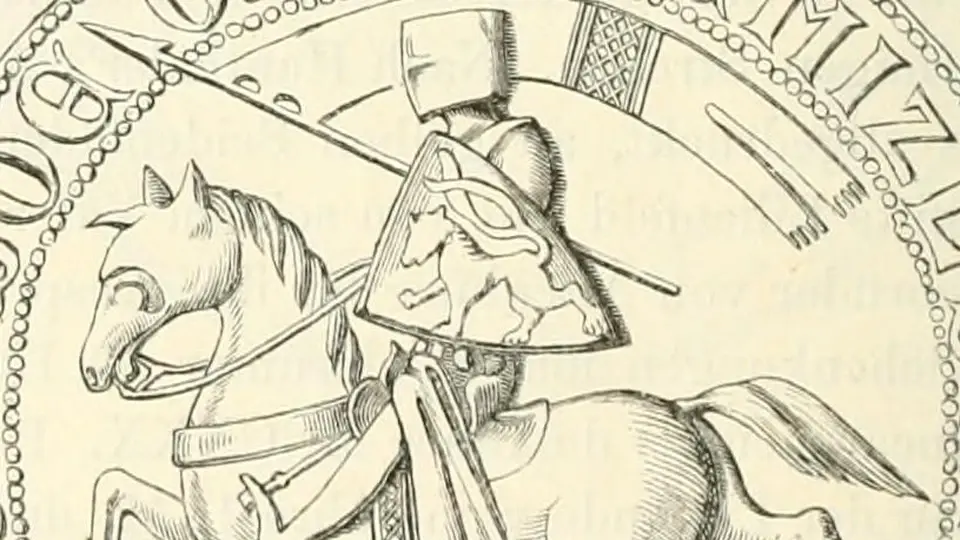
No shield of Ottokar's survives. What does survive is his seal: a two-sided wax seal on which he rides as an armed knight, carrying a shield with a lion on one face and a shield with the Austrian band on the other. Medieval armorials, compiled around the time of his death, add the colours of the Bohemian arms: a silver lion on red.
The question is what these sources establish about the shield Ottokar's seal represents, and how much of it can be reconstructed honestly.
The Short Answer
A triangular shield bearing a lion, on a seal used during Ottokar's lifetime; a silver lion on red, in an armorial compiled around his death.
The seal gives the device and the general outline of the shield. A French armorial of about 1280 gives the colours and describes a crowned lion with a forked tail. The size of any shield Ottokar actually carried, its wood, curvature, facing and fittings, and the exact drawing of its lion, are not recorded. A reconstruction has to choose them and say so.
A Note on the Evidence
This article keeps five kinds of information apart.
Who Was Přemysl Ottokar II?
Ottokar was born in 1232 or 1233, the second son of Wenceslaus I, King of Bohemia, of the Přemyslid dynasty. After the death of his elder brother Vladislaus in 1247 he became Margrave of Moravia. Late in 1247 Bohemian nobles opposed to his father chose him as "younger king". Wenceslaus first recognised him, then imprisoned him, and after a quick reconciliation confirmed him as margrave.
In the contest for the inheritance of the last Babenberg duke, Frederick II, who had died in 1246, Ottokar prevailed: the Austrian estates did homage to him in 1251, and he married Frederick's sister Margaret. When his father died in 1253 he succeeded to Bohemia. He lost Styria to Béla IV of Hungary in 1254, won it back after defeating the Hungarians at Kressenbrunn in 1260, and was crowned King of Bohemia in Prague in 1261. In 1269 he also acquired Carinthia and Carniola.
His reign also saw new towns, trade, and gold and silver mining in his lands. It brought him into conflict with his neighbours, and in the end with Rudolf of Habsburg.
From Eagle to Lion
Bohemian royal heraldry did not always mean a lion. Robert Luft's biography of Ottokar in the Neue Deutsche Biographie counts among the symbolic innovations of his reign the lion in place of the eagle in the Bohemian arms, and a ruler's seal showing a knight in place of the land's patron saint. The two-sided seal described below is an example of both.
Two Shields on One Seal: Bohemia and Austria
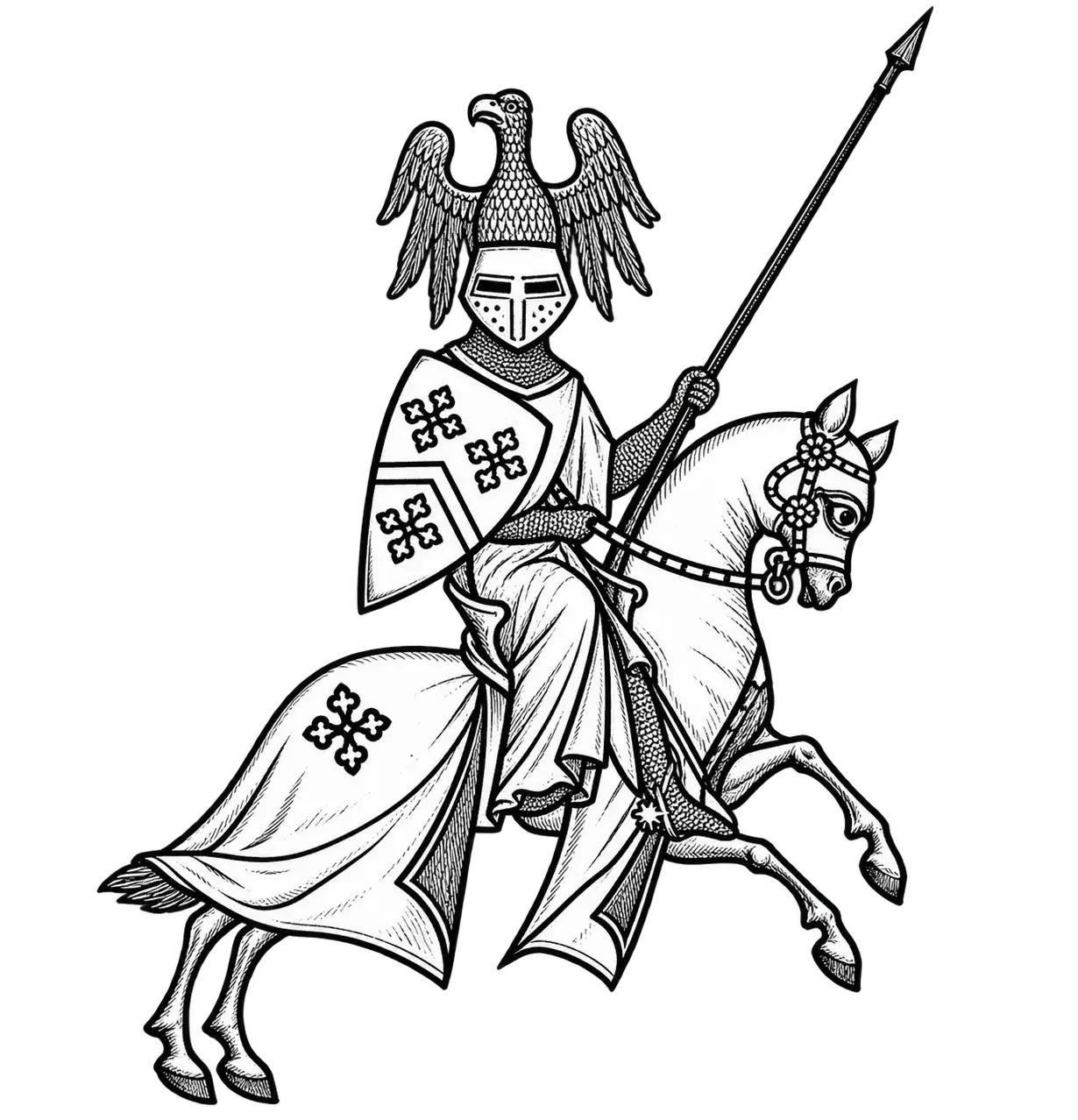
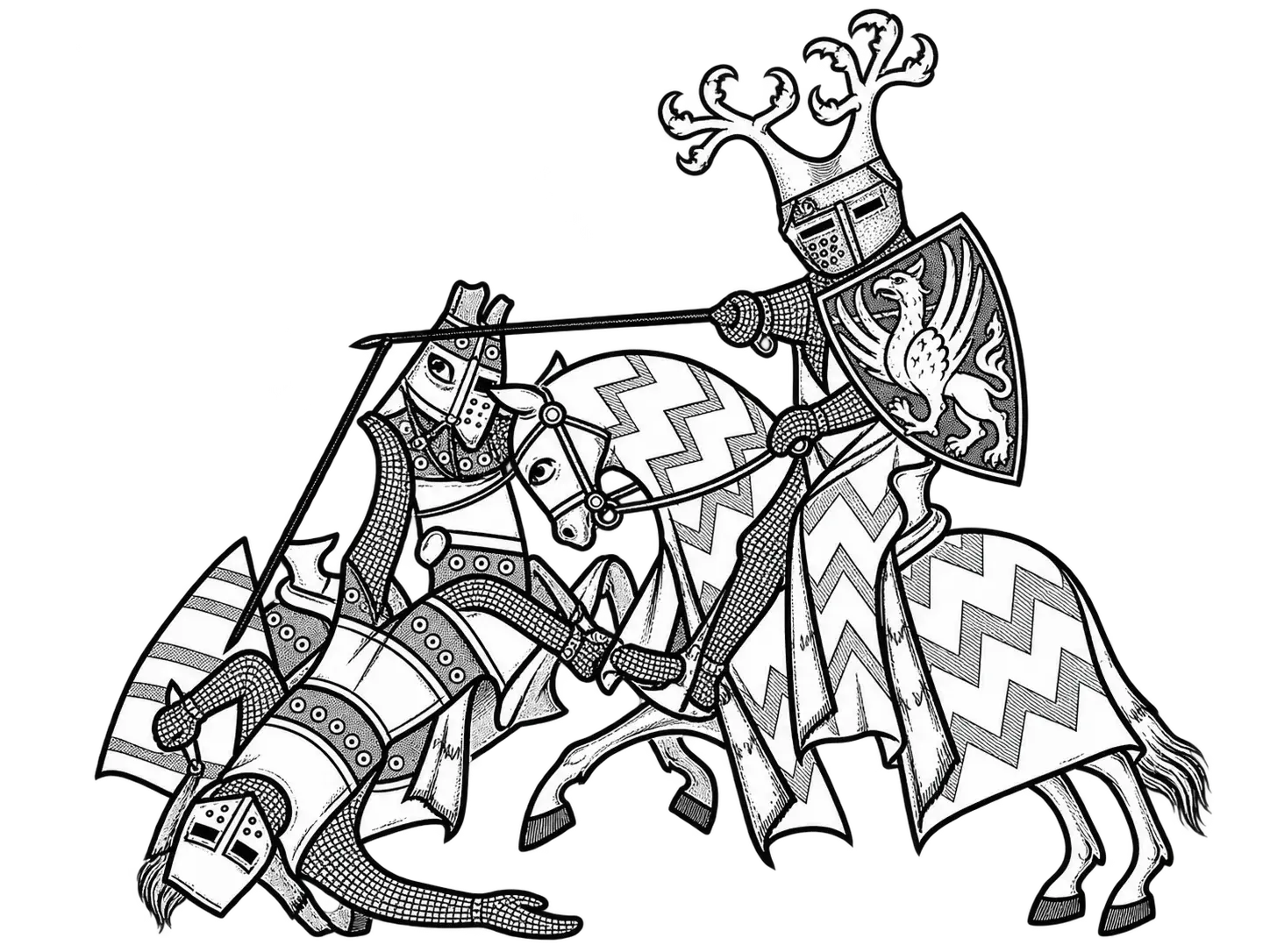
Ottokar's two-sided seal shows him on both faces as a mounted knight with a banner and a shield. On the Bohemian face the shield bears a lion, and the legend reads PREMIZL DEI GRACIA IVVENIS REX BOEMORVM. On the other face the shield bears the horizontal band of Austria, and the legend calls him OTACHARVS DEI GRACIA DVX AVSTRIE ET STIRIE, duke of Austria and Styria. The lion stated his Bohemian identity, the band his authority as Duke of Austria: heraldry used as a political language.
A second impression is known from a charter issued in Styria. During his conflict with his father, Wenceslaus I, Ottokar was chosen by opposition nobles as the 'younger king'. The title appears in the Latin legend IVVENIS REX on his equestrian seal. Although Ottokar succeeded his father in 1253, the impression attached to a charter he confirmed at Graz on 21 December 1260 is described as still bearing that earlier title.
The charter edition refers to these two engravings for the seal on the Graz charter. They show the seal type; which impression Sava drew is not recorded. The seal gives two shield designs connected with the same ruler. It does not show that he carried either device into any particular battle.
What Shape Was Ottokar's Shield?
In Sava's engravings the shield is triangular: broad across the top, with a gently curved upper edge, narrowing to a point below, and held across the rider's body. As far as can be seen on photographs of the damaged Olomouc impression, the shield there has the same broad-topped form, though that is an observation of an image, not a measurement. Sava, who studied the Austrian rulers' seals, observed that the armour, the form of the shield and the way it is carried closely resemble the two-sided seal of Duke Frederick II of Austria, Ottokar's Babenberg predecessor.
What the Lion Looked Like
Four kinds of evidence bear on the lion, and they say different things.
- The blazon. The French Wijnbergen armorial describes the arms of the King of Bohemia as a silver lion on red, with a forked tail crossed in saltire and knotted, crowned gold. It does not say whether the lion stands upright or walks.
- Sava's engravings. They show a lion on the shield, too small to show its tail or a crown.
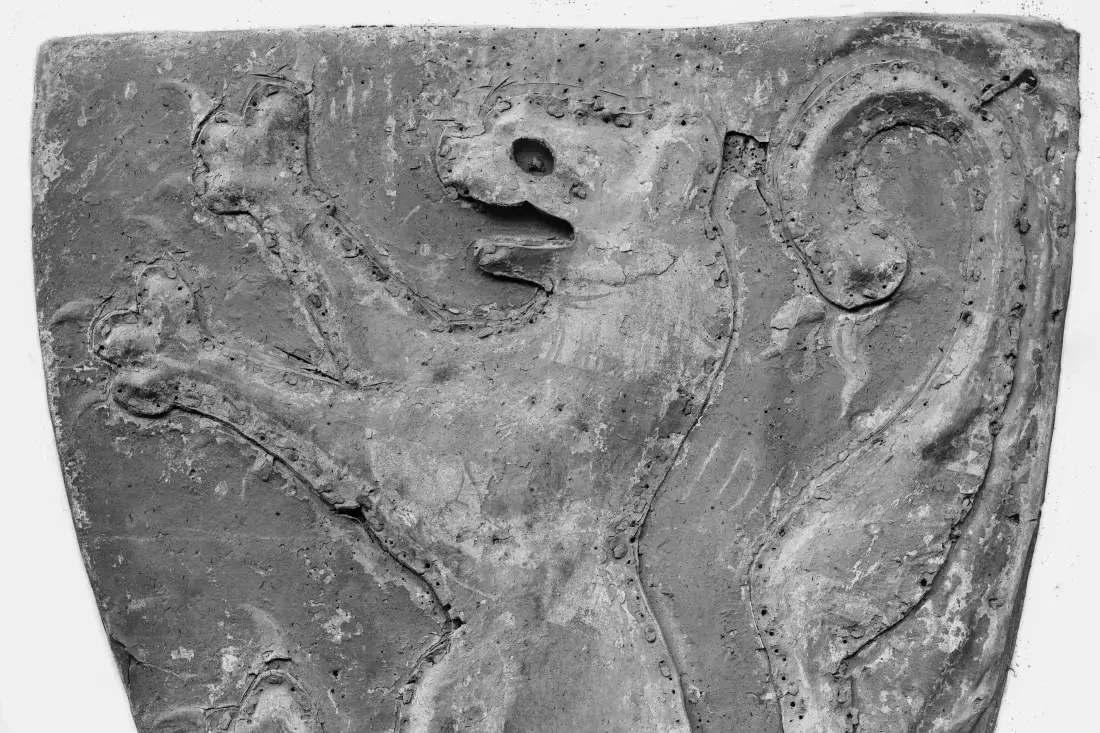
- The surviving impressions. Wax preserves shapes, not colours, and the Olomouc impression is damaged.
- The reconstruction. The posture, the drawing of the mane, claws and crown, and the form of the tail where it divides all have to be chosen.
How Are the Colours Known?
Wax seals do not record the colours of the shields they show. The colours of the Bohemian arms come from armorials, the rolls of arms compiled by heralds, as studied by Eszter Tarján.
Other armorials are weaker or disagree. The English Lord Marshal's Roll describes a silver lion rampant with a forked tail crossed in saltire on red, but it survives only in an early modern copy, depends on the Wijnbergen armorial, and its copyist often wrote silver where the original had blue. Walford's Roll, an English roll of about 1275, gives the King of Bohemia a crowned black lion on silver, which does not match. Tarján also reports, citing a study of Přemyslid coinage, that Ottokar's bracteates show a crowned lion with forked, crossed tails.
The red-and-silver reconstruction is therefore supported for the Bohemian arms by the Wijnbergen armorial, while the exact execution of any individual shield remains unknown. How such a surface was built up and painted is set out in How Was a Medieval Shield Actually Painted?.
The Shield Behind the Painting
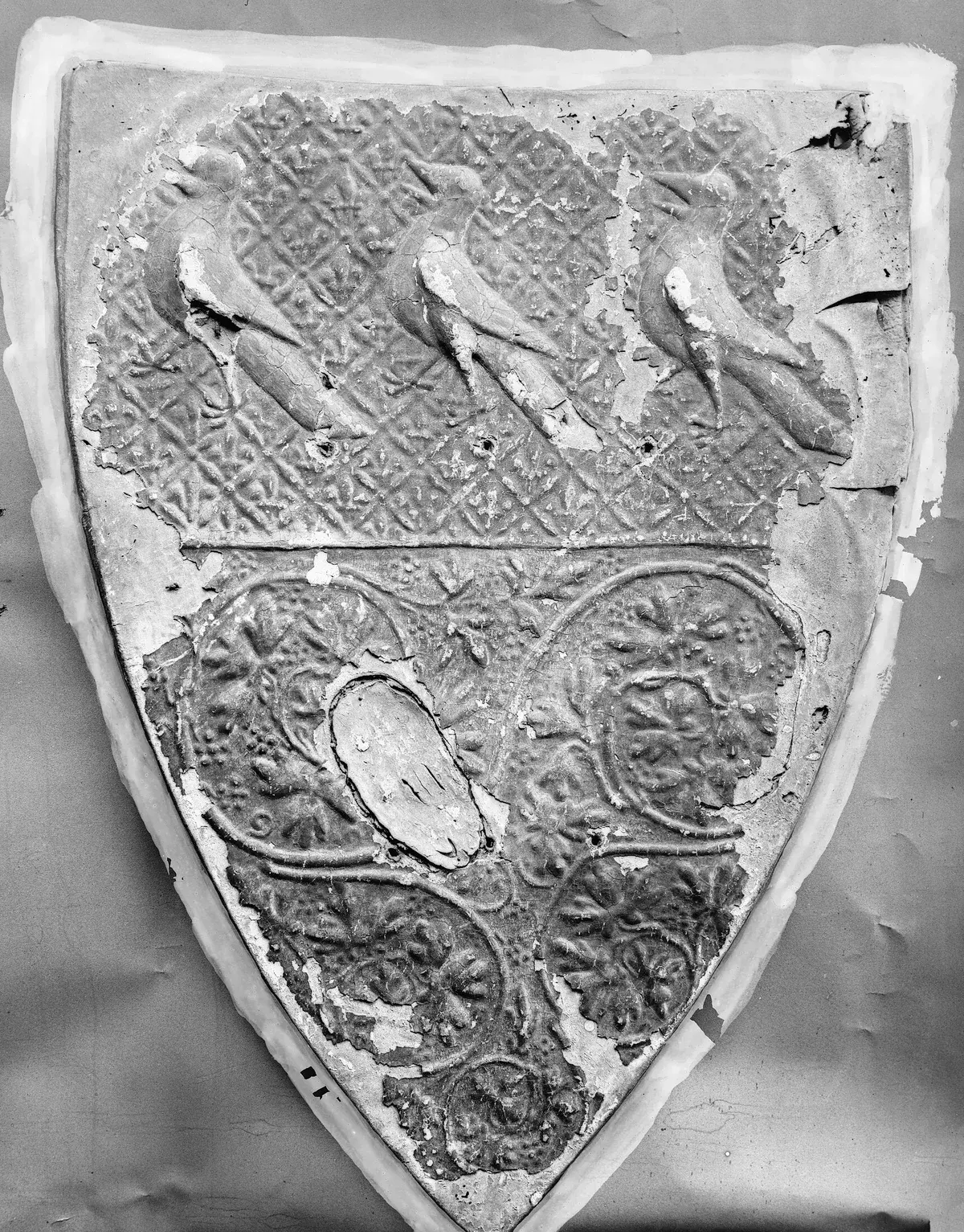
My research has not identified any surviving shield as Ottokar's own, so what the physical object was like cannot be answered from the seal. Three kinds of evidence have to be kept apart.
- The seal impressions of 1260 and 1261 establish the device and the general outline of the shield on Ottokar's seal.
- Surviving medieval shields and archaeological research show which materials and methods of construction were possible.
- The dimensions, wooden structure, curvature, covering, painted finish, rim, enarmes and carrying strap of a reconstruction are modern decisions, and have to be documented as such.
What the surviving shields show about these parts is examined in How Did Medieval Shield Core Construction Develop?, What Covered Medieval Shield Wooden Cores? and Rear Straps, Guige, Padding and Attachment Geometry.
The Fall of Ottokar II
After Rudolf of Habsburg was elected King of the Romans in 1273, Ottokar did not seek renewed investiture with his lands. Rudolf placed him under the ban of the Empire in 1275, and in the Peace of Vienna of 21 November 1276 Ottokar had to give up Austria, Styria, Carinthia and Carniola, keeping Bohemia and Moravia.
In 1278 he tried again to recover the Austrian lands. On 26 August his army was defeated on the Marchfeld, and, according to Luft's biography, he was killed after the battle by personal enemies. His son Wenceslaus II became King of Bohemia in 1283.
Reconstructing Ottokar's Shield at shieldwright.eu
I have not yet made a shield for Ottokar. A reconstruction I would plan starts from his two-sided seal, as a working interpretation of a shield of the 1250s and 1260s.
What Is Known, and What Is Not
| Question | Evidence |
|---|---|
| Did Ottokar's seal show a lion shield? | Yes: the Olomouc impression of 1261 and the Graz charter of 1260 |
| Did it also show the Austrian band? | Yes, on the other face of the same seal |
| What shape was the shield on the seal? | Triangular, broad at the top |
| Was the lion silver on red? | Recorded in an armorial of about 1280 |
| Did the lion have a forked tail and a crown? | Recorded in the same armorial; not legible in the engravings |
| Was the lion rampant? | Not specified in the earliest blazon |
| Why does the lion have a forked tail? | Not established |
| How big was the shield? | Unknown |
| How was it built? | Unknown; reconstructed from comparable shields |
| Was it the shield carried on the Marchfeld? | Not established |
| Can an evidence-led reconstruction be made? | Yes, with its choices disclosed |
Explore My Reconstruction of Ottokar II's Shield
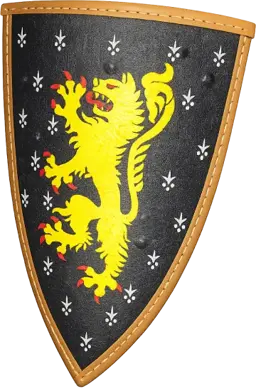
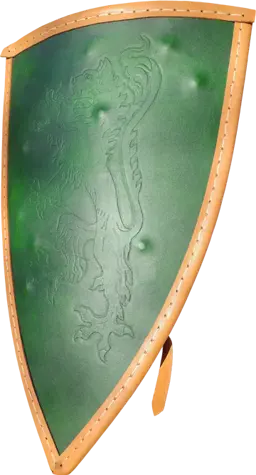
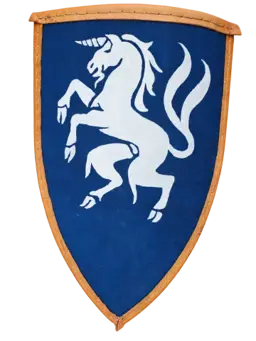
Below is a shield I would make in his arms today, drawn by the same renderer as my shield builder. The white lion with a forked tail on red follows the arms as recorded around his death, but the painting and its weathered finish are mine: the lion has no crown, and its tails are crossed but not knotted as the Wijnbergen armorial describes. The flat top, the size and the dark green linen on the back are my choices. Turn it to see the edge and the reverse, pause it, save the front or the back as an image, or open it in the builder to change it.
Heroes Collection
Přemysl Ottokar II — The Lion of Bohemia
Gules, a lion rampant queue fourchée Argent
This interactive shield is a historically informed interpretation of mine. The lion shield comes from Ottokar's two-sided seal and its silver-on-red colours from the Wijnbergen armorial; the lion's drawing, the weathered paint, the shape, construction and rear fittings are documented reconstruction choices, not recovered details of his own shield.
- ArmsEvidence
- A lion shield, as on the Bohemian face of his two-sided seal (Olomouc 1261; Graz, 21 December 1260). A silver lion on red with a forked tail, as the Wijnbergen armorial records the arms of the King of Bohemia, c.1280.
- LionReconstruction
- My painting of a rampant white lion with a forked tail, for silver, with weathered paint. Wijnbergen gives no posture; its lion is also crowned gold and its tail crossed in saltire and knotted. The painting crosses the tails but has no crown and no knot.
- FieldReconstruction
- Red for gules. The exact red of any shield of his is not recorded.
- Shape and sizeReconstruction
- Tall Flat-Top Heater, 58 × 85.4 cm, with the workshop's standard bow: a size that covers a mounted knight. The seal shows a triangular shield, broad at the top with a gently curved upper edge; the flat top and the size are my choices, since no shield of his survives and the seal cannot be measured to full size.
- CoreReconstruction
- Linden planks, 10–12 mm thick, glued edge to edge with animal glue and shaped to the curve. Medieval shields were built from glued wooden boards; linden was a shield wood of the thirteenth century (Konrad von Thüringen, Marburg).
- FrontReconstruction
- Two layers of linen glued over the face and turned round the edge onto the back, standing in for the parchment of surviving shields; gesso, paint and a beeswax finish.
- BackReconstruction
- Two layers of linen dyed dark green. A workshop colour choice: the reverse of his shield is not recorded.
- FittingsReconstruction
- Leather enarmes for the left arm (crossed forearm straps and a hand grip), a leather-covered arm pad and an adjustable guige on two riveted mounts. The seal does not show the reverse; their layout is mine.
Conclusion
Ottokar's seal shows the device and the form of the shield he chose to be seen with: a lion for Bohemia, a band for Austria. An armorial compiled around his death gives the lion's colours, its forked tail and its crown. Everything else about the shield, from its size to the drawing of the lion, has to be supplied by the maker, and said to be so.
A reconstructed shield should make the surviving evidence visible, while being equally clear about everything that history has not preserved.
Bibliography / Source Base
- Olomouc 1261. Státní okresní archiv Olomouc, Archiv města Olomouce, Listiny, inv. č. 1 (charter of 1261), with its catalogue record, used here for the damaged two-sided seal impression, its diameter, the lion and band shields and the IVVENIS REX legend, and the catalogue's dating of the seal type to 1251–1263.
- StUB IV. Urkundenbuch des Herzogtums Steiermark, vol. IV (Historische Landeskommission für Steiermark), no. 8, pp. 5–6, used here for the charter issued at Graz on 21 December 1260, its original in the Carinthian provincial archive at Klagenfurt, the editor's description of the two-sided seal and its legends, and the reference to Sava's figures. Source link.
- Sava. Karl von Sava, "Die Siegel der österreichischen Regenten", Mittheilungen der k.k. Central-Commission zur Erforschung und Erhaltung der Baudenkmale 9 (Vienna, 1864), pp. 260–262, figs. 29 and 30; collected as Die Siegel der österreichischen Regenten bis zu Kaiser Maximilian I. (Vienna, 1871), pp. 91–92. Used here for the engravings of the two faces of the seal, their legends, and Sava's comparison with the seal of Frederick II. Source link.
- Luft. Robert Luft, "Přemysl Otakar II. (Ottokar II.)", Neue Deutsche Biographie 20 (2001), pp. 697–699, used here for Ottokar's chronology and titles, his choice as "younger king" in 1247, the lion in place of the eagle in the Bohemian arms, the Peace of Vienna and his death after the Marchfeld. Source link.
- Tarján. Eszter Tarján, "Foreign Lions in England: East Central European Royal Coats of Arms in the English Court during the Reign of Edward I (1272–1307)", Annual of Medieval Studies at CEU 24 (2018), pp. 75–98, used here for the blazons of the Wijnbergen armorial (no. 1266), the Lord Marshal's Roll and Walford's Roll, the dating and reliability of those rolls, and the report of the lion on Ottokar's bracteates. Source link.
- Adam-Even and Jéquier. Paul Adam-Even and Léon Jéquier, "Un armorial français du milieu du XIIIe siècle: L'armorial Wijnbergen", Archives Héraldiques Suisses (1951–1952), the edition of the Wijnbergen armorial; cited here through Tarján, not consulted directly.