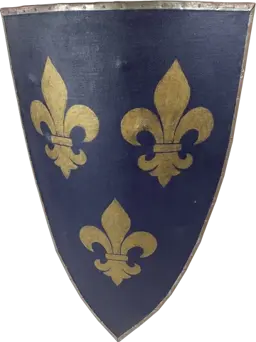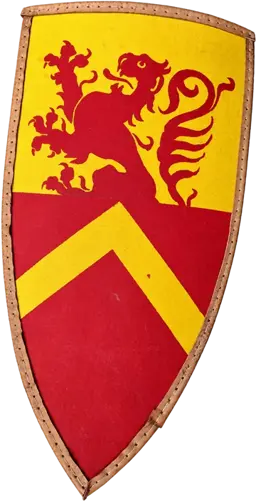
Protective Coatings, Repair, Ageing and Wear of Medieval Shields
Were medieval shields varnished, oiled or waxed, and what happened when their paint cracked, their edges broke or their straps wore out? The Seedorf, Konrad von Thüringen and Behaim shields show how hard it is to separate medieval use from centuries of later deterioration, repainting and restoration.
- Author
 Michal, shieldwright.eu
- Published
- 2026-10-17
- Updated
- 2026-10-27
- Read
- 16 min read
- Status
- Research article
A medieval shield was never intended to remain untouched.
Whether carried on campaign, used in combat, displayed in a hall or eventually preserved as a memorial, it existed in a world of changing weather, physical handling and material deterioration. Its wooden structure could absorb moisture. Its leather fittings could stretch or tear. Painted decoration could crack, flake or come away from the surface beneath it. Iron fittings could corrode, and exposed edges could be damaged.
Yet the shields displayed in museums today do not necessarily show what a shield looked like after a few years of medieval use. They show what survived.
Between the moment a shield was made and the moment it is examined today, several centuries may have passed. During that time it might have been repaired, repainted, modified, stored in unsuitable conditions or restored.
That creates a real problem for anyone reconstructing a medieval shield: how can the appearance of a shield that was used in the Middle Ages be told apart from the appearance of a medieval shield that has simply become old? Answering it means looking not only at the materials, but at how their surfaces were protected, how damage develops and what surviving objects can reliably show.
The Short Answer
There was no single protective treatment applied to every medieval shield, and surviving damage does not by itself prove medieval use.
Oils, resins, glazes and varnishes were all available to medieval craftsmen, and some surviving shields preserve complex painted surfaces with metallic decoration and organic layers. The existence of these materials does not prove that every shield received a final protective varnish.
A crack might come from an impact, or it might have opened centuries later through changes in humidity. Missing paint might reflect medieval abrasion, or it might have come away during long storage. Some repairs and repainting may date from a shield's working life; others belong to its later life as a ceremonial, memorial or museum object.
A surviving medieval shield is not simply an example of medieval craftsmanship. It is also a record of everything that happened to the object afterwards.
A Note on the Evidence
This article centres on twelfth- and thirteenth-century shields, with the early-fourteenth-century Karl von Trier shield (c.1320, the date of its painting) and the fifteenth-century Behaim shields as later comparisons. Five kinds of information are kept apart.
Why Medieval Shields Needed Protection
A medieval shield brought together materials with very different physical properties. The wooden core provided the main structure. Leather, parchment or textile could cover its faces. Mineral preparation layers gave a foundation for decoration, while pigments and metal leaf supplied colour and heraldic detail.
Each material responds differently to its environment. Wood expands and contracts as its moisture content changes. Leather and parchment are sensitive to humidity. Mineral grounds are comparatively brittle. Painted surfaces can fracture when the materials beneath them move.
The boundaries between materials are especially vulnerable. If a board moves, the ground above it may crack. If an adhesive bond weakens, a covering can separate from the core. Once part of a painted surface comes away, the areas around it become easier to lose.
Movement within a composite shield can damage the decorative layers above it. If a board joint opens, the covering and the paint over it can tear and flake away.
It is tempting to think of protection as something applied after painting. In practice the whole construction contributed to durability. A facing could cover the board joints, a suitable ground could give a consistent painting surface, and the way coverings were secured around the perimeter could affect how well the layers stayed in place. A transparent surface treatment, where one was used, was only one possible part of that system.
The materials underneath are examined in What Covered Medieval Shield Wooden Cores? and Did Medieval Shields Use Gesso?.
Were Medieval Shields Varnished?
This is one of the hardest questions to answer with confidence. Varnishes and resinous coatings were known in medieval European artistic practice, and oils and other organic materials played important roles in painting and finishing. In the early twelfth century, Theophilus describes painting doors and panels with colours ground in linseed oil and then covering them with a varnish of linseed oil cooked with resin, which he says makes every painting "beautiful and for ever durable". He does not apply it to shields. Three separate claims need to be kept apart:
- Medieval craftsmen knew how to prepare protective or decorative surface coatings.
- Such coatings could be used on painted wooden objects.
- A particular surviving shield originally received a particular coating.
The first two do not establish the third.
Transparent organic coatings are difficult to investigate after centuries of ageing. A surface that looks dark and glossy today might hold an original coating, or it might have been altered by later treatments. A shield that looks dry and matte might once have had a finish that has since disappeared. Conservators must also separate original paint and glazes from later varnishes, adhesives, consolidants and accumulated dirt. Calling a surface medieval varnish because it looks shiny would be unreliable.
A useful comparison comes from the seven Behaim shields in the Metropolitan Museum of Art. They belong principally to the fifteenth century, later than the twelfth- and thirteenth-century shields at the centre of my research. Christel Faltermeier and Rudolf Meyer documented complex painted surfaces on them: tempera painting, metal leaf, resinous glazes on two of the shields, and varnish on a third.
The same caution appears in How Was a Medieval Shield Actually Painted?, where a universal varnishing stage could not be demonstrated from the surviving shields.
Were Oil and Beeswax Used to Protect Medieval Shields?
Oils and waxes were familiar materials in medieval crafts, which makes them reasonable subjects of inquiry for wooden, leather and painted objects. But the availability of a material is not evidence of its use on a particular shield.
Drying oils form films as they cure, and oil-based painting and finishing became increasingly important in European artistic production. For shield reconstruction, the essential question is whether an oil was used as a paint binder, as an intermediate layer in the decoration, or as a final surface treatment. These uses are not interchangeable.
Even if confirmed, that would be evidence about how the paint was bound, not evidence that the finished shield was then coated in oil. Likewise, an oil used beneath metal leaf would not show that the whole shield was oiled afterwards. The pigment evidence is set out in How Were Medieval Shields Painted? Paints and Pigments.
Beeswax was also available. It can repel some surface moisture and change the appearance of certain materials. That does not establish a medieval practice of waxing painted shields.
The fact that a material was available to a medieval craftsman does not prove that it was used for every purpose that seems convenient today.
Water, Weather and the Medieval Shield
Medieval shields were carried outdoors, sometimes in difficult conditions. Rain, mud, sunlight and changing humidity were ordinary hazards. How well a particular shield resisted them depended on its construction and surface materials.
Wooden planks expand and contract with moisture. Where several boards were joined, that movement put stress on the joints, and if the joints moved beneath a stiff mineral ground, cracks could form above them. Parchment, hide and leather are particularly sensitive to moisture, and repeated changes can make them move and strain the adhesive beneath.
This helps explain why some surviving painted shields have cracks that follow structural features under the surface. It remains difficult to establish whether an individual crack formed during medieval use or much later.
Edges were especially exposed. The perimeter shows the ends of the wooden structure and the point where the coverings stop, so damage there can affect more than appearance: once a covering starts to lift, moisture and movement can drive further deterioration. Surviving shields show several approaches to finishing and reinforcing the perimeter, and no single medieval edge treatment. The evidence is set out in How Were the Edges of Medieval Shields Treated?.
How Did Medieval Shields Wear During Use?
Use could wear a shield in several ways, some gradual and some from a single impact or accident. The important distinction is between wear that is mechanically plausible and wear that is historically demonstrated.
Surface abrasion. A shield carried repeatedly against clothing, armour or equipment rubs against them, and the reverse is in contact with the arm and the carrying fittings. Over time, that contact could polish or abrade some materials. Identifying medieval abrasion on a surviving object, however, needs more than a smooth or discoloured patch: later owners, museum staff and conservators also handle surfaces.
Paint and ground. Painted areas could be scratched, chipped and lost. On a shield with a mineral preparation layer, a hard enough impact could damage both the colour and the ground beneath it. If the covering separated from the core, larger areas of decoration could eventually come away. The pattern of damage can sometimes point to the mechanism, but not necessarily to the date.
Fittings. Enarmes, guige and their attachment points carried real loads. Surviving hardware shows substantial nails, rivets and backing plates used to spread those loads, and such fittings could fail through wear, corrosion or movement in the wood. A broken strap could make a shield hard to use even when its painted front was intact. The fastenings themselves are examined in How Were Medieval Shield Handles Fixed?.
Were Damaged Medieval Shields Repaired?
It is reasonable to expect that some shields were repaired rather than discarded. A shield represented materials, specialist labour and expense. But what was practical and what the surviving evidence proves are different things.
A broken fitting could in principle be replaced, a worn strap renewed, a lifting covering reattached and damaged decoration repainted. These interventions are technically plausible. Their exact historical procedures should not be presented as fact without supporting evidence. A replacement nail is strong evidence of a medieval repair only if its date and its relationship to the surrounding materials can be established.
Repainting matters most, because it can hide earlier damage or transform a shield's appearance entirely. The Behaim shields are an unusually informative case.
Can Genuine Battle Damage Be Recognised?
Cracked paint, missing surfaces and damaged edges give a powerful impression of age and combat. Appearance alone cannot establish their cause. A missing section of decoration may come from an impact, or from adhesive failure, water damage, storage conditions or an earlier restoration. Even where an impact can be identified, whether it happened in medieval combat may be impossible to decide.
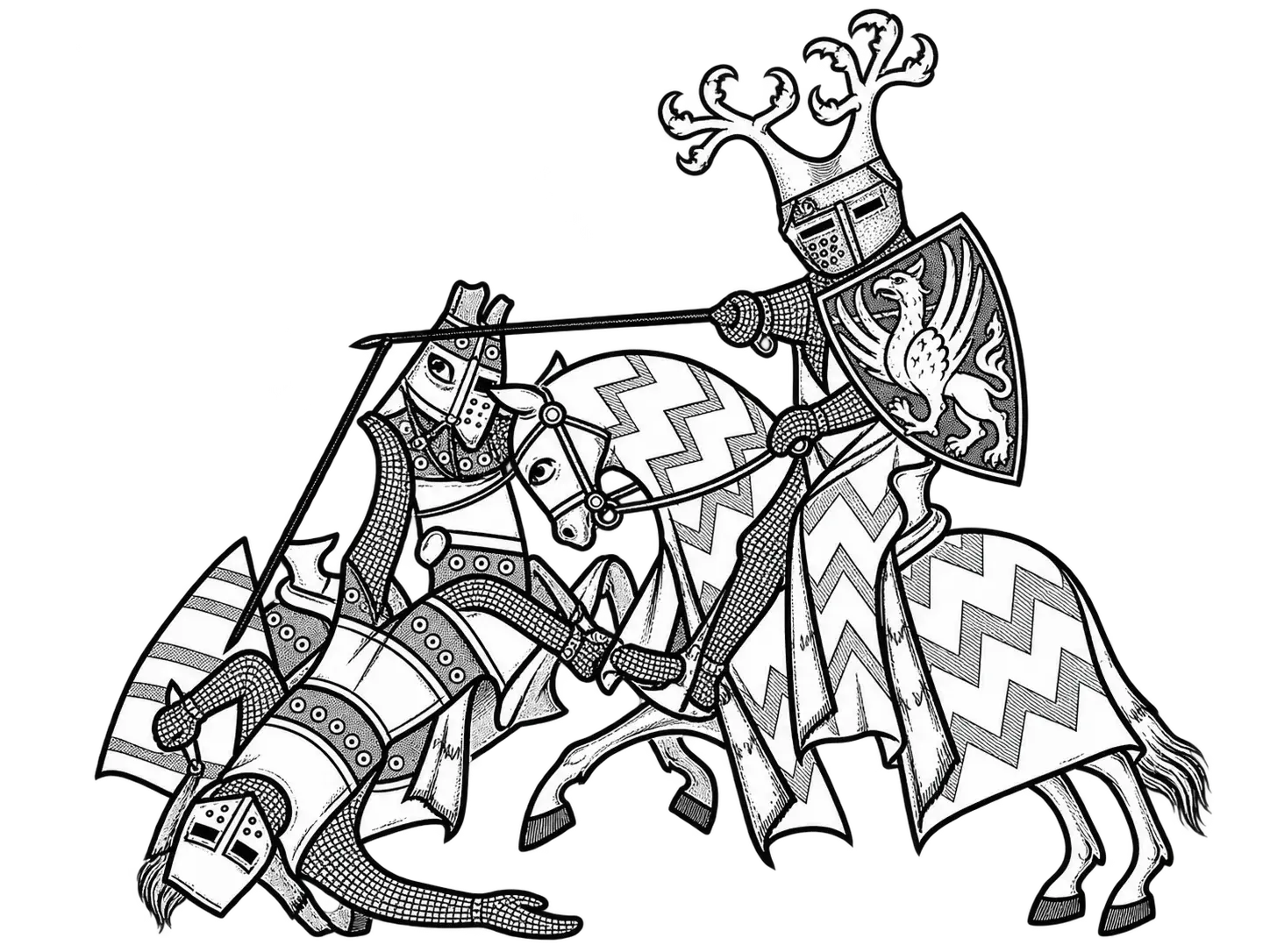
Modern representations of medieval shields often use deep scratches, dark stains, deliberately broken edges and heavy distressing to suggest authenticity. These effects can look convincing. They are not necessarily supported by the surviving evidence.
Damage from a sword, spear or axe would depend on the weapon, the angle and force of the blow, and the construction and materials of the shield. There is no single pattern that all medieval battle damage should follow. Darkening a whole shield does not reproduce how its materials actually age either: wood, parchment, pigments, metal and adhesives each deteriorate in their own way.
A shield that looks old is not necessarily a shield that looks historically used.
Ageing: What Seven Centuries Can Change
Ageing is not a single process. It is the cumulative result of physical, chemical and environmental change, and different parts of a shield deteriorate at different rates.
- Painted colours: some pigments alter chemically; others stay comparatively stable while their binders deteriorate or the surrounding materials darken. The colour seen today may differ substantially from the original.
- Metal leaf: silver tarnishes and loses much of its reflective appearance. Gold is chemically more resistant, but gold leaf can still be lost through abrasion or failure of the layers beneath it. A heraldic charge that looks dark and subdued today may once have been bright metal.
- Ground layers: mineral grounds can crack, detach or become exposed where paint has gone. Losses in the ground reveal the facing beneath, and the decay of that facing can eventually expose the wood.
- Wooden structure: wood can split, warp or open at its joints, sometimes long after the shield's period of use.
A modern photograph of a medieval shield therefore records its present condition, not necessarily its medieval appearance.
Seedorf, c.1200–1220: Reading an Aged Surface
The shield from Seedorf, traditionally associated with Arnold von Brienz and conventionally dated c.1200–1220, is one of the few surviving shields from this period and one of the most important for the study of high-medieval construction and decoration.
What is visible today is not the original blue and silver decoration preserved unchanged. It is the result of centuries of material change and of the shield's later preservation and conservation.
The Behaim Shields, 15th Century: Repainting and Historical Identity
Although later than the main period of my research, the Behaim shields are valuable because their conservation history shows how misleading a shield's visible surface can be.
Work at the Metropolitan Museum of Art revealed several layers of painting, with earlier designs hidden beneath later heraldry, identified through radiography and close examination. Helmut Nickel's study of the same shields discusses what this new evidence means for their history.
The findings show that a shield could be substantially transformed without losing its physical identity. It could go on existing as a heraldic or commemorative object long after its original purpose had ended, and its later decoration became part of its historical significance.
That creates an ethical problem for conservation. Removing later paint to reveal an earlier design can expose important evidence, but it can also destroy information about the object's later history. The Behaim study shows why conservation decisions need careful documentation and restraint.
A surviving object's present appearance must not be confused with the appearance it had when it was first made.
What Should a Historically Accurate Reconstruction Look Like?
There are several legitimate approaches:
- As newly made: the shield's probable appearance when finished, which may mean strong heraldic colours, carefully prepared surfaces and fresh materials.
- After ordinary use: plausible surface abrasion or minor wear after a hypothetical period of use. Without evidence from a specific object, those effects remain interpretation.
- As it survives: a copy of a museum object in its present condition. Its cracks, losses and darkened surfaces may belong to different periods of its history, so reproducing all of them copies the present object, not its medieval state.
In my own work I keep three things apart:
- Documented construction: materials, features or techniques supported by surviving objects and historical research.
- Historical interpretation: a plausible reconstruction built on incomplete evidence.
- Modern production decisions: choices made for durability, intended use, appearance or practical needs, which are not claimed as documented medieval practice.
Why Conservation Evidence Matters
Medieval shields survive in small numbers, and many have lost important parts of their original construction. Conservation can provide information that ordinary inspection cannot. Radiography can reveal hidden structure and earlier decoration. Microscopy can show how surface layers relate to one another. Material analysis can help distinguish pigments, grounds, metal leaf and other components.
Even sophisticated analysis has limits:
- Identifying a pigment does not necessarily identify its binder.
- Finding an organic coating does not establish when it was applied.
- Discovering a repair does not prove it happened during the shield's original period of use.
That is why a credible reconstruction has to work from specific evidence rather than from assumptions about how medieval objects ought to have been made. The Metropolitan Museum's investigation of the Behaim shields shows the value of this approach particularly clearly.
Conclusion: A Medieval Shield Was Not a Static Object
A medieval shield began its life as a constructed object. Its wooden core, coverings, adhesives, painted decoration and fittings worked together to make something that could be carried, displayed and, when required, used. From that moment, its materials began responding to their environment.
Some shields were certainly damaged. Some may have been repaired, adapted or redecorated. Others survived because they gained ceremonial, heraldic or memorial importance. The surviving objects preserve parts of those histories, but rarely a complete account.
A coating may have been decorative as well as protective. A repair might have changed the structure. Repainting might have hidden earlier heraldry. Damage visible today might have developed long after the shield stopped being used. For the maker, these uncertainties are not an obstacle to reconstruction. They are a reason to be precise about what is known.
An authentic medieval shield does not need to look seven hundred years old. It needs to reflect the materials, construction and appearance supported by the historical evidence.
Bibliography / Source Base
- Senn and Moser. Matthias Senn and Franz Moser, Der Reiterschild von Seedorf UR: ein Untersuchungs- und Restaurierungsbericht, Jahresbericht Schweizerisches Landesmuseum Zürich 100 (1991, published 1992), 80–85, used here for the Seedorf shield's originally bright blue field and silvered lion and the difference between its original and present appearance. DOI: 10.5169/seals-395364. Source link.
- Theophilus. Theophilus, De diversis artibus, book I, chapters 17 and 20–22, ed. and trans. Robert Hendrie (London, 1847), used here for the oil paint and the separate oil-resin varnish applied to painted doors and panels. Source link.
- Faltermeier and Meyer. Christel Faltermeier and Rudolf Meyer, "Appendix: Notes on the Restoration of the Behaim Shields", Metropolitan Museum Journal 30 (1995), 53–60, used here for the tempera painting and metal leaf on the Behaim shields, the resinous glazes on 25.26.2 and 25.26.5 (p. 53), the original and later varnishes on 25.26.1 (p. 54), the tentative dating of a later repainting campaign, and the multiple painted layers revealed during their conservation. Source link.
- Nickel. Helmut Nickel, "The Seven Shields of Behaim: New Evidence", Metropolitan Museum Journal 30 (1995), 29–51, used here for the dating of the Behaim shields, the earlier designs beneath their later heraldry and their history after their original use. Source link.
- Dowen et al. 2019. Keith Dowen, Lech Marek, Sławomir Słowiński, Anna Uciechowska-Gawron and Elżbieta Myśkow, Two Twelfth-Century Kite Shields from Szczecin, Poland, Arms & Armour 16, no. 2 (2019), 121–148, the principal published study of the painted Szczecin shield. The oil-or-fat binder reported for the shield could not be checked against the original conservation analysis for this article. DOI: 10.1080/17416124.2019.1667049. Source link.
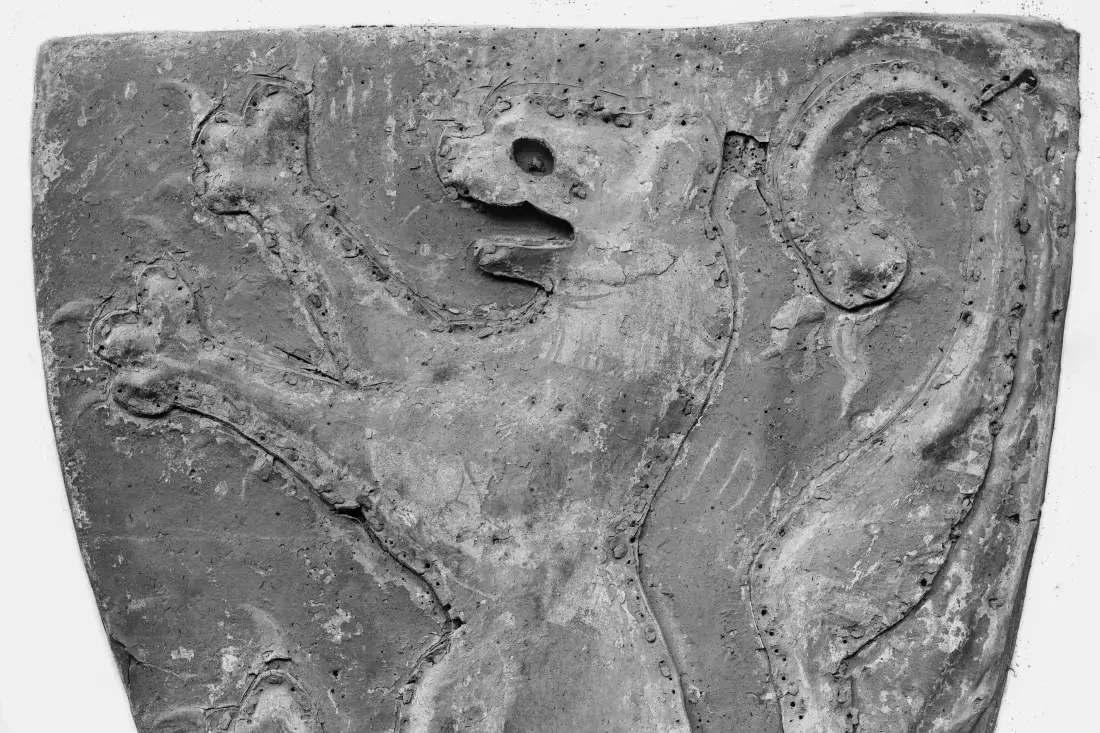
- Hefner-Alteneck. Jakob Heinrich von Hefner-Alteneck, Trachten, Kunstwerke und Geräthschaften vom frühen Mittelalter bis Ende des achtzehnten Jahrhunderts, 2nd ed., vol. II (Frankfurt am Main, 1879–89), plate 116, used here for the later re-nailing of the Konrad von Thüringen shield's lion, the resulting loss of the decoration on its back, and his restored drawing of the lion. DOI: 10.3931/e-rara-91785. Source link.
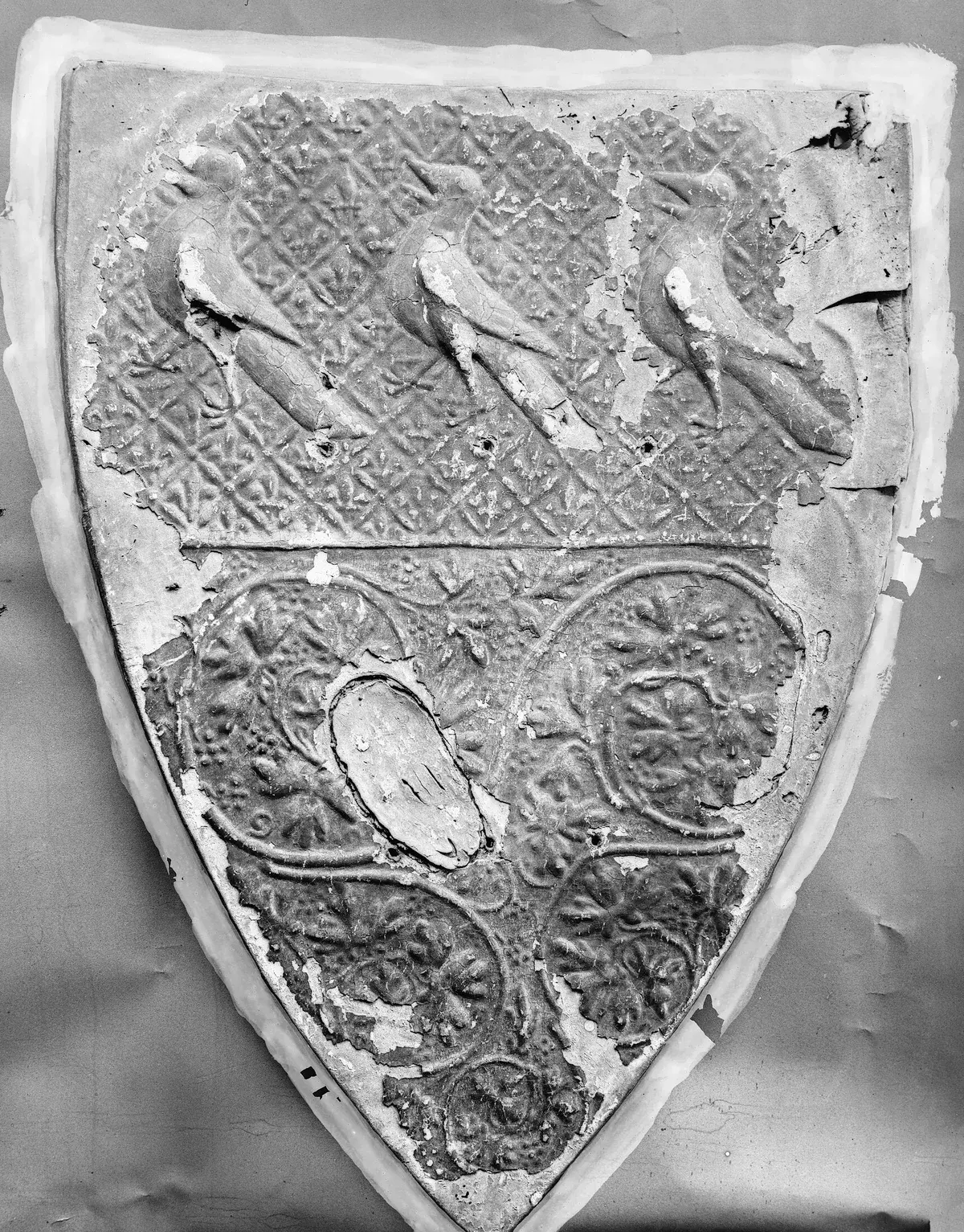
- Bildindex / Bildarchiv Foto Marburg. Institutional records for the Marburg shield group, Museum für Kunst und Kulturgeschichte der Philipps-Universität Marburg, including Schild des Landgrafen Konrad von Thüringen (inventory 3177, object record 0001336328), used here for the chalk ground of the Konrad von Thüringen shield. The hero image is a detail of Ludwig Bickell's photograph (Bildarchiv Foto Marburg fm810232, taken between 1869 and 1900, via Wikimedia Commons, public domain), cropped and converted to WebP. Source link.