Henry I the Bearded: The Shield of a Silesian Piast Duke
An early thirteenth-century seal preserves the shield emblem of Henry I the Bearded (c.1165/70–1238), one of medieval Poland's most powerful rulers: a crescent with a cross. What does the seal reveal, and how much of his shield can responsibly be reconstructed?
- Author
 Michal, shieldwright.eu
- Published
- 2026-10-31
- Updated
- 2026-11-02
- Read
- 12 min read
- Status
- Research article
In the early thirteenth century, Poland was not the unified kingdom recognised today. The territories of the Piast dynasty were divided among competing branches of the ruling family, each seeking to secure and extend its authority. One of the most successful of these rulers was Henry I the Bearded (Henryk I Brodaty), Duke of Silesia.
Like other medieval princes, Henry needed to communicate his authority not only through armed force and political agreements, but also through symbols. One of those symbols appeared on his shield.
No physical shield securely attributable to Henry I is known to survive. What survives is his seal, and the shields of his contemporaries. This article follows both, and keeps apart what each can and cannot show.
The Short Answer
A large shield bearing a crescent with a cross, hung from a broad strap over the shoulder.
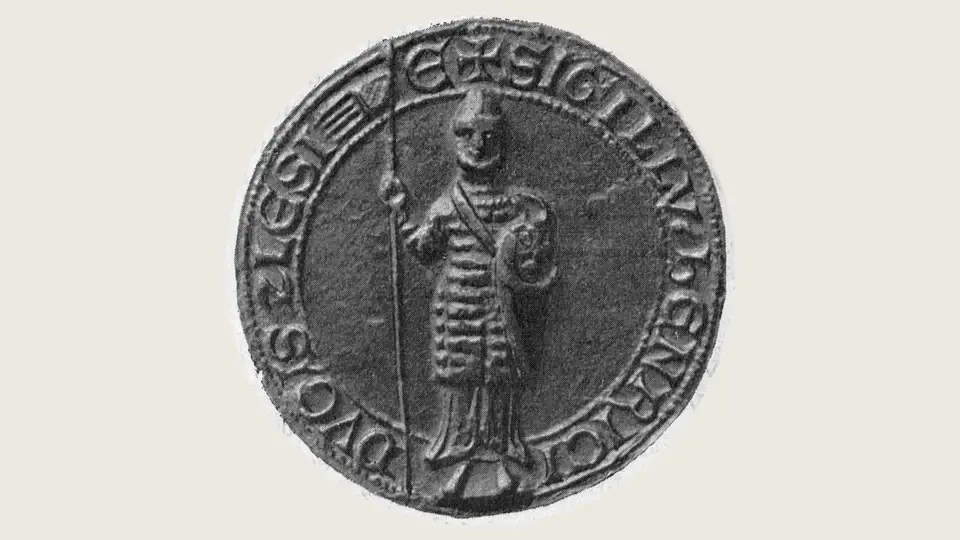
That is what Henry's standing seal shows, as described in the SFRAGIS seal catalogue, which dates its use to 1204–1238. The seal is monochrome and small, so it records the emblem and the suspension but not the colours, the size, the construction or the fittings on the reverse. Those have to be reconstructed from comparable surviving shields and documented as choices.
A Note on the Evidence
This article keeps five kinds of information apart.
A Duke in a Divided Kingdom
Born around 1165–1170, Henry inherited the rule of Silesia in 1201. Over the following decades, he expanded his political influence far beyond his original duchy. By the 1230s, his authority extended into Kraków and important territories of Greater Poland.
Henry was more than a military leader. His reign was associated with economic development, settlement, the expansion of towns and monasteries, and the strengthening of princely administration. His wife, Hedwig of Andechs, later venerated as Saint Hedwig of Silesia, became one of the most prominent religious figures associated with medieval Silesia.
Yet Henry's ambitions unfolded in a world where princely authority was constantly contested. Rival Piast rulers, territorial disputes and ecclesiastical conflicts shaped his long reign.
A Shield Preserved in Wax
No surviving wooden shield can be securely identified as belonging to Henry I. What does survive is something exceptionally valuable: contemporary seal evidence.
The legend around the edge reads + SIGILLV(M) : hENRICI DVCIS ZLESIE, "seal of Henry, duke of Silesia". Zenon Piech calls it typical of its time: a name and a title, nothing more. His son's seal, below, would name the younger Henry by his relationship to him.
This is not a modern heraldic reconstruction or an interpretation based solely on later family coats of arms. It is an emblem recorded in the medieval seal tradition associated with Henry himself.
For anyone seeking to reconstruct the shields of Poland's medieval rulers, this is an unusually strong starting point. It does not tell everything about Henry's shield, but it does show something essential about its appearance and its part in representing a prince.
The Crescent and the Cross
The combination of a crescent and a cross is striking in its simplicity. Unlike elaborate later heraldic compositions, the emblem consists of just two principal elements. Its visual strength comes from their relationship and contrast.
The crescent and cross are associated with Henry's personal and dynastic symbolism, and their appearance in his seals and documents establishes their importance. A cross could carry obvious Christian associations in medieval Europe, while crescents appeared in a variety of medieval symbolic and heraldic contexts. But general symbolism does not prove what Henry personally intended his emblem to communicate.
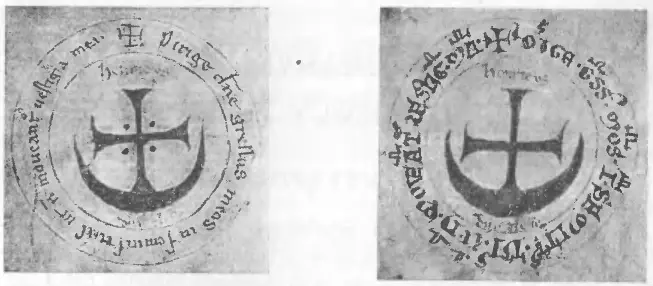
What can be said is that the emblem was recognisable enough to appear as part of Henry's princely representation. And its story did not end with him.
From the Crescent to the Silesian Eagle
One of the most interesting aspects of Henry's shield emerges when it is compared with the heraldic imagery associated with his son.
The contrast is significant. Henry I's shield presents the crescent and cross as the principal emblem. Henry II's seal sets the motif on an eagle's breast. The two seals were in use at the same time: the son had his own seal from 1224, fourteen years before his father died, so the eagle was not a change made after Henry I's death but appeared within his lifetime, on his heir's seal. This relationship is evidence for the development of Silesian Piast heraldry during the thirteenth century.
It also warns against a common reconstruction error. The familiar Lower Silesian arms, a black eagle on a gold field with a silver crescent-shaped band across its breast and wings and a silver cross rising from its middle, belong to the later established heraldic tradition. That complete composition should not automatically be transferred to Henry I's own shield.
What Shape Was Henry's Shield?
The seal shows a substantial shield suspended at the prince's side. Its appearance belongs broadly to the tradition of large shields used in the late twelfth and early thirteenth centuries, when elongated kite-shaped forms and their developments were prominent in military imagery.
However, the seal presents the shield in a small, oblique image. A seal engraver was not producing a workshop drawing. The shield was part of a carefully composed representation of princely authority, constrained by the circular field of the seal, so its proportions may be affected by artistic convention, perspective and the limited space available.
Historical drawings and reproductions of Henry I's standing seal do not always render the shield's outline identically. The surviving image is small, the shield hangs at an angle, and some of its edges are difficult to distinguish. The seal is also known from two matrices with minor differences in engraving. None of this establishes the precise shape of Henry's original shield. For reconstruction, securely identified medieval impressions should take precedence over later drawings, while the final outline must remain an informed interpretation rather than a measured historical fact.
How Might the Shield Have Been Made?
Although no shield of Henry's own is known to survive, other medieval shields show the technologies available during his lifetime. Among the most useful comparisons are the Seedorf shield, the shield preserved in Madrid's Real Armería under inventory number D 59, and the late twelfth-century shield remains from Szczecin.
| Shield | Date | Construction evidence |
|---|---|---|
| Real Armería D 59 (from Oña) | 12th century (by style) | Cedar-like wood, parchment on both faces (1898 catalogue) |
| Seedorf | c.1200–1220 | Glued alder boards, parchment on the front, prepared painted layers |
| Szczecin | Late 12th century | Thin alder planks, one shield with a painted surface |
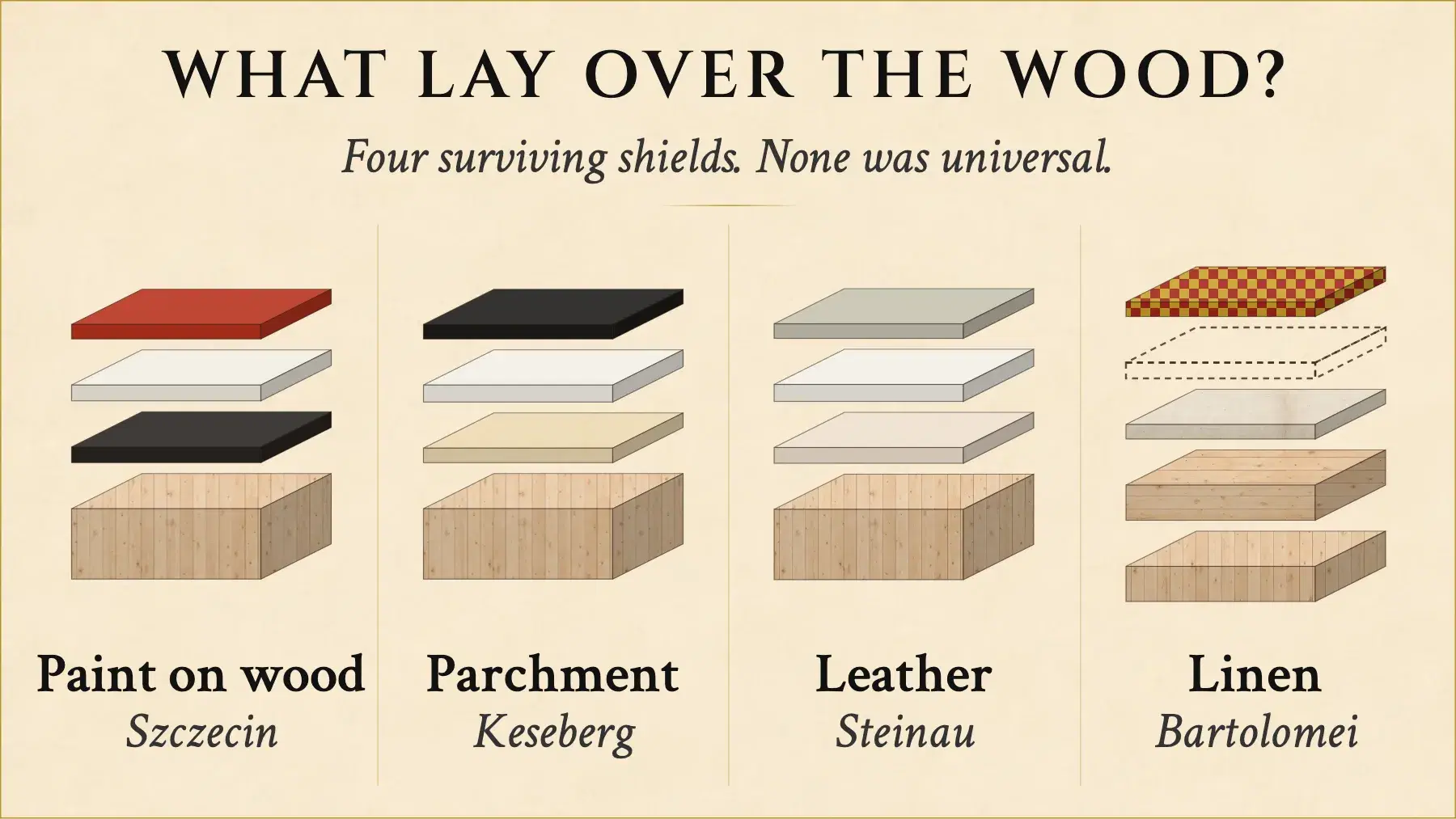
They do not all show the same things. Seedorf and the Szczecin shields are built of planks; D 59 and Seedorf carry parchment facings; painted surfaces survive on all three, recorded in very different detail. Together they show the range of construction available in Henry's time, not one method. How such boards were joined is examined in How Were Medieval Shield Planks Joined?, and the coverings in What Covered Medieval Shield Wooden Cores?.
The Strap Over Henry's Shoulder
There is another valuable detail in Henry's seal that is easy to overlook. His shield is not simply held in front of his body. It hangs from a broad strap crossing his shoulder.
A strap of this kind is called a guige, a word found in twelfth- and thirteenth-century Old French (see What Were the Parts of a Medieval Shield Actually Called?). It allowed a shield to be suspended from the body and could help with carrying or repositioning it. Its arrangement on surviving shields is examined in Rear Straps, Guige, Padding and Attachment Geometry.
What Colours Did Henry's Shield Carry?
This is perhaps the most tempting question of all. The crescent-and-cross design invites a painted reconstruction, and many combinations of contrasting colours could produce a convincing medieval shield. But the surviving seal is monochrome. It records the emblem's form, not its colours.
A blue field with a golden crescent and cross, a red field with white devices, or another visually plausible arrangement would therefore remain an artistic reconstruction. Such choices may be entirely appropriate for a modern handcrafted shield, provided they are described accurately. The painting itself is set out in How Was a Medieval Shield Actually Painted?.
A beautiful reconstruction need not pretend to possess evidence that does not exist.
Reconstructing Henry I's Shield at shieldwright.eu
For me, Henry I is a particularly rewarding reconstruction project. A contemporary depiction establishes the principal shield device and the broad shoulder suspension, and a growing body of evidence from surviving medieval shields can inform the physical construction. A responsible reconstruction brings these two kinds of evidence together without confusing them.
This approach produces more than a decorative shield inspired by medieval Poland. It makes a practical interpretation of historical evidence: a real wooden object through which the strengths and limits of present knowledge become visible.
That is one of the central purposes of historical reconstruction for me. Not to claim that every detail of the past can be recovered, but to establish what is known, investigate what is plausible, and be open about what remains uncertain.
What Is Known, and What Is Not
| Feature | Evidence | Confidence |
|---|---|---|
| Crescent-and-cross emblem | Contemporary seal imagery and scholarly catalogues | High |
| Large shield | Contemporary seal representation | High |
| Broad shoulder suspension | Visible on the seal | High |
| Original colours | No secure contemporary colour source identified | Unknown |
| Exact size and proportions | Cannot be measured reliably from the seal | Unknown |
| Wood species and construction | Inferred only from surviving period comparisons | Reconstruction |
| Rear straps and padding | Not visible on the seal | Reconstruction |
| Exact symbolic meaning | Not securely established | Uncertain |
Explore My Reconstruction of Henry I's Shield
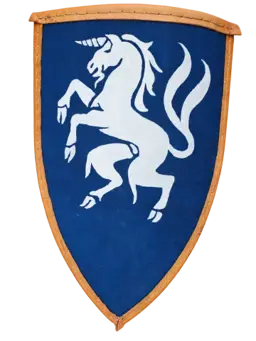
Below is the shield I would make for Henry I today, drawn by the same renderer as my shield builder. The crescent and cross follow his seal; the blue and gold are my choice, since no source records his colours. Turn it to see the edge and the reverse, pause it, save the front or the back as an image, or open it in the builder to change it.
Heroes Collection
Henry I the Bearded — The Crescent and Cross
Azure, a cross pattée rising from a crescent, Or
This interactive shield is a historically informed interpretation of mine. The crescent and cross come from Henry's seal; the colours, shape, construction and rear fittings are documented reconstruction choices, not recovered details of his own shield.
- EmblemEvidence
- A cross rising from a crescent, as on his standing seal (SFRAGIS, 1204–1238) and his personal sign in the rota of his 1208 Trzebnica privilege.
- DrawingReconstruction
- The flared (pattée) arms of the cross and the proportions of both figures are my drawing; the seal is too small and worn to fix them.
- ColoursReconstruction
- Gold on blue. No contemporary source records Henry's colours; this is an artistic choice, as the article explains.
- Shape and sizeReconstruction
- Kite Heater, 56 × 95 cm, with the workshop's standard bow. The seal shows a large shield in the long form of the early thirteenth century; its exact outline and size cannot be measured from a 60 mm seal.
- CoreReconstruction
- Linden planks, 10–12 mm thick, glued edge to edge with animal glue and shaped to the curve. Shields of his time were built from glued boards (Seedorf, Szczecin: alder); linden was a shield wood of the thirteenth century (Konrad von Thüringen, Marburg).
- FrontReconstruction
- Two layers of linen glued over the face and turned round the edge onto the back, standing in for the parchment of surviving shields; gesso, paint and a beeswax finish.
- BackReconstruction
- Two layers of undyed linen. The reverse of his shield is not shown on the seal.
- GuigeEvidence
- An adjustable shoulder strap on two riveted mounts. The seal shows the shield hanging from a broad strap over his shoulder; its mounts and buckle are mine.
- FittingsReconstruction
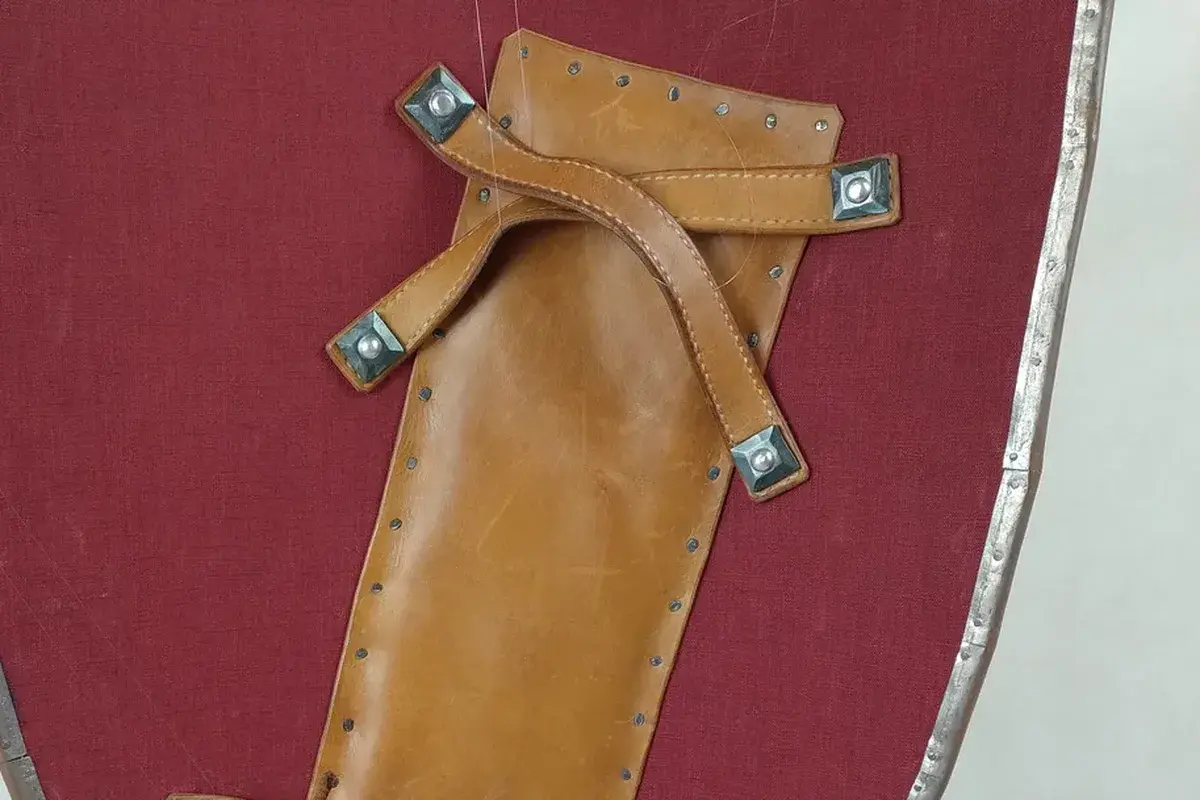
- Leather enarmes for the left arm (crossed forearm straps and a hand grip) and a leather-covered arm pad. The seal does not show the reverse; their layout is mine.
A Shield That Connects Two Generations
Henry I the Bearded died in 1238, leaving his territories and political ambitions to Henry II the Pious. Only three years later, Henry II was killed at the Battle of Legnica, one of the most consequential events in the history of medieval Silesia.
The shields associated with these two rulers preserve a visual connection between them. In the father's seal, a crescent and cross appear as the principal shield device. In the son's seal, used alongside his father's from 1224, that motif appears on an eagle. Together, these representations give a glimpse of how the heraldic identity of the Silesian Piasts was formed.
For a shield maker, Henry I's image is especially valuable because it gives something both modest and remarkable: a recognisable medieval shield emblem associated with a named ruler, preserved across eight centuries.
No shield of his is known to survive. The evidence of its emblem remains, and from that evidence a carefully documented reconstruction can begin.
Bibliography / Source Base
- SFRAGIS. SFRAGIS sigillographic catalogue, John Paul II Catholic University of Lublin, "Henryk Brodaty, książę śląski, pieczęć piesza (typ B)", used here for the standing seal's date range (1204–1238), its diameter of 60 mm, its two matrices, the armed standing figure with banner, and the shield with a crescent and cross hung from a shoulder strap. Source link.
- SFRAGIS, Henry II. SFRAGIS sigillographic catalogue, John Paul II Catholic University of Lublin, "Henryk II Pobożny, książę śląski, pieczęć piesza", used here for Henry II's standing seal in use 1224–1239, its elongated shield with an eagle bearing a crescent and small cross on its breast, and its legend naming him as the duke's son. Source link.
- Piech. Zenon Piech, Ikonografia pieczęci Piastów (Kraków, 1993), no. 39 and photograph 37 for Henry I's seal, and p. 222, no. 40 for Henry II's, used here as the specialist catalogue behind both seal descriptions.
- Ławrynowicz. Olgierd Ławrynowicz, Treści ideowe broni rycerskiej w Polsce wieków średnich, Acta Archaeologica Lodziensia 51 (Łódź, 2005), used here for the recognition of the crescent-and-cross design in the study of medieval Polish arms and heraldry.
- Wawrzonowska. Zdzisława Wawrzonowska, Uzbrojenie i ubiór rycerski Piastów śląskich od XII do XIV wieku, Acta Archaeologica Lodziensia 25 (Łódź, 1976), no. 5 and pl. II.5, used here for the military equipment and visual representations of the Silesian Piasts.
- Schlesisches Urkundenbuch. Heinrich Appelt (ed.), Schlesisches Urkundenbuch, vol. I: 971–1230 (Vienna, Cologne and Graz, 1963–1971), instalment 1: 971–1216 (1963), no. 115 (1208), used here for the two original engrossments of the Trzebnica privilege (Rep. 125 nos. 10a and 10, the original issue and a duplicate) and for the editor's commentary identifying Henry I's cross-and-crescent personal sign in the rota and linking it with the shield on his seal. Source link.
- Piech 2016. Zenon Piech, "Studia nad legendą pieczęci Piastów" (2016), pp. 205–264, at pp. 222–223 and fig. 4 (p. 257), used here for the legend of Henry I's seal, the two matrices of his seal, its impressions of 1203–1237, and Henry II's seal (impressions 1224–1240) introduced in his father's lifetime. Source link.
- Piekosiński. Franciszek Piekosiński, Pieczęcie polskie wieków średnich, part I: Doba piastowska (Kraków, 1899), p. 79, no. 90, fig. 68, used here for the photograph of the impression of Henry I's standing seal on a document of 1234, reproduced from the scan in SFRAGIS. Source link.
- Polaczkówna. Helena Polaczkówna, "Roty przywileju Henryka Brodatego dla Trzebnicy", in Księga pamiątkowa ku czci Władysława Abrahama, vol. 1 (Lwów, 1930), p. 430, used here for the reproduction of Henry I's personal sign in the rotae of his 1208 privilege for Trzebnica, via Wikimedia Commons. Source link.
- Real Armería 1898. Conde de Valencia de Don Juan, Catálogo histórico-descriptivo de la Real Armería de Madrid (Madrid, 1898), D. 59, pp. 150–151, used here for the wood, parchment covering and stylistic twelfth-century date of D 59. Source link.
- Senn and Moser. Matthias Senn and Franz Moser, Der Reiterschild von Seedorf UR: ein Untersuchungs- und Restaurierungsbericht, Jahresbericht Schweizerisches Landesmuseum Zürich 100 (1991, published 1992), 80–85, used here for the Seedorf shield's glued alder boards, parchment facing and painted layers. DOI: 10.5169/seals-395364. Source link.
- Dowen et al. 2019. Keith Dowen, Lech Marek, Sławomir Słowiński, Anna Uciechowska-Gawron and Elżbieta Myśkow, Two Twelfth-Century Kite Shields from Szczecin, Poland, Arms & Armour 16, no. 2 (2019), 121–148, used here for the plank-built Szczecin shields. DOI: 10.1080/17416124.2019.1667049. Source link.