How Were Medieval Shield Handles Fixed? Nails, Rivets and Washers on Surviving Medieval Shields
How the leather straps of medieval shields were actually fastened, traced across surviving shields from Seedorf to Steinau-Steinrück: front-entering nails, square, round and rosette washers, clenched and peened ends, and leather covers over the metal — and why there was no single medieval shield washer.
A medieval shield handle was not normally attached with a modern bolt, screw, nut or neat factory-made washer.
The surviving medieval shields show something much more interesting.
Leather hand and arm straps were commonly fixed directly through the wooden shield body using substantial iron or copper-alloy nails or rivets. On the reverse of the shield, the fastener could be secured over a small metal backing plate or washer. Sometimes the projecting end was hammered over sideways. Sometimes it was peened into a rivet. On several surviving shields the metal was then covered with leather so that a sharp nail end could not injure the user's arm.
The washers themselves were not standardised. Surviving examples include square iron plates, round washers and even decorative rosette-shaped washers. Some shields preserve seven, eight or nine original strap-fastening positions. Others have lost almost their entire carrying system, leaving only holes in the wooden core.
My study of twenty-four surviving shields, spanning the eleventh to the fourteenth centuries, therefore gives something better than a theoretical medieval recipe. It shows how real shields were actually constructed.
The Short Answer
A substantial nail or rivet passed from the front of the shield through the wooden core and the leather strap on the rear. A washer or small backing plate spread the load, after which the fastener was either clenched over or peened like a rivet.
That is the normal principle. Everything else — the shape of the washer, the metal of the nail, the way the end was finished, the number of fastening points — varied from shield to shield.
A Note on the Evidence
Strap hardware survives far better than the straps themselves. Iron and copper nails, washers and holes through the core can outlast the leather by centuries, while the leather decays, is cut away or is replaced. This article therefore separates what survives from what is reconstructed.
First, What Is a Medieval Shield "Handle"?
For most high-medieval shields, "handle" is slightly misleading. The knight was usually not holding a rigid wooden or metal handle in the way one might hold the grip of a modern riot shield.
Instead, the rear of the shield carried a system of leather straps, usually referred to as enarmes. One strap or part of the system restrained the hand, while another supported the forearm. Their exact arrangement varied. Many shields also carried a longer shoulder or neck strap, traditionally called the guige, allowing the shield to be suspended from the body.
The surviving shields make it clear that these leather components were not lightly tacked onto the rear surface. Their attachment had to withstand the weight of the shield, the movement of the arm and the forces generated when the shield was pushed, struck or abruptly moved. That required substantial fasteners passing through the wooden core.
The Basic Construction Principle
Several surviving shields preserve enough hardware to reconstruct the mechanical principle with considerable confidence.
The nail or rivet was generally inserted from the front of the shield. It passed through the decorated surface and the wooden core. On the reverse it passed through the leather strap or its attachment assembly. A washer or backing plate could then be placed over the projecting end.
The end was finally secured in one of two principal ways:
- Bent or clenched over, trapping the washer and leather against the wooden shield.
- Peened, spreading the end of the fastener to create a true riveted joint.
Both methods survive. This matters for reconstruction, because there was apparently no universal rule requiring every strap fastener to be a formally peened rivet. Some surviving shields use riveted fasteners; others use nails whose ends were simply hammered over. Jan Kohlmorgen's survey of surviving medieval equestrian shields records both systems and explicitly notes the use of square and round washers.
Seedorf, c.1200–1220: Eight Nails and Square Iron Plates
The shield traditionally associated with Arnold von Brienz at Seedorf provides one of the earliest detailed examples. Anton Denier's nineteenth-century description recorded the rear arm assembly before further deterioration and restoration changed its appearance.
He described four leather straps associated with the arm fittings. These were secured by eight substantial nails driven from the front of the shield, their visible heads described as gilded. On the reverse, the nails passed through small square iron plates, and the projecting ends were bent over rather than formed into neat rivet heads.
Around the beginning of the thirteenth century, then, there is a shield carrying substantial front-entering fasteners, square iron backing plates and clenched nail ends. The complete routing of the Seedorf straps cannot now be reconstructed with certainty, but the fastening technology itself is much better preserved in the historical record.
Vögte von Keseberg, c.1250: Copper Nails and Round Washers
The shield associated with the Vögte von Keseberg, conventionally dated around the middle of the thirteenth century, shows a different solution. Its carrying system was secured with seven fastening nails made from copper. These were riveted rather than merely bent over, and the surviving technical description specifically records round washers.
The shield also retains evidence for a leather bridge associated with the guige and another fastening strap.
On one shield there are square iron backing plates and clenched nails. On another, copper fasteners riveted over round washers.
That immediately disposes of the idea that square iron washers were the universal medieval solution. Both belong to the same shield-making tradition.
W. von Liederbach, 1250–1300: Square Washers and Leather Safety Covers
The shield associated with W. von Liederbach is particularly valuable because it preserves not only the metal fastening system but also a method used to prevent that system from injuring the bearer.
The original arrangement had nine hand-grip fastening positions. Eight rounded nail heads survive on the front, while the position of the ninth can still be identified. On the reverse, the nail ends were bent over rather than riveted, each secured with a square iron washer.
But the construction did not stop there. Small rectangular pieces of leather were incorporated into the fastening arrangement. After the metal had been secured, these leather flaps could be folded over the exposed nail end and fixed down — in effect, a protective cover. Instead of leaving the wearer's arm beside a projecting piece of hammered iron, the shield maker enclosed the fastening beneath leather.
Two stitched leather bridges associated with the guige also survive on the Liederbach shield.
The attachment system was not merely strong. Attention was also paid to the interaction between the metal fitting, the leather straps and the user's arm.
Welfenberg-Helfenberg: Rivets Peened Over Square Washers
The shield conventionally associated with Welfenberg or Helfenberg preserves another variation of the same general system. Seven fastening points are reported for the hand grips, and here the fasteners were riveted or peened over square washers.
Surviving evidence also indicates leather associated with the fasteners: rectangular leather flaps enclosed the strap terminals and covered the metal fittings. Modern observations of the shield likewise describe its rivets as peened over square washers and note the leather flaps associated with the strap terminals.
This construction is particularly revealing because it demonstrates the relationship between strap, washer and protective covering. The washer was not decorative hardware added for appearance. It was part of a mechanical joint. The metal distributed the load around the fastening point, while the leather protected both the strap assembly and the bearer's arm.
Stromberg: Seven Positions, One Surviving Washer
The Stromberg shield demonstrates what often happens to these systems over time. Originally there were seven strap-fastening positions. Today most of the hardware has disappeared. Only one strap fragment survives, together with a single nail and its associated iron washer. The other attachment points survive primarily as holes.
Absence of surviving straps or washers does not necessarily mean that a shield lacked them. Leather decays. Iron corrodes. Hardware can be deliberately removed, and shields preserved in churches were sometimes modified for display. The pattern of holes through a shield can therefore become almost as important as the surviving hardware itself.
Steinau-Steinrück, c.1300–1320: Nails Bent Over Square Iron Washers
The Steinau-Steinrück shield preserves one of the clearest fastening systems in the corpus. Seven hand-grip fastening nails survive, and an eighth position can be identified from an empty hole.
The surviving nails have rounded heads on the front. On the rear, remnants of the leather straps survive at some fastening points together with square iron washers. Most importantly, the nail ends are explicitly described as bent over rather than riveted.
That distinction matters. A modern maker might naturally assume that a historically accurate shield requires every attachment nail to be neatly peened like a conventional rivet. Steinau demonstrates otherwise. A substantial nail could simply be driven through the shield, passed through the leather and washer, and then hammered sideways over the washer to lock the whole assembly together.
It was crude only in the modern aesthetic sense. Mechanically, it worked.
The Valère Shield: Decorative Rosette Washers
Not every medieval shield washer was a plain square of iron. The shield traditionally associated with a Herr von Raron, preserved at Valère in Sion, historically retained its enarmes and provides a particularly elaborate example of fastening hardware.
Helmut Nickel's study of thirteenth-century shield fittings in the Metropolitan Museum Journal specifically notes that the rivet heads on this shield were set on rosette-shaped washers.
This is an important counterexample to the idea that historically accurate hardware must always look rough and purely utilitarian. A medieval shield could be both a weapon and a prestigious heraldic object, and its rivet heads were visible on the decorated front. There was every reason for the hardware itself occasionally to become decorative — part of the visual language of the shield rather than something hidden behind the straps.
Why Were Washers Necessary?
The reason is mechanical. A leather strap attached by a single narrow nail concentrates considerable force around a very small area. Without reinforcement, the nail can pull through the leather, enlarge its hole or damage the surrounding material.
A broader washer spreads the load. Instead of the entire force acting against the diameter of the nail shaft or a small peened head, it is distributed across a much larger area.
On the surviving Marburg shields these washers are often square pieces of metal rather than the perfectly circular objects the modern word "washer" brings to mind. It is more useful to imagine them as small backing plates with a central hole. Their function matters more than their shape.
Were Medieval Shield Washers Really Hand Forged?
This requires some caution. Calling every surviving washer "hand-forged" risks imposing a modern manufacturing category on medieval evidence.
The surviving pieces were handmade metal fittings, but a small square washer did not necessarily require a smith to forge it individually from a separate billet. A smith could work from thin wrought-iron plate: cut or shear a small piece, punch or pierce its central hole, dress its edges and adjust it with a hammer.
It is safe to say that handmade iron backing plates existed. It is not safe to say that every surviving washer was individually forged in exactly the same manner.
Square, Round or Rosette?
The surviving evidence answers this very clearly: all three existed.
- Square iron washers or backing plates occur repeatedly, including at Seedorf, Liederbach, Welfenberg-Helfenberg and Steinau-Steinrück.
- Round washers are recorded on the Keseberg shield.
- Rosette-shaped washers appear on the Valère / Raron shield.
There is no single correct medieval washer shape. If the aim is to reconstruct a specific surviving shield, its actual fastening system should be copied. If the aim is a historically plausible thirteenth-century shield without copying one individual object, a simple hand-cut square iron backing plate is one of the best-documented solutions in the surviving central European material.
Should the Nail Heads Be Visible on the Front?
Yes. This is one of the most important conclusions from the surviving evidence. The strap-fastening nails were commonly driven from the decorated front of the shield toward the rear, so their heads were visible on the shield face.
- Seedorf had substantial front-entering nails whose heads were historically described as gilded.
- Steinau-Steinrück preserves rounded heads.
- Liederbach preserves eight rounded heads on its face.
- The Valère shield combines visible rivet heads with decorative rosette washers.
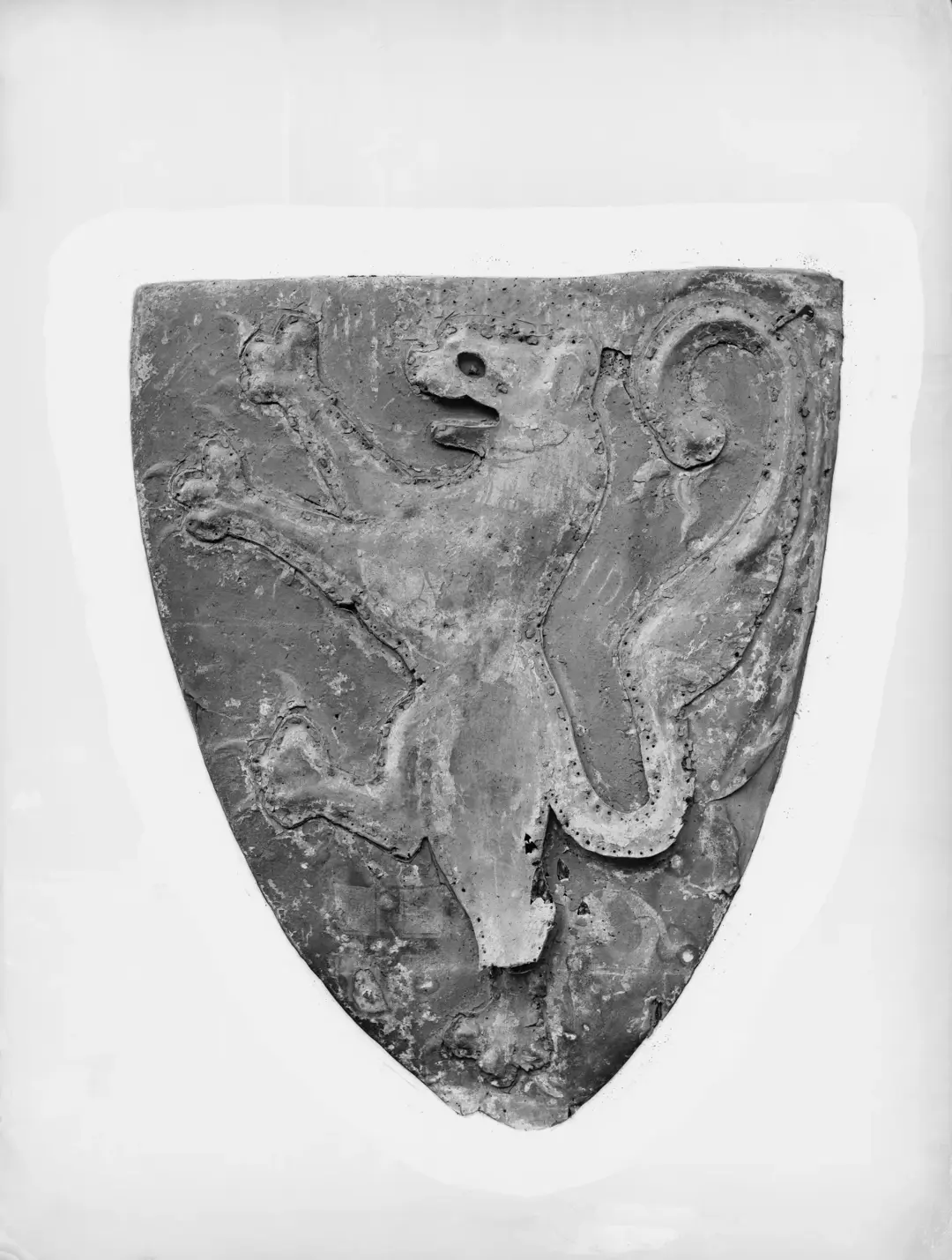
The Oña shield Real Armería D 60 also preserves three original hemispherical heads on its face, with square backing washers supporting strap remains on the reverse. Its chronology is disputed, however, and may be considerably later than the c.1200 date sometimes assigned to it, so it should not be used on its own to back-project this arrangement into the thirteenth century.
A completely clean medieval shield face with all strap hardware concealed is therefore not automatically more authentic. On many real shields, the strap attachment formed part of the visible front construction. Nickel even notes the medieval association between the visible fastening rivets and references to the "four nails" of a knight's shield.
Riveted or Clenched?
Again, both. The Keseberg and Welfenberg-Helfenberg evidence demonstrates peened or riveted fasteners. Seedorf, Liederbach and Steinau-Steinrück preserve or historically record nail ends that were bent over rather than formally riveted.
A reconstruction should not treat one method as a primitive version of the other. They were alternative solutions within the same broad technological tradition. The important sequence was:
Front nail or rivet head → wooden shield core → leather strap assembly → metal washer or backing plate → secured nail end.
How the final end was secured could vary.
The Missing Component: Leather Over the Metal
One of the most useful details preserved in the surviving shields is also one of the easiest for a modern reconstruction to omit: the metal fastener could be covered.
Liederbach preserves evidence for leather flaps folded over the secured nail ends. Welfenberg-Helfenberg preserves a related system in which leather associated with the strap terminals covered the riveted fittings. Other shield descriptions likewise indicate coverings associated with fastening points.
This makes practical sense. A bent nail or peened rivet sitting directly beside the user's hand or forearm would be uncomfortable and potentially dangerous. A small leather covering turned a mechanically effective but rough fastening into a usable piece of equipment.
The protective leather should be considered part of the historical fastening system, not merely an optional modern safety modification.
What the Surviving Shields Actually Show
Taken together, the surviving shields do not support a single standard pattern for medieval strap fittings. Instead they show a family of related solutions.
| Shield / period | Fastening evidence | Status |
|---|---|---|
| Seedorf / Arnold von Brienz, c.1200–1220 | Four straps; eight front-entering nails with gilded heads; small square iron plates; ends bent over. | Historical description (Denier 1897) |
| Vögte von Keseberg, c.1250 | Seven copper nails, riveted over round washers; leather guige bridge. | Technical description |
| W. von Liederbach, 1250–1300 | Nine positions, eight rounded heads surviving; ends bent over square iron washers; leather cover flaps; two stitched guige bridges. | Direct evidence |
| Welfenberg-Helfenberg | Seven hand-grip positions; rivets peened over square washers; leather flaps over strap terminals and fittings. | Direct evidence |
| Stromberg | Seven positions; one nail, one iron washer and one strap fragment survive. | Partial — mostly holes |
| Steinau-Steinrück, c.1300–1320 | Seven nails plus one empty hole; rounded heads; ends bent over square iron washers; strap remnants. | Direct evidence |
| Valère / Herr von Raron | Enarmes historically retained; rivet heads set on rosette-shaped washers. | Institutional study (Nickel) |
| Oña, Real Armería D 60 | Three hemispherical heads on the face; square backing washers with strap remains. | Direct evidence — disputed chronology |
- Leather hand and forearm straps were attached through the shield body.
- Substantial nails or rivets entered from the front.
- Metal backing plates or washers frequently reinforced the attachment on the reverse.
- Square iron forms are well represented; round washers also survive; decorative rosette forms existed.
- Some nail ends were simply bent over; others were properly peened.
- Copper as well as iron fasteners could be used.
- Leather covers could protect the user from the secured metal ends.
- The number and arrangement of the fasteners varied between shields.
Most importantly, the evidence warns against reconstructing missing strap geometry with too much confidence. Several surviving shields preserve the fasteners far better than the leather straps themselves.
A row of medieval nail holes is evidence. A complete modern drawing of exactly how every missing strap passed between those holes may still be reconstruction.
A Historically Defensible Reconstruction
For a twelfth- or thirteenth-century shield based on the surviving central European material, the most defensible generic fastening is surprisingly simple.
What should be avoided is making the result look too industrial. The archaeological picture is not one of zinc-plated hardware-store washers, threaded bolts and machined nuts. It is one of leather, wrought metal, hammered fasteners and simple pieces of plate made to perform a very specific mechanical job.
And because those fittings often remained visible on the front of the shield, they were part of the shield maker's work just as surely as the timber, parchment, gesso and paint.
Conclusion
The humble washer says something surprisingly important about medieval shields. They were not simply painted wooden boards with straps attached to the back. The straps were integrated mechanically into the shield itself.
Their fasteners passed through the decorated face and wooden core. Their loads were spread by metal backing pieces. Their nail ends were clenched or riveted. Their sharp ends could be enclosed beneath leather. On one shield the washer might be a rough square of iron; on another it was round; on a prestigious shield it could become a decorative rosette.
There was no universal medieval shield washer. There was a practical metalworking tradition adapting the same basic engineering principle to different shields, workshops and requirements.
For anyone reconstructing a medieval shield today, that gives a much better standard than asking whether a modern fitting "looks medieval." The actual engineering of the originals can be copied — and in several remarkable cases, the original nails, washers, leather fragments and fastening holes are still there to show exactly how it was done.
Bibliography / Source Base
- Denier. Anton Denier, 1897 study of the Seedorf shield, used here for the historical description of the four leather straps, eight front-entering gilded-head nails, square iron backing plates and bent-over nail ends.
- Kohlmorgen. Jan Kohlmorgen, Der mittelalterliche Reiterschild: Historische Entwicklung von 975 bis 1350 und Anleitung zum Bau eines kampftauglichen Schildes (2002), used here for the Marburg strap-fastening evidence (Keseberg, Liederbach, Welfenberg-Helfenberg, Stromberg, Steinau-Steinrück), the square and round washer forms, and reconstruction guidance for washer sheet thickness and edge dressing.
- Bildindex / Bildarchiv Foto Marburg. Institutional records for the Marburg shield group, Museum für Kunst und Kulturgeschichte der Philipps-Universität Marburg, including the shields of the Vögte von Keseberg, W. von Liederbach, Welfenberg/Helfenberg, Stromberg and Steinau/Steinrück. Source link.
- Nickel. Helmut Nickel, study of medieval heraldic and shield fittings in The Metropolitan Museum Journal, used here for the rosette-shaped washers on the Valère / Raron shield and the medieval association of visible fastening rivets with the "four nails" of a knight's shield.
- Musées cantonaux du Valais. History Museum of Valais records for the shield associated with a Herr von Raron at Valère, Sion, including its historically retained enarmes.
- Soler del Campo. Álvaro Soler del Campo, technical study of the Oña shields D 59 and D 60 in the Real Armería, Madrid, used here for the hemispherical nail heads, square backing washers and strap remains on D 60, and for its disputed chronology.
- Laking. Guy Francis Laking, A Record of European Armour and Arms Through Seven Centuries, vol. I (1920), used here as later comparative material.