How Were Medieval Shields Painted? Paints, Pigments and the Medieval Shield Surface
What paints and pigments were used on medieval shields? Follow surviving shields from the 11th to early 15th centuries through red paint, chalk grounds, vermilion, orpiment, blue fields, silver leaf, gilding and relief decoration.
A medieval shield was not simply a wooden object with a coat of colour brushed over it.
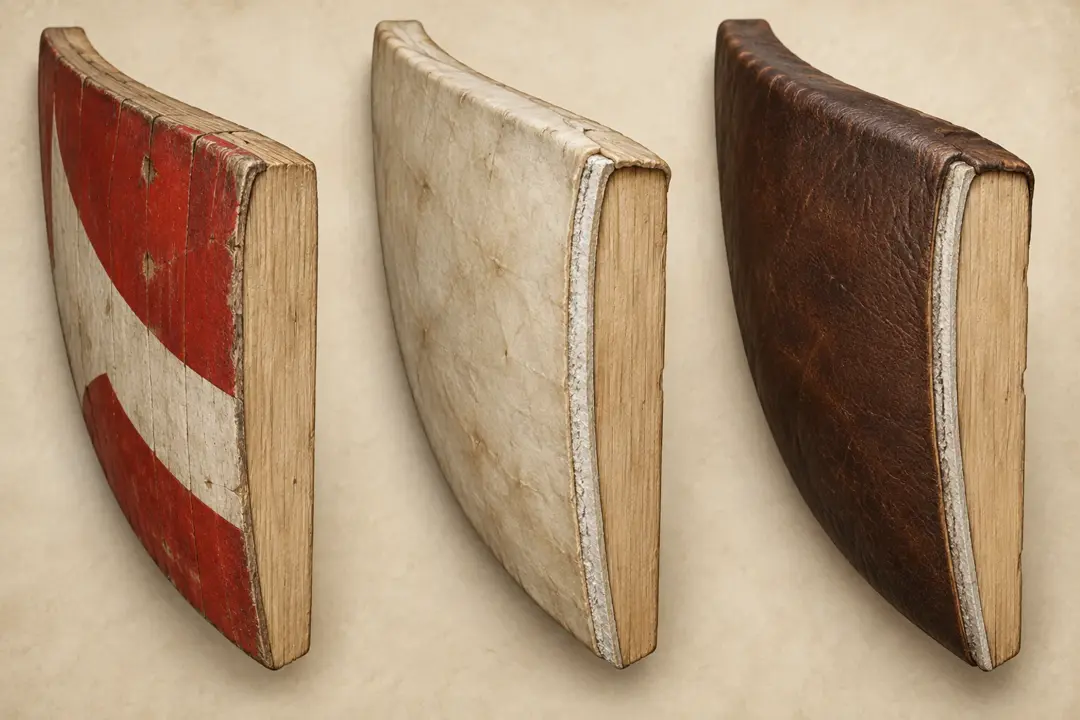
On many surviving shields, the visible heraldry was the final stage of a layered system. Wood might be covered with parchment, leather or textile. A pale mineral preparation could then create a smooth painting surface. Heraldic colours were applied above it. Silver or gold leaf could replace painted white or yellow. Relief decoration could be built up beneath or above the ground. Some shields were decorated on both faces.
Yet the surviving evidence is uneven. On some objects we can identify only a colour. On others, conservation work reveals several layers of the original surface. In a few cases, scientific analysis provides evidence for individual pigments or metallic leaf. For many shields, the exact pigment chemistry and binding medium remain unknown.
The safest way to understand medieval shield painting is therefore not to begin with a recipe. It is to begin with the surviving shields themselves.
This article follows the Shieldwright corpus chronologically from the 11th century into the early 15th century and asks four questions: what surface was being painted, whether a preparation or ground was used, what colours and decorative materials survive, and what can actually be said about the paint itself.
The result is a picture of medieval shield painting as a sophisticated but varied craft. There was no single medieval shield-painting recipe. The surviving evidence shows changing combinations of wood, skin or textile coverings, mineral grounds, coloured paint, metal leaf and relief decoration.
A Note on Evidence
Shieldwright separates direct object evidence, institutional or conservation evidence, specialist observation, historical description, reconstruction and unknown information. That distinction matters particularly for colour.
A shield that appears black today was not necessarily black when it was made. Pigments can darken or fade. Silver can tarnish almost to black. Organic layers disappear. Surfaces can be cleaned, repaired or repainted. Nineteenth-century descriptions may record details that have since been lost, but they are not chemical analyses.
A colour name is not, by itself, a pigment identification.
For that reason, names such as red, blue or yellow in this article do not automatically identify a pigment. A blue field is evidence for a blue surface. It is not, by itself, proof of azurite, ultramarine, indigo or another blue colourant.
The same caution applies to binders. Egg tempera is historically plausible in medieval painting, but it should not be assigned to a particular shield unless the evidence supports it.
11th Century: Lenzen and the Earliest Colour in the Corpus
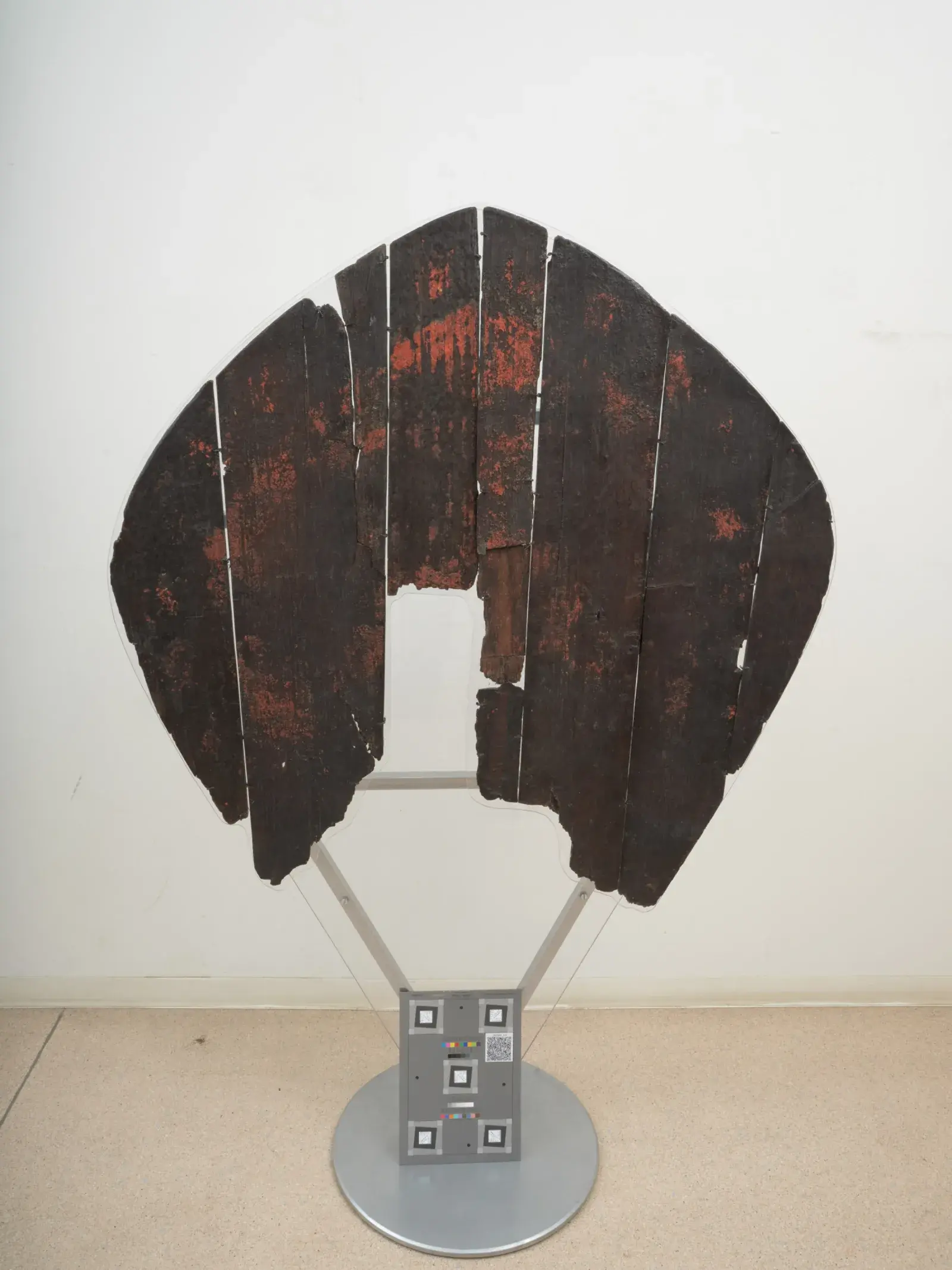
The earliest shield in the Shieldwright surviving-object corpus is the fragmentary shield from Lenzen in Brandenburg, associated with the second half of the 11th century.
Its importance to shield construction is considerable because its alder core is cross-laminated. Its importance to the history of painted shields is quieter, but still significant. Traces of red paint have been reported on the outside of the original.
That tells us that colour formed part of the shield's visible surface. What it does not tell us is equally important.
Lenzen therefore gives us an appropriate starting point. By the 11th century, a shield could carry a deliberately coloured exterior, but the surviving evidence is not sufficient to reconstruct a complete painting recipe.
The first lesson of the chronology is restraint: colour can survive even when the original painting system does not.
Late 12th Century: The Painted Szczecin Shield
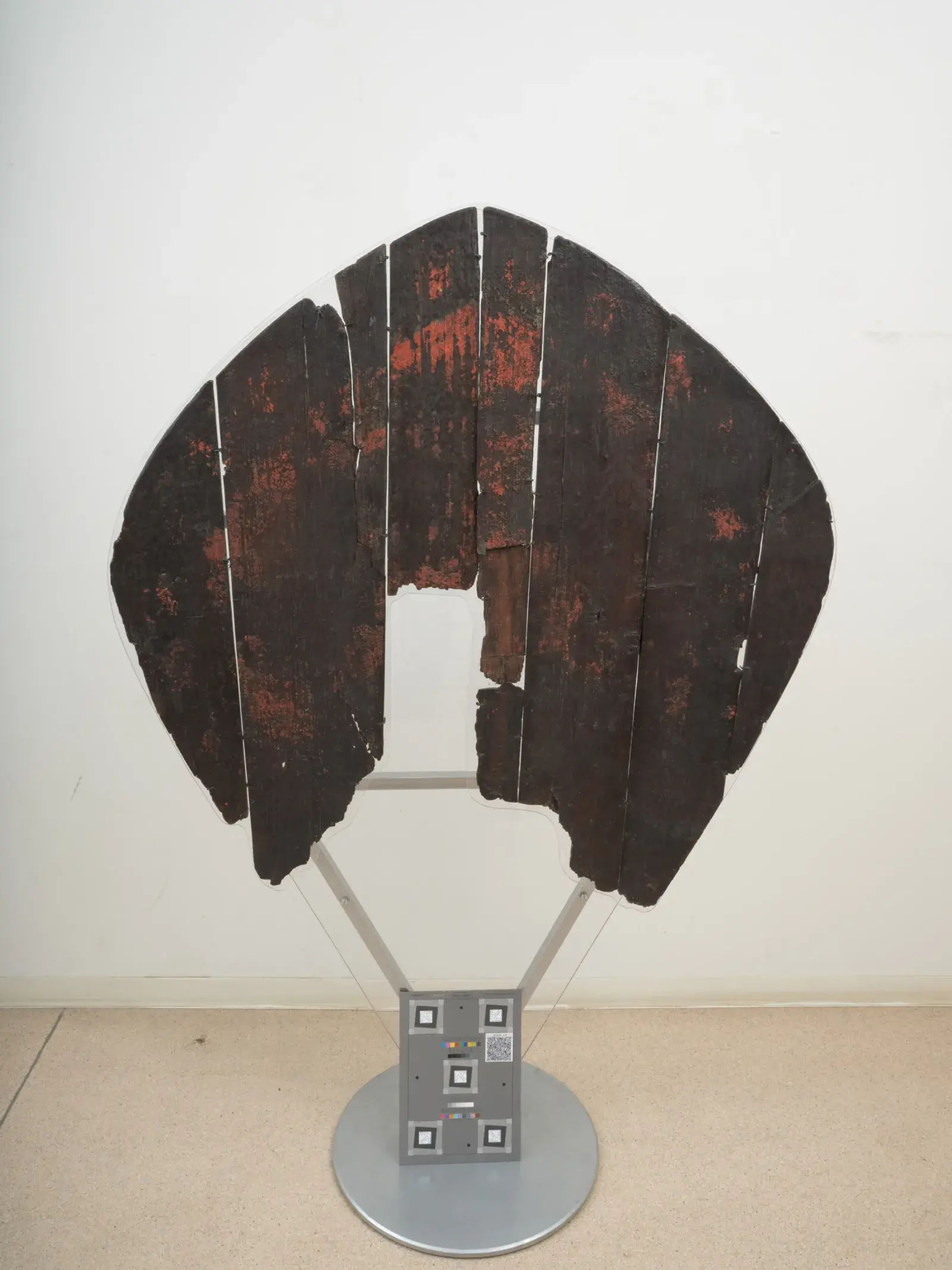
The painted shield from Szczecin, usually dated to the late 12th century, is one of the most important objects for understanding medieval shield painting because its surface has been examined as a sequence of layers.
The reported stratigraphy begins with the wooden core. Above it was recorded a black organic layer, followed by a white lime-rich preparation layer, and then the coloured decoration. Analytical work reported pigments including vermilion, hematite and orpiment in sampled areas. The binding material has been described as oil or fat.
This is unusually valuable evidence. Vermilion is a brilliant mercury sulphide red. Hematite provides an iron-oxide red. Orpiment is a strongly coloured arsenic sulphide yellow. These are not hypothetical colours selected for a modern reconstruction. They are pigments reported from the surviving shield.
The shield's decoration included a red cross-like device on a pale field, with yellow detail surviving in parts of the design.
The interpretation of the black organic layer beneath the white preparation remains important. It has been interpreted as evidence for an organic facing, possibly hide, but the exact nature of that layer should not be overstated without the complete analytical record.
What is secure is the broader sequence:
- wood → organic layer → pale mineral preparation → coloured paint
That sequence is a major step in the chronology. The colour was not simply brushed onto bare timber. The painter worked on a prepared surface.
The second Szczecin shield is conventionally described as unpainted, but that label must be treated carefully. Its present condition does not prove that it never possessed a lost facing, preparation or painted surface. The Shieldwright dossier therefore treats "unpainted" as a descriptive modern name rather than evidence for an intentional medieval bare-wood finish.
Together, the two Szczecin objects warn us against assuming either universal painting or universal bare wood.
Around 1200–1220: Seedorf, Blue and Silver
The Seedorf / Arnold von Brienz shield moves the evidence from coloured paint into a more elaborate heraldic surface.
Modern Swiss National Museum interpretation, based on examination of the object, reports that the shield's field was originally a bright blue, despite its much duller grey-green appearance today. The lion was decorated with silver leaf.
This distinction matters. Medieval heraldic "white" did not always have to be made with white paint. A metallic silver surface could perform the heraldic role of argent while producing a much more brilliant visual effect.
The shield also preserves evidence for a prepared surface associated with its parchment covering. Historical and conservation-derived descriptions support a layered preparation beneath the decoration, although the exact analytical recipe of the ground and the precise blue pigment have not been recovered in the accessible Shieldwright source chain.
The important point is therefore not to guess the blue. It is to recognise the system. A shield around the beginning of the 13th century could combine:
- wooden core → parchment facing → preparation layer → coloured field → metallic heraldic decoration
Seedorf also demonstrates why modern appearance can be deceptive. The field visible today is not a reliable colour chart for the object as it left the medieval workshop.
The shield was once considerably more brilliant.
c. 1230–1240: Konrad von Thüringen and the Shield as a Painted Object
The shield associated with Konrad von Thüringen is among the richest surviving examples in the corpus.
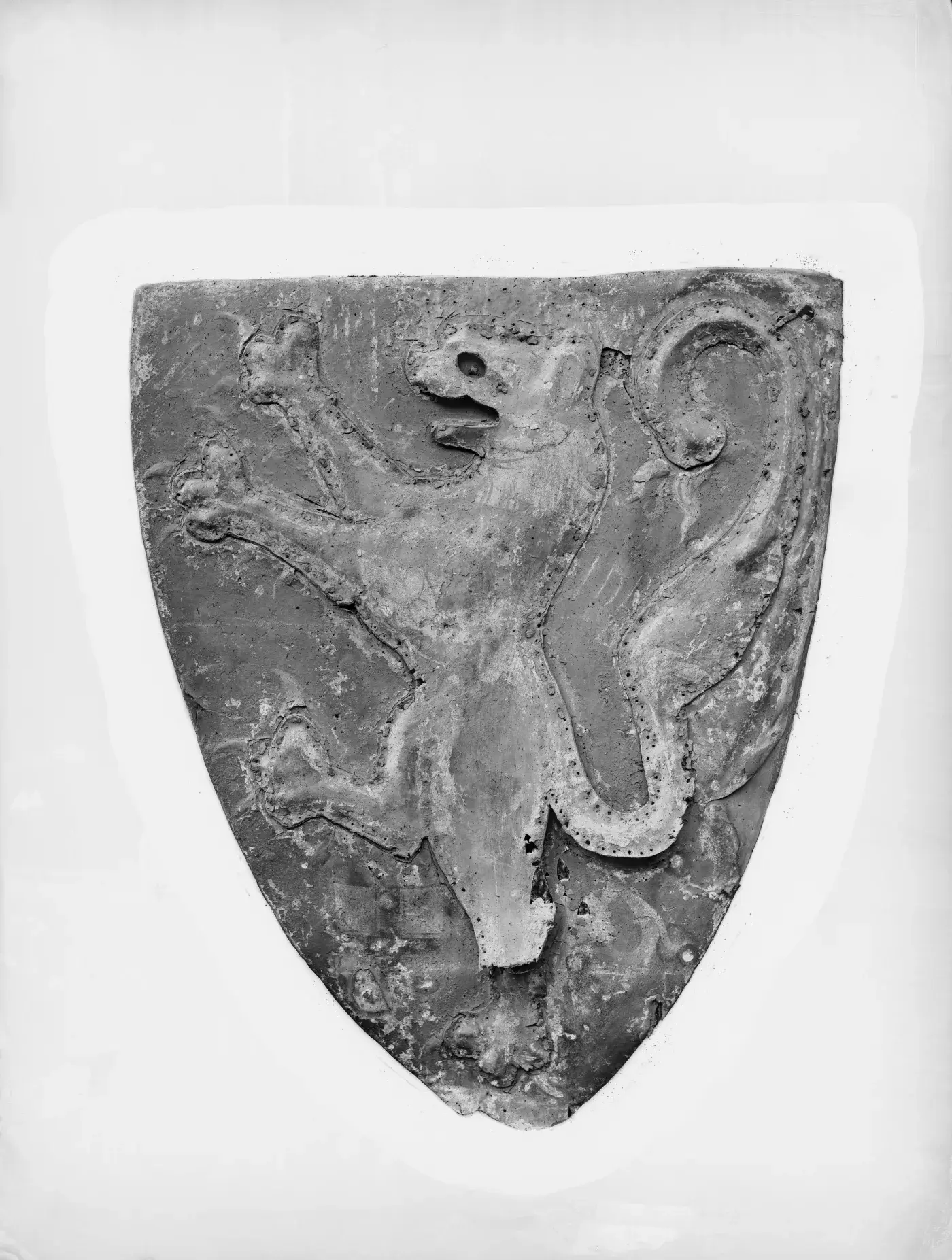
Its linden core was covered and prepared for decoration. Institutional evidence records leather, chalk ground and polychromy, while historical technical descriptions identify parchment-covered surfaces. The front carried a blue field and a large raised heraldic lion. Historical descriptions record red and silver treatment on the lion and remains of a gilded crown.
But the reverse is perhaps even more remarkable. It was described as parchment-covered, originally gilded, and decorated with a painted figural composition. Recorded details include an armoured knight, a woman in red, green tendrils and red flowers.
This is far beyond the idea of a shield as a board carrying a simple two-colour coat of arms. It was a complex decorated object.
The surviving evidence also documents the use of a chalk ground. Relief or modelled elements formed part of the decorative system. Later repairs, including long nails driven through the shield to refix the lion, damaged the reverse ground, gilding and paint.
Konrad therefore gives us several important pieces of evidence at once: a pale ground prepared the surface, strong heraldic colour was combined with metallic decoration, relief could be incorporated into the design, and the reverse could receive expensive and elaborate decoration as well as the front.
Mid-13th Century: Chalk Grounds Become a Repeated Pattern
As the 13th-century corpus expands, a repeated construction becomes visible.
The Vögte von Keseberg shield is reported with parchment on both faces, followed by chalk ground and paint. Its heraldry is described as a dark or black field with two silver animals.
The Nordeck zu Rabenau shield likewise carries a pale chalk ground. Its heraldic decoration is described as three black sea- or wood-lily leaves against the white prepared surface.
These objects are important because they show that the pale mineral preparation seen on individual earlier shields was not an isolated curiosity. Across several high-medieval shields, a skin or parchment covering and chalk-based ground formed a practical painting support.
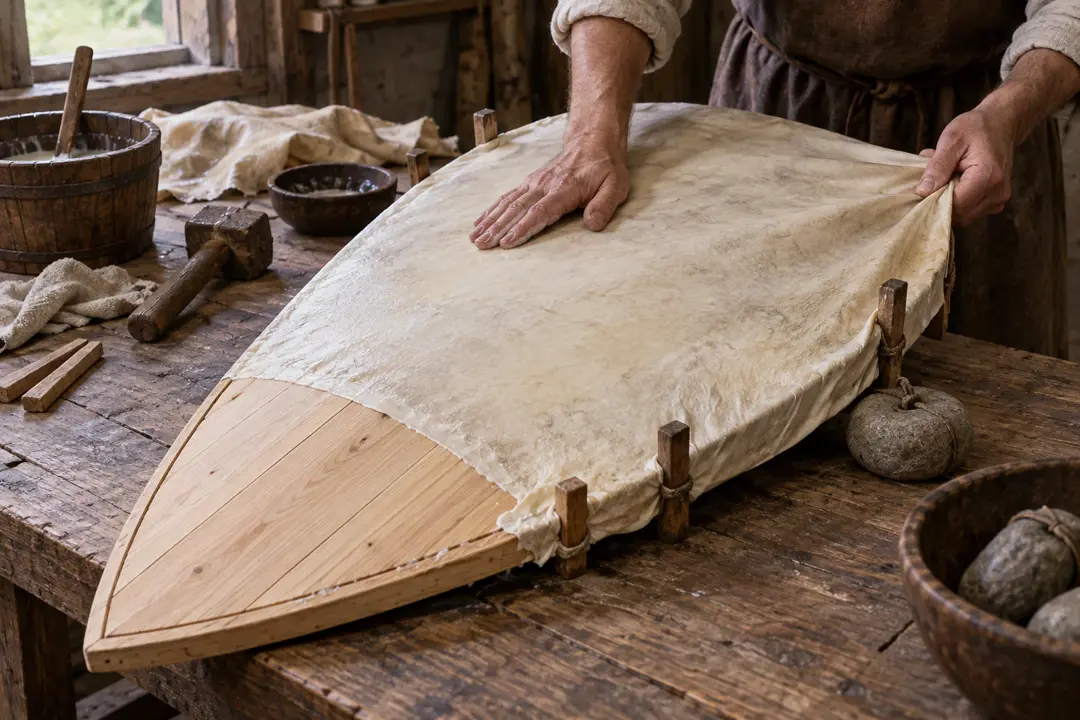
This had obvious advantages. The irregular grain and joints of a wooden core could be visually separated from the painted surface. A pale ground could create a more uniform base. Translucent or relatively weak colours could appear brighter against it. Fine heraldic edges and decorative details could be painted on a smoother surface than raw timber would provide.
Those advantages help explain the technique, but they are not evidence that every shield used it. The surviving objects show a recurring workshop solution, not a universal law.
Later 13th Century: Relief, Silver and Increasing Surface Complexity
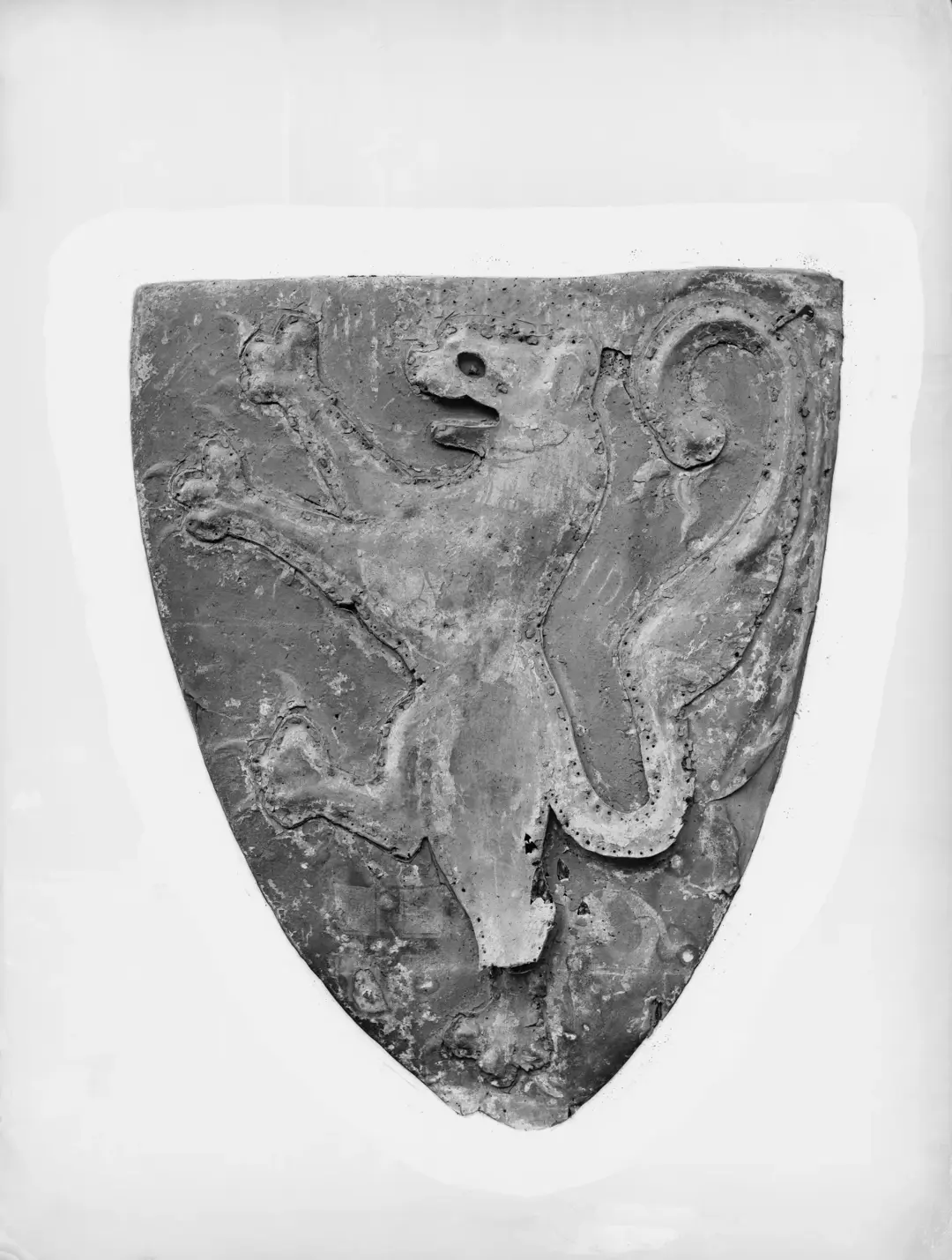
Several later 13th-century shields from the Marburg tradition show that decoration could become physically three-dimensional.
The Welfenberg / Helfenberg shield has a chalk ground with modelled or raised decoration. Its background is described as a damasked grid containing four-petalled flowers. The heraldic charge rises approximately two millimetres above the surrounding surface and is bordered by a dotted decorative band.
The Counts of Arnsberg shield likewise uses parchment and chalk ground with approximately one-and-a-half-millimetre modelled relief. Its heraldic field was painted red and included metallic decoration.
The Stromberg shield belongs to the same broad technological world. Specialist descriptions record parchment or skin covering, chalk ground, modelled decoration, silvering and paint. Some details of the exact covering material remain contradictory in the source tradition, but the existence of a deliberately built decorative surface is clear.
This changes the way we should imagine the medieval shield painter. Painting was not always the final application of flat colour. The surface could first be built, modelled or textured. Metal leaf could be incorporated. Paint then interacted with a relief surface that caught light physically.
A shield could therefore occupy a space somewhere between heraldic painting, panel painting and low-relief decorative work.
c. 1250–1300: W. von Liederbach and the Marburg Painting Tradition
The shield associated with W. von Liederbach belongs to the same broad high-medieval group.
Its surviving evidence supports a covered surface with chalk ground and painted heraldry. The accessible Shieldwright dossier does not provide a secure modern chemical identification of the pigments, binder or silvering materials.
That limitation is useful. By this stage of the chronology, we can identify a repeated technological pattern across several objects without pretending that all of them have been scientifically analysed to the same level.
Technique can sometimes be established more securely than chemistry.
We may know that parchment was grounded and painted while still not knowing whether a particular red was vermilion, red lead, an iron oxide or a mixture. We may know that an area was silvered without possessing a complete analysis of its mordant or protective coating.
The historical surface can therefore be reconstructed at different levels of confidence.
Late 13th Century: The Valère Eagle Shield
The Valère eagle shield in Sion, around c.1300, preserves an important heraldic surface, but its pigment evidence illustrates the opposite problem from Szczecin.
The object and its decoration survive, yet the accessible research did not recover a modern object-specific analysis identifying the pigments, binder, gilding materials or exact ground composition.
The correct response is not to borrow a recipe from Seedorf, Konrad or Szczecin. It is to leave the chemistry unknown.
c. 1292–1308: Heinrich I of Hesse and a Gilded, Modelled Surface
The shield associated with Heinrich I of Hesse preserves one of the most technically elaborate surfaces in the corpus.
Its front parchment carries a gilded chalk ground. Above this is a modelled heraldic animal formed using two layers of linen impregnated with chalk ground, worked into relief.
This is a striking piece of evidence. Textile was not merely a hidden reinforcement. In this case it participated directly in the decorative construction of the heraldic figure.
The surface was therefore assembled in stages:
- wood → covering → chalk ground → gilded surface → textile-and-ground relief → heraldic finishing
Again, this is closer to a complex painted and gilded artwork than to a simple piece of military equipment receiving a quick coat of colour. The exact pigment and binder chemistry remains only partly established in the accessible evidence, but the physical construction of the decorative surface is itself highly informative.
Around 1300–1320: Colour Systems Continue, Recipes Remain Elusive
The older Schenk von Schweinsberg shield is reported with parchment on both faces, chalk ground and paint. Its heraldic scheme includes blue, silver, red and silver lozenges.
The Steinau / Steinrück shield is described in historical material as having a magnificently modelled surface with a golden ground, although gold-versus-silver descriptions require care because old metallic surfaces and historical terminology can be misleading.
The Herren von Muschenheim shield likewise belongs to the parchment, chalk-ground and painted tradition, with silver-related surface evidence requiring object-specific technical confirmation.
The von Dernbach shield preserves heraldic colour information, but the exact physical execution of its tinctures remains insufficiently analysed in the accessible dossier.
These shields reinforce a pattern that has become unmistakable by the early 14th century. The painter was working within a mature decorative technology involving pale grounds, strong heraldic colour, metallic effects and, on some objects, modelled surfaces.
But there was still no reason to expect a single standardized pigment box.
Early 14th Century: Karl von Trier
The Karl von Trier shield provides a particularly vivid surviving colour scheme.
Its front is described as having a yellow ground. Against it is a white Gothic or Manesse-form shield carrying the arms of the Grand Master: a black Order cross, a gold or yellow fleur-de-lis-ended cross, and a small gold or yellow central shield with a black eagle.
The paint surface is badly damaged. The central core joint has opened, tearing the covering, and large areas of paint have flaked away, especially toward the lower part of the shield.
This damage is instructive. A medieval shield surface was a layered structure attached to a moving organic support. Wood changes with humidity. Board joints move. Skin, parchment, textile, ground and paint respond differently. When the support deforms or a seam opens, brittle preparation and paint layers can crack and detach.
The surviving condition of Karl von Trier therefore helps explain why so little original medieval shield colour remains intact.
The disappearance of paint is not evidence that shields were visually plain.
14th Century: Metallic Heraldry and the Problem of Modern Appearance
Several shields in the corpus demonstrate a recurring problem: metallic heraldry can become visually misleading with age.
Silver tarnishes. Gilding wears away. Varnishes darken. Ground becomes exposed. Later retouching can alter the balance of colours.
Seedorf's once-bright blue and silver appearance is the clearest example, but the same caution applies to the silver and gold effects described on the Marburg shields.
A modern viewer looking only at the present object can therefore underestimate the brightness of the medieval shield. A freshly completed high-status shield may have combined saturated red, blue, yellow, black and white with large areas of reflective silver or gold. In sunlight, torchlight or candlelight, such a surface would have behaved very differently from the aged, matte museum object we see today.
This is not an invitation to make reconstructions excessively bright without evidence. It is a warning not to use seven centuries of ageing as the colour standard for a newly made medieval object.
Late 13th to 14th Century Spain: Parchment, Gesso and Black Surfaces
The Spanish shields in the corpus broaden the geographical picture.
The Real Armería D 60 shield associated with Oña is described as having parchment on both faces, with a gypsum or gesso preparation and heraldic painting. Its elaborate stucco, gold and pigment decoration makes it particularly important when considering shields whose function may have included ceremonial or funerary display as well as martial associations.
Another late-13th-century shield in the Real Armería is described in the specialist literature as having a wooden core, parchment on both faces and a black painted surface. Its exact modern catalogue identity and paint stratigraphy remain unresolved in the current dossier.
These objects show that the use of prepared skin-covered surfaces was not confined to the German and Swiss material.
At the same time, they remind us that function matters. A highly elaborate memorial, ceremonial or display shield should not automatically be treated as a direct specification for a working battlefield shield.
14th to Early 15th Century: Sion and the Survival of Complex Decorative Programs
The later shields from Sion demonstrate how elaborate shield decoration continued into the late medieval period.
The Bartolomei shield preserves evidence for an earlier red-and-gold checkered scheme associated with a mounted Saint Maurice, together with later surface changes. Its research dossier deliberately separates the original decorative system from later over-covering and repainting.
The Sion Cathedral Chapter shield, MV1, has a particularly complex visible programme. Its central arms are surrounded by black foliage or damask on a yellow-green ground. An outer border uses a yellow quatrefoil or network pattern against black, enclosed by a white line. The object therefore preserves not merely heraldic tinctures but ornamental patterning around the arms.
This distinction is essential. By the early 15th century we can see highly sophisticated painted shield surfaces, but visual complexity does not automatically give us chemical certainty.
The Black Prince Shield: Colour, Gilding and the Edge of the Corpus
The shield associated with the Black Prince at Canterbury sits toward the later edge of the Shieldwright corpus.
Its surviving heraldic surface includes lions and evidence of gilding, but the exact construction of the relief decoration and the complete pigment, binder and gilding system require further technical extraction.
It is nevertheless important in the chronology because it demonstrates the continuing integration of heraldry, applied or relief decoration and precious metallic surfaces.
By this point, the long development visible in the surviving corpus has produced shields that can be read simultaneously as protective objects, heraldic identifiers, status objects, memorial objects and works of decorative craft.
What Pigments Can We Actually Identify?
The answer is narrower than a general list of pigments available to medieval painters.
For the Shieldwright corpus, the strongest object-specific pigment evidence presently comes from the painted Szczecin shield.
Other shields securely preserve or historically record red, blue, yellow, green, black and white surfaces, together with silver and gold effects. But a colour name is not the same thing as a chemical identification.
That distinction should remain visible in any reconstruction. For example, medieval painters had access to several possible blue materials. Knowing that Seedorf was blue does not establish which one was used unless the analytical evidence identifies it. Likewise, "red" can describe several entirely different pigments.
The Shieldwright approach is to reconstruct from the identified pigment where one is known, and from the historically supported colour family where chemistry remains unknown.
What Was the Paint Bound With?
This is one of the most tempting places to overstate the evidence.
Medieval painters knew several binding systems. Egg-based tempera, animal glue, oils and other organic binders all belong to the wider medieval painting tradition. But a general medieval recipe is not automatically a shield recipe.
For the painted Szczecin shield, the reported analytical interpretation points to an oil or fat binding material. For many of the other shields in the corpus, the exact binder has not been securely identified in the accessible object-specific evidence.
That means we should resist sentences such as "medieval shields were painted in egg tempera." Some may have been. The surviving Shieldwright corpus does not presently justify turning that possibility into a universal rule.
Medieval shield painters used coloured pigments within layered organic and mineral surface systems, but the precise paint binder is often one of the least securely identified parts of the surviving object.
Was Gesso Used on Medieval Shields?
Yes, but with an important qualification.
Several surviving shields provide strong evidence for pale mineral preparation layers commonly described in the literature as chalk ground, lime preparation, gypsum or gesso.
The Szczecin painted shield has a white lime-rich preparation. Seedorf preserves evidence for a prepared layer associated with its covered surface. Konrad von Thüringen has a documented chalk ground. The Keseberg, Nordeck, Welfenberg/Helfenberg, Stromberg, Arnsberg, Heinrich I and several other Marburg shields are described with chalk-ground systems. The Oña material includes gypsum/gesso preparation.
So the broad answer is clear. Prepared mineral grounds were an established part of medieval shield decoration.
"Gesso" should not be treated as one chemically identical substance in every century and region. Chalk, gypsum, lime-rich material and their organic binders must be distinguished where the evidence allows.
For reconstruction, the object being reconstructed should determine the recipe, not the modern umbrella word.
How Was a Medieval Shield Painted?
The twenty-four-shield corpus does not produce one recipe, but it does allow us to reconstruct a recurring workflow.
First came the wooden core. On many high-medieval examples, the wood was then covered with parchment, skin, leather or, in some decorative systems, textile.
A pale mineral preparation could be applied over that covering. This created a more uniform painting surface and, on some shields, provided material for relief decoration.
The heraldic field and charges were then painted. Silver or gold leaf could be incorporated where metallic heraldic tinctures or luxurious decoration were required. On elaborate shields, relief, patterned grounds, gilding and additional painted ornament could be added.
The reverse might remain simpler, but it was not necessarily ignored. Konrad von Thüringen proves that the back of a shield could itself become an elaborate painted and gilded surface.
The result was not simply painted wood. It was a composite decorated skin built over a wooden structure.
What Colours Would a New Medieval Shield Have Looked Like?
Probably much stronger than many surviving originals suggest.
Fresh vermilion can be intensely red. Orpiment can be brilliantly yellow. A properly prepared pale ground increases luminosity. Fresh silver leaf reflects light rather than appearing dark grey or black. Gold leaf remains visually powerful even in relatively small areas.
The medieval shield therefore needs to be imagined before centuries of oxidation, abrasion, dirt, flaking, restoration and fading.
This does not mean every shield was colourful or expensive. The unpainted Szczecin object warns us against that assumption, as do the many objects for which the original surface is incomplete or unknown.
But where the evidence demonstrates paint, ground and metal leaf, the original visual effect could be striking.
What the Twenty-Four Surviving Shields Tell Us
Viewed chronologically, the corpus reveals several durable patterns.
Painted shield surfaces existed by at least the 11th century within the material studied here. By the late 12th century, Szczecin provides direct evidence for a deliberately layered painting system and chemically identified pigments. Around 1200, Seedorf demonstrates the combination of prepared covering, strong colour and silver leaf.
By the early and middle 13th century, parchment or skin coverings with chalk grounds appear repeatedly in the surviving high-medieval material. The 13th-century Marburg shields show that heraldic decoration could become modelled, gilded, silvered and physically three-dimensional. Konrad von Thüringen proves that elaborate painting was not necessarily restricted to the front.
Later shields continue to combine prepared surfaces, heraldic colour, metallic decoration and ornamental patterning.
At the same time, many exact pigments and binders remain unidentified. That final point is as important as the discoveries.
The surviving shields give us enough evidence to reject the idea that medieval shields were simply rough boards painted with whatever colour was available. But they do not give us permission to invent one universal medieval paint recipe.
A Historically Responsible Reconstruction
For Shieldwright, the practical conclusion is straightforward.
This is the difference between a medieval-looking shield and an evidence-led reconstruction.
Conclusion
The surviving shields of the 11th to early 15th centuries do not reveal one medieval method of painting shields. They reveal a craft tradition.
At its simplest, that tradition could leave us only a trace of red on a wooden object. At its most elaborate, it could involve parchment, textile, chalk ground, relief work, saturated pigments, silver, gold, patterned backgrounds and painted decoration on both faces.
The late-12th-century Szczecin shield gives us some of the clearest pigment evidence: vermilion, hematite and orpiment above a pale preparation layer, with an oil- or fat-related binder reported in analysis. Seedorf shows how dramatically an aged surface can mislead us, its present grey-green appearance concealing an originally bright blue field and silver lion. Konrad von Thüringen shows the shield transformed into a richly painted, gilded and modelled object. The wider 13th- and 14th-century corpus demonstrates that parchment or skin coverings and chalk grounds were recurring technologies, while metallic and relief decoration could turn heraldry into a surface that reflected and modelled light as well as colour.
But the most important conclusion may be methodological. We should reconstruct what the evidence preserves, not what we expect a medieval shield to have been.
Sometimes that evidence gives us the pigment. Sometimes it gives us only the colour. Sometimes it gives us the ground but not the binder. And sometimes the historically correct answer is simply that the original surface is no longer known.
That uncertainty is not a weakness in reconstruction. It is part of reconstructing the past responsibly.
Bibliography / Source Base
- Archäologisches Landesmuseum Brandenburg. Institutional material and finds documentation on the 11th-century Lenzen shield fragment and its reported red paint traces.
- Kennecke. Heike Kennecke, Burg Lenzen: Eine frühgeschichtliche Befestigung am westlichen Rand der slawischen Welt, Materialien zur Archäologie in Brandenburg 9 (2015), 91–92, fig. 63.
- Muzeum Narodowe w Szczecinie. National Museum in Szczecin, catalogue record for the painted wooden shield MNS/A/22250/1, dated c.1176–1200. Source link.
- Dowen et al. 2019. Keith Dowen, Lech Marek, Sławomir Słowiński, Anna Uciechowska-Gawron and Elżbieta Myśkow, Two Twelfth-Century Kite Shields from Szczecin, Poland, Arms & Armour 16, no. 2 (2019), 121–148, used here for the reported stratigraphy, vermilion/hematite/orpiment pigment identifications and oil-or-fat binder interpretation. DOI: 10.1080/17416124.2019.1667049. Source link.
- Jagielska. Irena Jagielska, Badania i konserwacja drewnianej tarczy ze szczecińskiego Podzamcza, Materiały Zachodniopomorskie, new series VI/VII (2009/2010), 285–298, used here for the black organic layer and white preparation interpretation.
- Senn and Moser. Matthias Senn and Franz Moser, Der Reiterschild von Seedorf UR: ein Untersuchungs- und Restaurierungsbericht, Jahresbericht Schweizerisches Landesmuseum Zürich 100 (1991, published 1992), 80–85, the key technical source for the shield's originally bright blue field and silvered lion. DOI: 10.5169/seals-395364. Source link.
- Bildindex / Bildarchiv Foto Marburg. Institutional records for the Marburg shield group, including Schild des Landgrafen Konrad von Thüringen, Museum für Kunst und Kulturgeschichte der Philipps-Universität Marburg, inventory 3177, object record 0001336328, and related shields (Vögte von Keseberg, W. von Liederbach, Counts of Arnsberg, Nordeck zu Rabenau, Welfenberg/Helfenberg, Stromberg, Steinau/Steinrück, Heinrich I of Hesse, the Schenk von Schweinsberg shields, Karl von Trier and Muschenheim). Source link.
- Kohlmorgen. Jan Kohlmorgen, Der mittelalterliche Reiterschild: Historische Entwicklung von 975 bis 1350 und Anleitung zum Bau eines kampftauglichen Schildes (2002), used here as technical secondary literature for the Marburg group ground, gilding, silvering and modelled-relief evidence.
- Warnecke. Friedrich Warnecke, Die mittelalterlichen heraldischen Kampfschilde in der St. Elisabeth-Kirche zu Marburg (Berlin, 1884), used here only as older source-chain evidence for Marburg technical descriptions, not as unchecked modern conservation proof.
- Nickel. Helmut Nickel, Der mittelalterliche Reiterschild des Abendlandes, FU Berlin dissertation 1958 / Der Herold offprint 1959/60, cited as broader historiography unless direct wording is available for a specific technical claim.
- Soler del Campo. Álvaro Soler del Campo, technical and historical study of the Oña shields in the Real Armería, Madrid, including the D 60 parchment, gypsum/gesso preparation, gilding and pigment decoration, and the related black-painted Real Armería shield.
- Musées cantonaux du Valais. History Museum of Valais records and catalogue research for the Valère eagle shield MV172, the Bartolomei shield MV4 and the Sion Cathedral Chapter shield MV1, including the surviving decorative programmes and later re-covering evidence.
- Laking. Guy Francis Laking, A Record of European Armour and Arms Through Seven Centuries, vol. I (1920), used here for historical technical description of the Valère eagle shield and the Black Prince's funerary shield.
- Canterbury Cathedral / Royal Armouries. Canterbury historical and archaeological material and Royal Armouries research references for the Black Prince shield at Canterbury Cathedral, including the lion heraldry, gilding evidence and composite surface construction.
- Metropolitan Museum of Art. Technical publication on medieval shield construction and decoration, used here as comparative evidence for skin-covered wooden shields, gesso, tempera, metallic decoration and later restoration on shields outside the core Shieldwright dossier group; treated as comparison rather than transferred directly to the 12th- or 13th-century material.