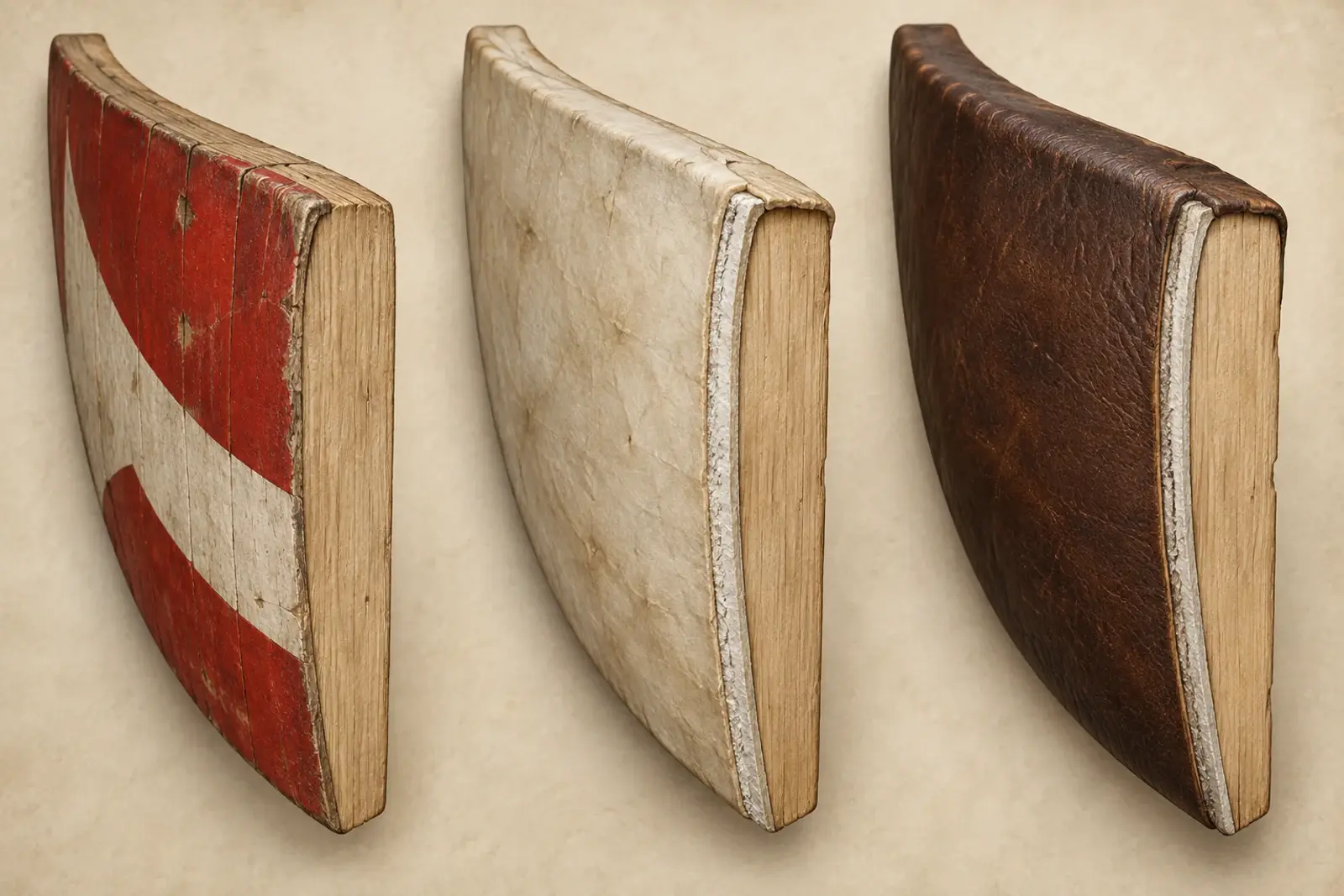
How Were the Edges of Medieval Shields Treated?
A chronological study of shield-edge and perimeter construction across the surviving corpus, from the woven organic reinforcement at Lenzen to the mitred and nailed parchment turnover at Welfenberg-Helfenberg — and why "rim" may be the wrong way to picture the medieval shield edge.
The edge of a medieval shield seems, at first, like a simple construction problem. A shield made from wooden boards is vulnerable around its perimeter: the ends of the boards can split, blows can damage exposed wood, and whatever covers the faces of the shield must terminate somewhere.
For a modern maker, the obvious solution can seem to be a rim: leather, rawhide, metal, or some other material wrapped around the edge. But the surviving medieval shields tell a considerably more complicated story.
A study of surviving shields from the eleventh through fourteenth centuries does not reveal one standard medieval shield rim. Instead, it reveals several different approaches. Some shields had substantial organic material around their perimeter. On others, the covering of the shield face itself was carried around the wooden edge, sometimes secured mechanically. On many surviving shields, the exact perimeter construction remains unknown.
Most importantly, the surviving high-medieval evidence does not support treating a thick leather, rawhide, or metal rim as a universal feature of the medieval shield. To understand why, the surviving evidence needs to be followed chronologically.
A Note on the Evidence
The surviving high-medieval evidence does not support treating a thick leather, rawhide, or metal rim as a universal feature of the medieval shield.
The perimeter is one of the most easily over-reconstructed parts of a medieval shield, so this article separates several kinds of evidence with particular care. A surviving turnover documented by conservation, a historical catalogue description, a plausible reconstruction and an open unknown are not the same kind of claim, even when they describe the same word: rim.
Lenzen: An Organic Perimeter in the Eleventh Century
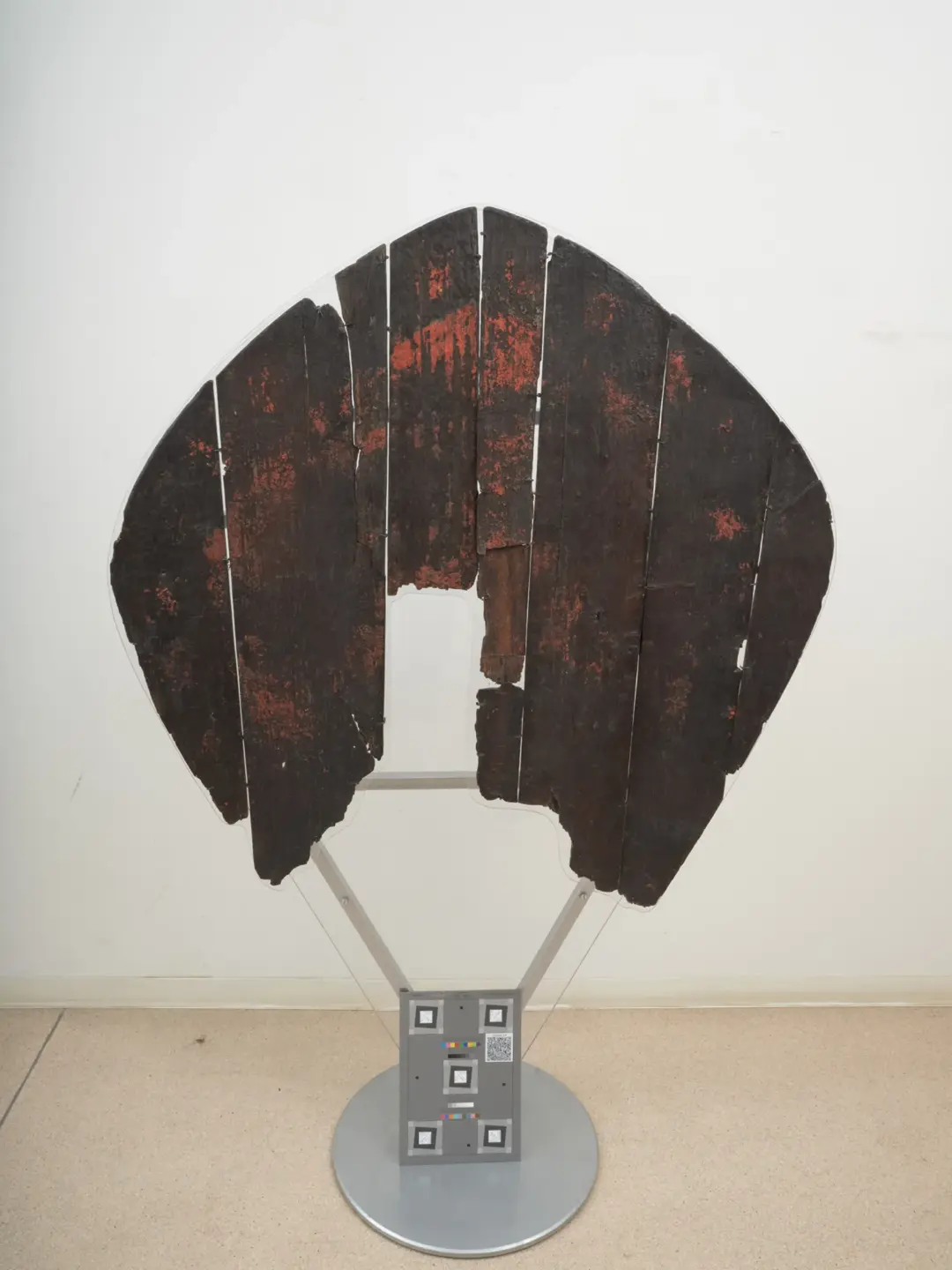
One of the most unusual pieces of evidence comes from the shield remains discovered at Lenzen, generally dated to the second half of the eleventh century. The shield was constructed from alder and survives only incompletely, but its perimeter is particularly important.
Around the edge was a woven organic structure approximately 10 cm wide. The exact botanical identification remains uncertain: different interpretations of the material have included bast, grasses, and possibly bark-derived material. The important fact is therefore not the precise plant species, which remains disputed, but the construction itself.
The Lenzen shield demonstrates directly that an early medieval shield perimeter could be treated with a substantial woven organic reinforcement. This is very different from the familiar modern reconstruction of a strip of leather folded neatly over the edge.
There was more than one medieval solution to protecting a wooden shield perimeter.
The Lenzen material should not be transformed into a universal eleventh-century construction method. It is one surviving object. But it proves that medieval shieldmakers could employ complex organic perimeter structures that would rarely survive archaeologically. That makes Lenzen one of the most important shields in this evidence trail.
Szczecin: What We Do Not Know Matters Too
The late-twelfth-century shield finds from Szczecin provide an equally useful lesson, although for almost the opposite reason. The unpainted kite shield from Szczecin, dating broadly to the late twelfth century, preserves an alder core constructed from two planks.
It is tempting to use the surviving object to answer the edge question. A dossier review, however, found no secure object-specific evidence establishing a leather binding, rawhide rim, metal edge, nailed strip, or other perimeter reinforcement for this particular shield.
This distinction matters because leather and rawhide occur in discussions of the Szczecin material more generally. That does not permit evidence associated with another object, or with the wider publication as a whole, to be transferred automatically to this shield.
Historical reconstruction becomes unreliable when "not preserved" or "not reported" is silently changed into "probably rawhide."
The Twelfth Century Does Not Give Us a Standard Rim
Taken together, Lenzen and Szczecin already undermine the idea of a single medieval edge treatment. Lenzen provides positive evidence for an organic perimeter structure. Szczecin does not currently provide sufficient object-specific evidence to reconstruct one confidently.
The responsible conclusion is therefore not that eleventh- and twelfth-century shields had a particular standard rim. It is that multiple construction traditions probably existed, while preservation heavily favours wood and metal over organic edge treatments.
This preservation problem follows into the thirteenth century. Fortunately, several later shields preserve their coverings well enough to show something extremely important: the "rim" was not necessarily a separate component at all.
Seedorf: The Covering Becomes the Edge
The shield traditionally associated with Arnold von Brienz at Seedorf, generally placed around the late twelfth to early thirteenth century, provides some of the most valuable evidence in the entire group. The shield is covered with parchment.
Conservation-derived descriptions indicate that a single piece of parchment covers the front and is carried tightly but irregularly around both side edges and around the upper edge. A second piece of parchment occupies the remaining central area of the rear.
This is enormously important for reconstructing medieval shield edges. There is no need here to imagine a separate thick rim protecting the wooden core. The front covering itself wraps around the perimeter. The edge therefore forms part of the overall composite construction:
- Wooden core → covering → turnover around edge → rear termination.
- Rather than: wooden core → front covering → separate protective rim.
The Seedorf evidence is even more valuable because the upper edge has been involved in a long-running debate about the shield's original shape. Older scholarship proposed that the shield had once been a longer "Norman" or kite shield and was subsequently cut down. Later conservation-derived evidence challenges this interpretation.
The present upper edge reportedly displays the same manner of parchment working and attachment as the side edges. Neither the parchment nor the associated painted surface reportedly shows the disruption that would be expected if a substantial upper section had been sawn away and the covering subsequently rearranged.
Whatever conclusion is ultimately drawn about the shield's complete history, the perimeter evidence itself is significant. Seedorf gives direct support for covering turnover as an edge-treatment system. It does not provide evidence for a separate rawhide rim.
Nordeck zu Rabenau: Another Turned Edge
The shield associated with Nordeck zu Rabenau provides another useful piece of evidence. Its covering has been described as parchment or leather, and surviving material at the left edge appears to turn around the perimeter.
Unfortunately, the preservation does not allow the entire edge system to be reconstructed confidently. There is evidence for turnover at one part of the perimeter, but not enough evidence to claim that the exact same arrangement continued around every edge.
This is an important distinction. It would be easy to reconstruct the missing perimeter by symmetry. Archaeologically, however, that would convert a plausible reconstruction into supposed fact.
Even this limited evidence reinforces what Seedorf suggests. The shield facing itself could serve as part of the edge treatment.
Heinrich's Lion Shield at Marburg: An Important Unknown
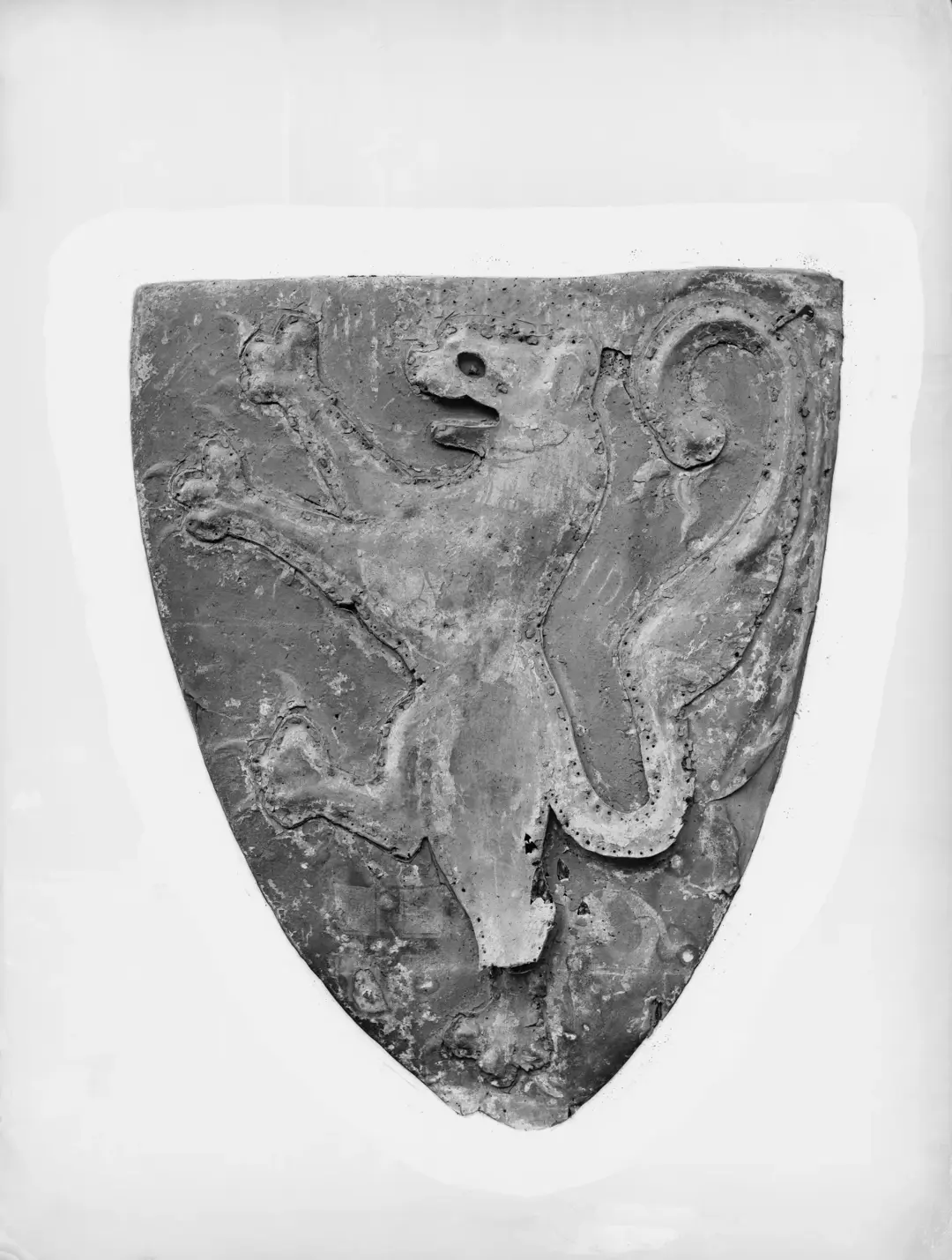
The so-called Heinrich lion shield at Marburg preserves another valuable high-medieval composite construction. Its wooden core consists of several linden boards, and the shield carries parchment covering and painted heraldic decoration.
But despite the survival of the covering, research has not yet established the exact geometry of its termination at the perimeter. Did the parchment stop at the edge? Did it turn onto the rear? How far? Was it secured mechanically? Was another material added over it? At present these questions remain unresolved.
That makes the Marburg shield useful precisely because it prevents generalising too quickly from Seedorf. Parchment-covered shields existed. Parchment turnover around the perimeter existed. But it cannot therefore be assumed that every parchment-covered shield used exactly the same edge construction.
Konrad von Thüringen: Covering Turnover Without a Separate Rim
The shield associated with Konrad von Thüringen, also preserved at Marburg, strengthens the evidence considerably. Here research recovered evidence that the parchment covering turns around the perimeter, including the left and upper edges.
The precise construction still has uncertainties, but one conclusion is particularly important: no separate nailed leather or rawhide edge binding has been established.
Again, the shield does not require a separate rim to be invented. The surviving covering itself provides the documented perimeter treatment.
By this point in the chronological evidence trail, a pattern begins to emerge. Several high-medieval shields show or suggest front covering → around wooden edge → onto rear, rather than front covering → wooden edge → separate leather/rawhide rim. That difference has major consequences for reconstruction.
Welfenberg-Helfenberg: The Clearest Construction Evidence
The Welfenberg-Helfenberg shield provides perhaps the most technically useful evidence of all. Its front is covered in parchment, and here the perimeter treatment is unusually well documented.
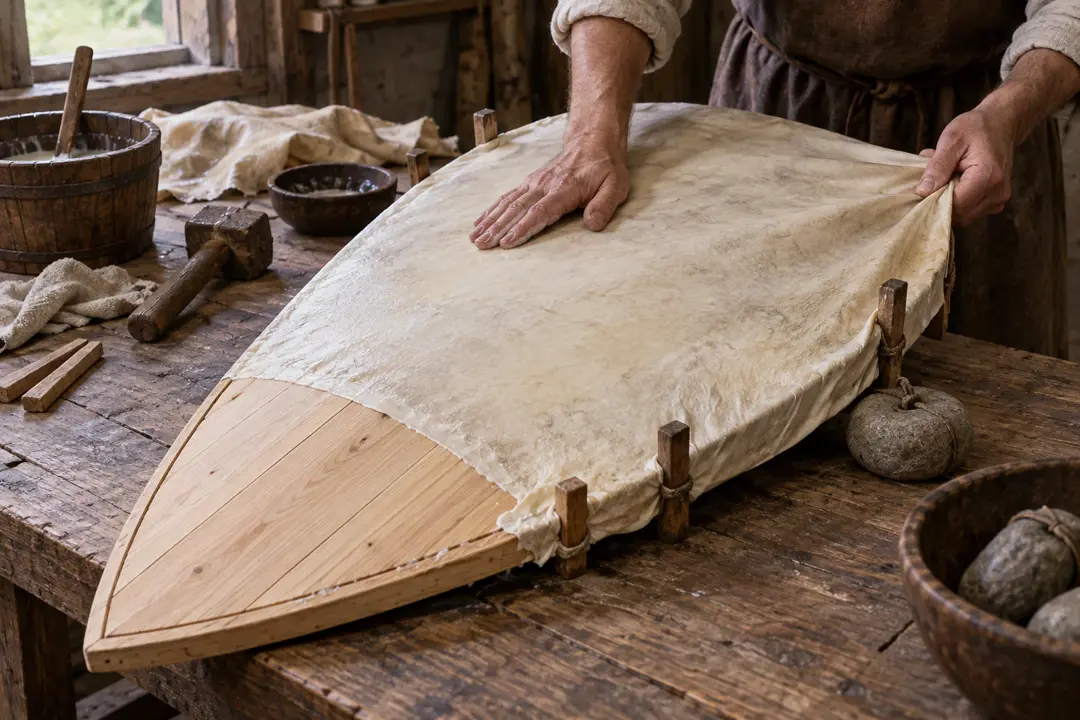
This gives something much closer to an actual construction sequence. The shieldmaker covered the face. At the perimeter, the covering was folded around the edge. Where necessary, the material was cut or arranged so that it could negotiate the shield's geometry. The resulting turnover was then mechanically secured with nails.
This is very different from attaching a separate leather rim after completing the shield surface. The edge is an integral part of the facing operation.
For reconstruction purposes, this is extraordinarily valuable because it demonstrates not merely that parchment could wrap around a shield. It documents a practical medieval method for doing so.
W. von Liederbach: Turnover Without Evidence for a Separate Rim
The shield associated with W. von Liederbach continues the same pattern. Its front covering is parchment, while the rear is also reported to carry parchment. At the perimeter, the front parchment turns around the edge. The turnover onto the rear is somewhat irregular.
Once again, however, research found no secure evidence requiring a separate rim placed over this construction. The perimeter therefore appears to have been created primarily through the covering system itself.
This repeated evidence is significant. Seedorf is not standing alone. Neither is Welfenberg-Helfenberg. Across several surviving high-medieval shields, the covering and the edge are structurally connected.
The Counts of Arnsberg Shield: A Narrow Turn onto the Rear
The shield associated with the Counts of Arnsberg provides another particularly useful example. The shield is covered with a thin parchment-like leather. At its perimeter, the front covering turns narrowly around the edge onto the rear face. Again, no independent separate rim has been securely established.
The width of the turnover matters. Modern reconstructions sometimes produce very broad leather edge strips because the maker wants maximum durability. The Arnsberg evidence instead demonstrates that the transition from front to rear could be comparatively restrained. The purpose may have been less about creating a massive impact-resistant rim and more about completing and securing the composite skin of the shield.
The edge may have been treated as a junction between surfaces, rather than as a separate armoured component.
Other Thirteenth- and Fourteenth-Century Shields: Evidence Ceilings
Several other shields in the researched corpus reinforce the need for caution.
- The Stromberg shield preserves evidence for white-tanned leather on its faces, but its exact edge treatment remains only partially understood.
- The Steinau-Steinrück shield also preserves white-tanned leather covering, yet the research ceiling for the perimeter itself remains effectively unknown.
- The Vögte von Keseberg shield preserves parchment on both front and rear, but the exact perimeter system remains insufficiently resolved.
- The Valère eagle shield likewise does not currently provide enough evidence to reconstruct its edge treatment confidently.
- The older and younger Schenk von Schweinsberg shields preserve important evidence for their coverings and painted surfaces, but their perimeter arrangements remain incomplete in the available documentation.
The Sion Shields
The surviving shields associated with Sion and Valère add another complex group to the evidence. Some preserve multiple textile layers and evidence of later repainting or reuse. For the Bartolomei/Sion shield, an original linen covering survives beneath a later painted textile layer. For the related Sion Cathedral Chapter shield, later painted canvas overlies earlier textile material.
These shields demonstrate how profoundly a shield could be modified during its lifetime. Their exact edge systems remain only partially understood. That uncertainty itself is useful because it reminds us that the perimeter visible today may belong to more than one historical phase. An edge could be recovered. A damaged covering could be replaced. A shield could be repainted. New textile could be applied over an older surface.
The Spanish Shields
The later-thirteenth-century shields preserved in the Real Armería in Madrid, including the shield traditionally associated with Oña, continue to demonstrate the widespread use of parchment coverings. Front and rear coverings survive or are documented on several examples.
But again, the precise perimeter treatment is not sufficiently established in the current evidence to justify inventing a particular edge binding. This is especially important because a parchment-covered shield can tempt the reconstructor to assume that the parchment must have wrapped around the perimeter in exactly the manner documented at Welfenberg-Helfenberg.
It may have done so. But "may have" is not the same as "did." The evidence from one surviving shield should guide interpretation of another, but it should not replace the missing evidence.
Herren von Muschenheim and the Fourteenth Century
The Herren von Muschenheim shield, dating into the fourteenth century, preserves a linden core and parchment covering. Its edge treatment, however, remains only partially resolved.
Once again, this is significant. By the fourteenth century the evidence still does not force a universal heavy perimeter binding. Instead, the surviving corpus continues to contain a mixture of documented turnovers, incompletely preserved edges and unresolved constructions. The historical picture therefore remains diverse.
What Does the Chronological Evidence Actually Show?
Once the surviving shields are placed beside one another, several conclusions become much clearer.
The first is that organic edge treatment has deep roots. Lenzen demonstrates a substantial woven organic perimeter in the eleventh century. But that construction should not automatically be transformed into a leather or rawhide strip, nor projected unchanged into later centuries.
The second major development visible in the surviving high-medieval shields is the integration of the edge into the shield's overall covering system. Seedorf provides evidence for parchment carried around the sides and upper edge. Nordeck zu Rabenau preserves turnover at least along the left edge. Konrad von Thüringen provides further evidence for perimeter turnover without an established separate rim. Welfenberg-Helfenberg provides especially strong construction evidence: parchment turned around the edge, mitred and nailed. W. von Liederbach again preserves front parchment carried around the perimeter. The Counts of Arnsberg shield preserves a narrow turnover of its parchment-like leather onto the rear.
This is no longer an isolated observation. It is a recurring construction principle.
The Medieval "Rim" May Be the Wrong Mental Model
This evidence suggests that the word rim can sometimes distort how we think about high-medieval shields. A rim sounds like a separate component. It suggests something added around an already completed shield. But several surviving shields instead point toward an integrated construction:
- Wooden core → front covering → covering carried across the perimeter → turnover onto rear → glued, nailed, otherwise secured, or combined with rear covering.
In this system there may be no separate "rim" at all. The edge is simply the place where the shield's composite skin changes direction.
This construction also makes mechanical sense. A covering bonded to the front surface helps hold the wooden boards together. Carrying that covering around the perimeter protects the vulnerable edge of the boards. Turning it onto the rear helps prevent the covering from peeling away from the face. Mechanical fasteners can then reinforce the turnover where necessary. The result is a unified composite structure.
Where Does Rawhide Fit?
Rawhide remains a perfectly plausible shieldmaking material. When soaked, it becomes flexible and can be formed around complex shapes. As it dries it contracts and becomes hard. Experimental reconstruction shows that it can provide extremely effective edge protection. Earlier archaeological evidence from outside this principal high-medieval dossier group also demonstrates that shields could employ organic perimeter treatments.
But the distinction between plausibility and evidence is essential. The fact that rawhide works brilliantly does not prove that every medieval shield had a rawhide rim. Indeed, the strongest surviving high-medieval evidence in this researched corpus frequently points instead toward turnover of the shield's existing parchment or leather covering.
What About Leather Rims?
The same principle applies to tanned leather. Leather is historically appropriate, workable and mechanically useful. But a thick separate leather strip stitched or nailed around every heater shield is not what this surviving corpus demonstrates.
Some shields certainly employ leather or parchment-like leather as covering material. The Counts of Arnsberg shield is particularly useful here. But again, its documented perimeter treatment is the turnover of that covering, not a clearly separate heavy leather rim.
The distinction is small visually but enormous archaeologically.
What About Metal Rims?
Metal requires even greater caution. Metal edge fittings certainly existed in medieval shieldmaking traditions. Local metal reinforcement is entirely plausible and archaeologically documented in broader shield traditions. But small edge fittings, clips or repairs should not automatically be interpreted as fragments of a continuous iron border.
A complete metal channel around a large kite or heater shield is a very specific construction claim. It adds weight. It requires substantial metalworking. It changes the balance of the shield. It also produces an obvious structural and visual element.
Absence of Evidence Must Remain Absence of Evidence
Perhaps the most important lesson from the 24-shield research project is methodological. For several shields something concrete can be said about the perimeter. For others it cannot. Those unknown cases must remain unknown.
- If a shield's dossier says "edge treatment unresolved," that does not mean "probably rawhide."
- If no nails survive, it does not mean "probably stitched."
- If no organic material survives, it does not mean "the edge was bare."
- If parchment covers the front, it does not automatically mean "the parchment wrapped around the edge."
Each of those may be reasonable hypotheses. None is automatically evidence.
A Chronological Evidence Trail
The surviving shields therefore give a useful, if incomplete, sequence.
| Shield / period | Perimeter evidence | Status |
|---|---|---|
| Lenzen, 2nd half 11th c. | Substantial woven organic perimeter, approximately 10 cm wide; exact botanical material remains disputed. | Direct evidence — organic tradition |
| Szczecin unpainted kite shield, late 12th c. | No secure object-specific edge binding has yet been established. | Unknown |
| Seedorf / Arnold von Brienz, c. late 12th–early 13th c. | Front parchment turns tightly and irregularly around the side and upper edges; conservation evidence supports continuity of this treatment around the surviving upper perimeter. | Direct evidence — covering turnover |
| Nordeck zu Rabenau | Covering turnover survives or is reported at the left edge; complete perimeter arrangement remains unknown. | Partial — one edge only |
| Heinrich lion shield, Marburg | Parchment-covered construction is established, but exact perimeter turnover remains unresolved. | Unknown |
| Konrad von Thüringen | Parchment turnover at the perimeter is documented; no separate rawhide or nailed leather rim has been established. | Direct evidence — covering turnover |
| Welfenberg-Helfenberg | Front parchment is turned around the wooden edge, mitred and nailed. | Direct evidence — clearest technical example |
| W. von Liederbach | Front parchment turns around the edge onto the rear; no independent rim is established. | Direct evidence — covering turnover |
| Counts of Arnsberg | Thin parchment-like leather covering turns narrowly around the perimeter onto the rear; again, no separate rim is established. | Direct evidence — narrow turnover |
| Stromberg | Covering survives, but perimeter construction remains incompletely understood. | Unknown |
| Steinau-Steinrück | Covering evidence survives, while the edge system remains unknown. | Unknown |
| Vögte von Keseberg | Parchment covers both faces; precise edge treatment remains unresolved. | Unknown |
| Valère eagle shield | Edge system currently remains unknown or unreported in the evidence recovered. | Unknown |
| Bartolomei/Sion and related Sion shields | Multiple textile phases survive, but the perimeter requires caution because later recovering and repainting complicate reconstruction. | Unknown — stratigraphic complexity |
| Madrid / Real Armería shields, late 13th c. | Parchment covering is documented, while the exact perimeter treatment remains insufficiently resolved. | Unknown |
| Schenk von Schweinsberg shields | Covering systems survive, but current evidence does not permit a complete edge reconstruction. | Unknown |
| Herren von Muschenheim, 14th c. | Parchment-covered shield, but the exact perimeter system remains only partially resolved. | Unknown / partial |
The gaps in that sequence are as important as the positive evidence.
What Should a Historically Reconstructed Shield Use?
There is therefore no single correct answer. The question should never begin "What did medieval shields use for rims?" It should begin "Which shield, from which place and period, are we reconstructing?"
A reconstruction can still be made in such circumstances. But the reconstructed element should be identified as interpretation rather than archaeological fact.
Conclusion
The edge of a medieval shield was not necessarily a separate rim. That is perhaps the most important conclusion to emerge from the surviving shields studied here.
The eleventh-century Lenzen remains demonstrate that substantial organic perimeter reinforcement existed. But the high-medieval shields reveal another important construction tradition. At Seedorf, parchment turns around the perimeter. At Nordeck zu Rabenau, turnover survives at least along one edge. On the Konrad von Thüringen shield, parchment again turns around the edge. At Welfenberg-Helfenberg, the construction becomes exceptionally clear: the front parchment is carried around the perimeter, mitred and nailed. W. von Liederbach repeats the turnover principle. The Counts of Arnsberg shield shows its thin parchment-like leather covering carried narrowly onto the rear.
Alongside them stand numerous shields for which the edge remains uncertain. Together, they produce a picture far more interesting than the generic "leather-rimmed medieval shield."
Medieval shieldmakers could treat the perimeter as part of the complete composite structure of the shield. The wooden core, covering, edge and rear were not necessarily separate systems. They could form one continuous construction. And sometimes the archaeological record simply does not tell us how the edge was finished. That uncertainty should not be hidden.
Reconstruct what the individual object demonstrates, infer only where necessary, and never turn a mechanically convenient modern solution into a universal medieval practice.
Bibliography / Source Base
- Archäologisches Landesmuseum Brandenburg. Institutional material and finds documentation on the 11th-century Lenzen shield fragment, used here for the surviving woven organic perimeter material.
- Muzeum Narodowe w Szczecinie. National Museum in Szczecin, catalogue record for wooden shield MNS/A/22250/1, dated 1176-1200. Source link.
- Dowen et al. 2019. Keith Dowen, Lech Marek, Slawomir Slowinski, Anna Uciechowska-Gawron and Elzbieta Myskow, Two Twelfth-Century Kite Shields from Szczecin, Poland, Arms & Armour 16, no. 2 (2019), 121-148. DOI: 10.1080/17416124.2019.1667049. Source link.
- Soler del Campo. Álvaro Soler del Campo, technical study of the Oña shields D 59 and D 60 in the Real Armería, Madrid, including the parchment covering and perimeter evidence on both objects.
- Senn and Moser. Matthias Senn and Franz Moser, Der Reiterschild von Seedorf UR: ein Untersuchungs- und Restaurierungsbericht, Jahresbericht Schweizerisches Landesmuseum Zurich 100 (1991/1992), 80-85. DOI: 10.5169/seals-395364. Source link.
- Rahn. Johann Rudolf Rahn, 1878 examination / 1883 publication tradition for the Seedorf shield, used here for the source-qualified observation of front parchment turned around the side and upper edges.
- Bildindex / Bildarchiv Foto Marburg. Institutional records for the Marburg shield group, including Schild des Landgrafen Konrad von Thuringen, Museum fuer Kunst und Kulturgeschichte der Philipps-Universitaet Marburg, inventory 3177, object record 0001336328, and related shields (Heinrich lion shield, Vögte von Keseberg, W. von Liederbach, Counts of Arnsberg, Nordeck zu Rabenau, Welfenberg/Helfenberg, Stromberg, Steinau/Steinrück, the Schenk von Schweinsberg shields, Muschenheim). Source link.
- Kohlmorgen. Jan Kohlmorgen, Der mittelalterliche Reiterschild: Historische Entwicklung von 975 bis 1350 und Anleitung zum Bau eines kampftauglichen Schildes (2002), used here as technical secondary literature for the Marburg group and related shield-edge claims.
- Warnecke. Friedrich Warnecke, Die mittelalterlichen heraldischen Kampfschilde in der St. Elisabeth-Kirche zu Marburg (Berlin, 1884), used here only as older source-chain evidence for Marburg technical descriptions, not as unchecked modern conservation proof.
- Nickel. Helmut Nickel, Der mittelalterliche Reiterschild des Abendlandes, FU Berlin dissertation 1958 / Der Herold offprint 1959/60, cited as broader historiography unless direct wording is available for a specific technical claim.
- Musées cantonaux du Valais. History Museum of Valais records and catalogue research for the Sion Cathedral Chapter pavois MV 1, the Bartolomei/Sion shield and the Valère eagle shield, including evidence for later re-covering and repainting.