Historically Inspired Series
Henry II the Pious — The Silesian Eagle
Silesia · c. 1224–1241
Or, an eagle displayed Sable, on its breast a crescent Argent and in its hollow a cross pattée Argent
…ut fidelis ac strennuus miles Cristi, Tartaris pro populo dei constanter se opposuit.
…like a faithful and valiant knight of Christ, he stood firm against the Tartars for the people of God.
Who He Was
Henry II the Pious (Henryk II Pobożny), son of Henry I the Bearded and Hedwig of Andechs, took part in government in his father’s lifetime and succeeded him in 1238 in Silesia, Kraków and parts of Greater Poland. A high duke, not a crowned king, he was killed fighting the Mongols at the Battle of Legnica on 9 April 1241.
No shield known to have belonged to him survives. His seal, recorded from 1224 to 1239, shows an elongated shield bearing an eagle with a crescent and a small cross on its breast: his father’s device, set on the eagle.
The Evidence
What Is Proven, and What Is My Reconstruction
This interactive shield is a historically informed interpretation of mine. The eagle with a crescent and cross on its breast comes from Henry's seal; the colours follow the later arms of Silesia, and the shape, construction and rear fittings are documented reconstruction choices, not recovered details of his own shield.
In plain words: no shield of his survives. Only what is marked as evidence comes from the sources; everything else, which is most of the build, is my interpretation.
What the evidence shows
- Emblem
- An eagle with a crescent and a small cross on its breast, as on his standing seal (SFRAGIS, 1224–1239).
What is my reconstruction
- Drawing
- The eagle is drawn in the later heraldic style, with a crescent spanning its breast and a red tongue, not copied line for line from the seal's simpler bird.
- Colours
- A black eagle on gold with a white crescent and cross, the colours of the later arms of Silesia. No contemporary source records Henry's own colours; this follows later tradition, as the article explains.
- Shape and size
- Short Kite Heater, 56 × 88 cm across the flat board, with the workshop's standard 10 cm bow. The seal shows an elongated shield tapering to a point; its exact outline and size cannot be measured from the seal.
- Core
- Linden planks, 10–12 mm thick, glued edge to edge with animal glue and shaped to the curve. Shields of his time were built from glued boards (Seedorf, Szczecin: alder); linden was a shield wood of the thirteenth century (Konrad von Thüringen, Marburg).
- Front
- Two layers of linen glued over the face and turned round the edge onto the back, standing in for the parchment of surviving shields; gesso, paint and a beeswax finish.
- Back
- Two layers of linen dyed blue. A workshop colour choice: the reverse of his shield is not recorded.
- Guige
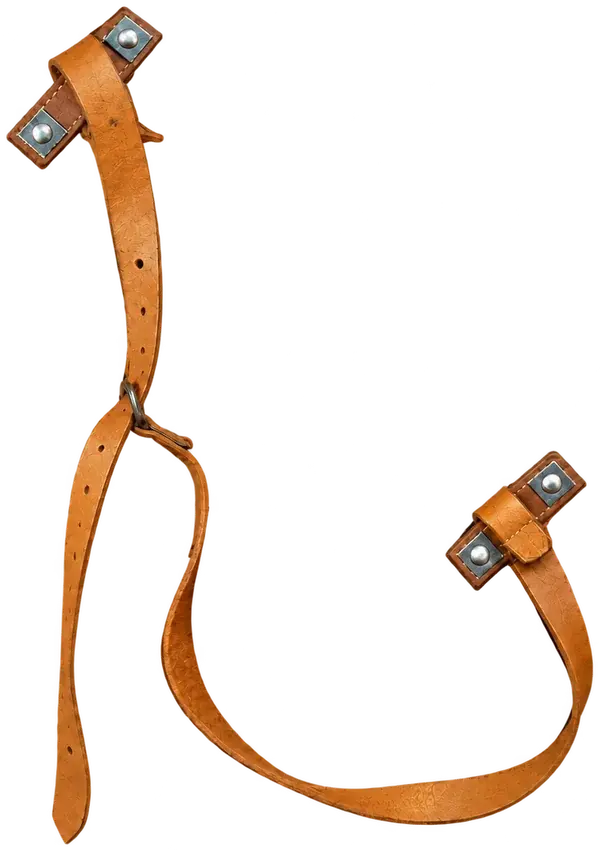
- An adjustable shoulder strap on two riveted mounts. Unlike his father's, Henry II's seal shows no shoulder strap; the guige is a workshop addition.
- Fittings
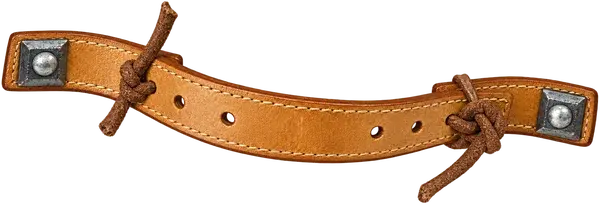
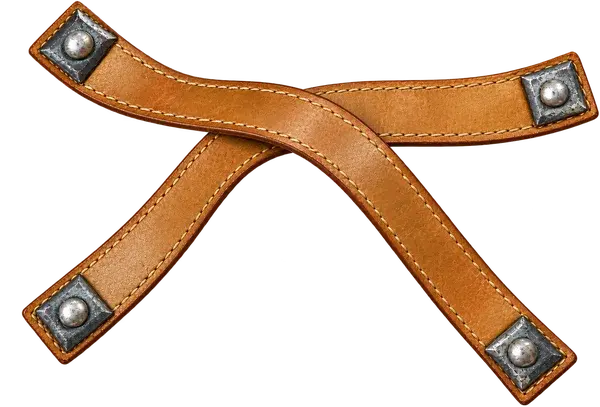
- Leather enarmes for the left arm (crossed forearm straps and a hand grip) and a leather-covered arm pad. The seal does not show the reverse; their layout is mine.
Made as an Artefact
I paint and weather every shield of the series by hand, so each one differs a little from the preview and from every other. The preview shows the design; the shield you receive is its own.